

Australian SaaS companies stall on GTM hiring for five reasons: they hire for the wrong stage, brief for a title instead of a problem, assess the story instead of the evidence, hire the leader after the team, and leave new hires to ramp alone. None of them is a shortage of candidates. In the quarter to 22 September 2026 there were 45,864 unique direct-employer GTM job ads in Australia and New Zealand (The Pointer Index). The market is full. The problem is choosing well inside it.
This guide covers why growth stalls without strong GTM recruitment, why Australian SaaS companies in particular find it hard, and the hiring process high-growth teams use to fix it.
What Causes Tech Startups to Stall Without Strong GTM Recruitment?
A startup stalls when revenue depends on people it has not hired yet, or on people who are not working. Product can be ready, funding can be in the bank, and growth still flatlines because nobody is creating or closing pipeline at the rate the plan assumes.
The pattern is predictable:
The cost isn't the recruitment fee. It is the quarters you lose.
Why Do Australian SaaS Companies Struggle With GTM Recruitment?
Because the ANZ talent pool for proven SaaS sellers and leaders is small, and most of it is already employed and not looking. Four things make Australia harder than larger markets:
| Factor | What it means for hiring |
|---|---|
| Small proven pool | The number of people in ANZ who have scaled a SaaS sales team from early stage is small. Most are employed, well paid and only move for the right story. |
| Competing against global logos | AWS, Microsoft and the big security vendors are among the largest GTM hirers in ANZ, competing for the same people with global brand names. |
| Few home-grown playbooks | Many local SaaS companies are building their first sales motion, so there are fewer leaders who have done it here before. |
| Generalist recruiters | Large agencies cover sales alongside accounting and construction. They match keywords on CVs but rarely test how someone actually sells. |
Pay is part of it too. Our market data puts a VP of Sales or CRO in Australia at $240,000 to $340,000 base and $380,000 to $580,000 OTE (current salaries). Getting that hire wrong is a six-figure mistake before you count the team they hired.
The Five Reasons GTM Hiring Stalls
1. Hiring for the wrong stage
A seller who thrived at a 500-person company with marketing, SDRs and a brand behind them often struggles at a 20-person startup where they have to create their own pipeline. The reverse is also true. In our experience, stage fit predicts success better than logos on a CV. Ask what stage, what ACV, what sales cycle and what support they had when they hit their numbers.
2. Briefing a title instead of a problem
"We need a Head of Sales" isn't a brief. "We need someone who can take sales off the founder, still close deals themselves, and hire two AEs by June" is. The title is the same. The person is different. A lot of failed hires were briefed as a title.
3. Assessing the story, not the evidence
Interviews reward people who interview well. Ask candidates to show the work: a real pipeline review, a discovery call role-play, the hiring plan they used last time, the forecast they built. A strong story with no detail behind it falls apart in 20 minutes.
4. Hiring the leader after the team
Companies often hire three AEs, watch them struggle, then hire a sales leader to fix it. The leader inherits a team they didn't choose and a process nobody built. Hire the first leader, or a fractional sales leader, before the team scales, so they build it the way they will run it.
5. Leaving new hires to ramp alone
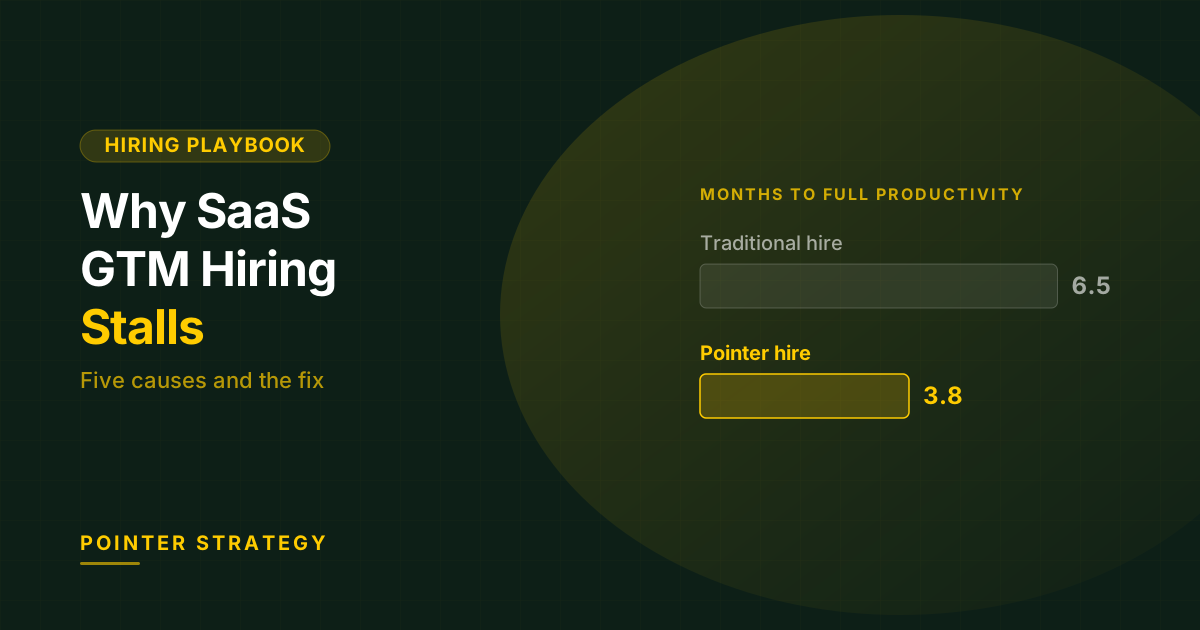
The offer is signed and everyone relaxes. Then the new hire spends four to seven months working out the product, the market and the process on their own. Pointer hires, who get structured onboarding, coaching and training through their first year, reach full productivity in about 3.8 months against 6.5 for a traditional hire.
How Do High-Growth SaaS Firms Build Effective GTM Recruitment Processes?
They treat hiring like a sales process: defined, measured and run by people who know what good looks like. Here is the process we recommend, in six steps.
The order matters. Most companies spend all their effort on step 2 and skip 1, 3 and 6. For the full version, with who owns each step and what it should produce, see how to build a GTM recruitment process.
Which Roles Should an Australian SaaS Company Hire First?
It depends on stage, but a common sequence looks like this:
| Stage | Typical first GTM hires | Watch out for |
|---|---|---|
| Pre-$1M ARR | Founder sells, first AE or a hybrid seller | Hiring a VP before there is anything to lead |
| $1M to $3M ARR | First sales leader, 2 to 4 AEs, first marketer | Hiring the team before the leader |
| $3M to $10M ARR | Managers, customer success, RevOps | A CRM and forecast nobody trusts |
| $10M+ ARR | CRO, segment leaders, partnerships, enablement | Leaders who have only worked at one stage |
Build a GTM Team That Doesn't Stall
Pointer Strategy recruits sales, marketing, customer success, partnerships, RevOps and GTM leadership for B2B SaaS and tech companies across Australia and New Zealand. Every hire is assessed by people who have done the job, and every placement comes with 12 months of live training and mentorship, so the hire is productive and stays. We built GTM ANZ, the region's largest go-to-market community, which is why we usually know the right people before they are on the market.