

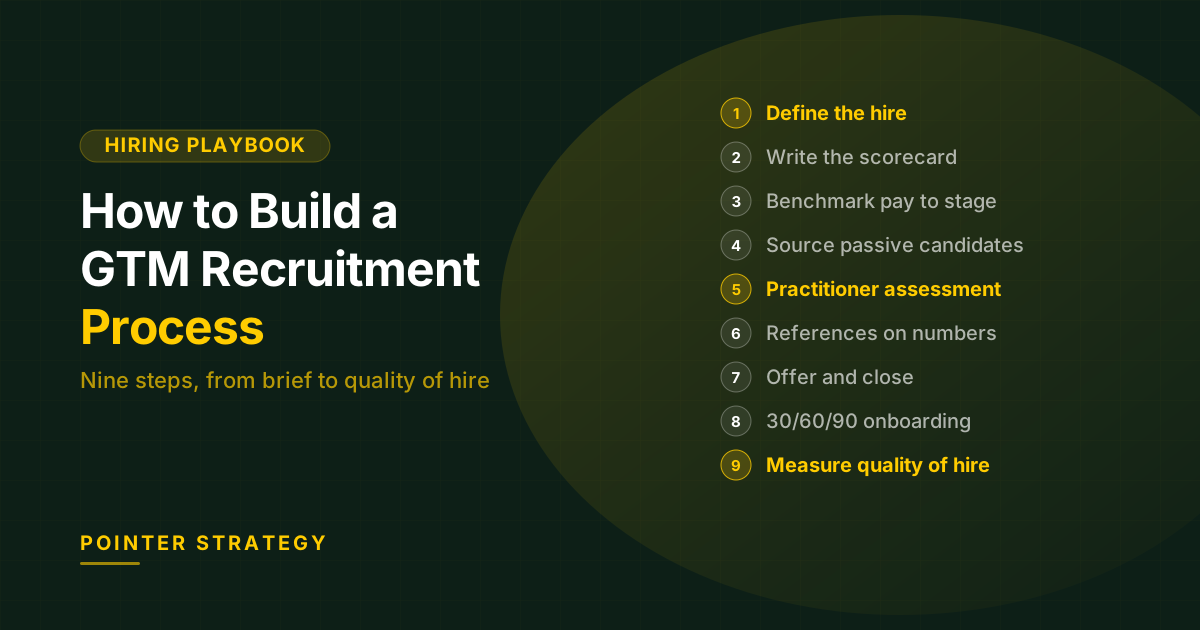
A GTM recruitment process has nine steps: define the hire against the revenue problem and your stage, write an outcome scorecard, benchmark pay to stage, source passive candidates, have practitioners assess real work, check references on numbers, close the offer, plan the first 90 days, and measure quality of hire a year later. Most companies only run the middle of that list. The first three steps decide who you look for. The last three decide whether the hire pays back.
This guide is for founders, CEOs and revenue leaders at Australian and New Zealand SaaS companies hiring across sales, sales leadership, marketing, customer success, partnerships and RevOps. If you want the reasons growth stalls when hiring goes wrong, we covered them in why Australian SaaS companies stall on GTM hiring. This is the process that fixes it.
What Is a GTM Recruitment Process?
A GTM recruitment process is the repeatable way a company hires the people who create and keep revenue, from the first AE to the CRO. It differs from general recruitment in one way that matters: the output of the role can be measured. A seller has a number. A marketer has pipeline. A CSM has renewals. So the process should be built on evidence of those outcomes, not on CVs and interview performance.
The market isn't the constraint. There were 45,864 unique direct-employer GTM job ads in Australia and New Zealand in the quarter to 22 September 2026 (The Pointer Index). The hard part is choosing well inside that market, then making the hire work.
The GTM Recruitment Process at a Glance
| Step | Owner | Output |
|---|---|---|
| 1. Define the hire | CEO or revenue leader | A brief that names the revenue problem, stage and motion |
| 2. Write the scorecard | Hiring manager | Three to five outcomes for the first 12 months |
| 3. Benchmark pay to stage | Hiring manager and finance | A range you are willing to print in the ad |
| 4. Source passive candidates | Recruiter or hiring manager | A shortlist of people who have done it at your stage |
| 5. Practitioner-led assessment | Someone who has done the job | Scored evidence against the scorecard |
| 6. Reference checks on numbers | Hiring manager or recruiter | Results confirmed by former managers |
| 7. Offer and close | Hiring manager | A signed offer with no surprises at resignation |
| 8. 30/60/90 onboarding | The new hire's manager | A written ramp plan before day one |
| 9. Measure quality of hire | Revenue leader | A 6 and 12 month review against the scorecard |
Step 1: Define the Hire Against the Revenue Problem and Your Stage
Brief the problem, not the title. "We need a Head of Sales" is a title. "We need someone who can take sales off the founder, still close deals themselves and hire two AEs by June" is a brief. Same title, different person.
Before anyone opens a job board, write down the revenue problem (pipeline, conversion, retention, forecasting, a founder who can't let go of deals), your stage (ARR, team size, ACV, sales cycle) and your motion (inbound, outbound, partner-led or product-led).
Stage is the one people get wrong. A leader who scaled a 40-person enterprise team can struggle with three reps and no playbook, and the reverse is just as common. $1M ARR with three reps needs a builder who will still sell. $30M ARR needs someone who can run managers.
Sequence matters too. Companies often hire three AEs, watch them struggle, then hire a leader to fix it. The usual point for a first sales leader is $1M to $3M ARR with three to five reps, once the founder can no longer coach and close at the same time. We covered the signals in when to hire a VP of Sales.
Step 2: Write a Scorecard, Not a Job Ad
A scorecard lists the three to five outcomes the hire must deliver in their first 12 months, and the conditions they need to have delivered them under before. For a first Head of Sales that might read: founder out of day-to-day deals, two AEs hired and ramped, a forecast the board trusts. For a first RevOps hire: one version of the numbers across marketing, sales and CS, and a CRM people actually use.
Everything later scores against this page: the ad, the assessment, the references and the 12-month review. Skip it and every interviewer hires against their own version of the role.
Step 3: Benchmark Pay to Stage, Not to the Ads
What a GTM leader earns in Australia depends on the stage and size of the company. Our benchmarks:
| Role | Base | OTE |
|---|---|---|
| Head of Sales | $149,000 to $221,000 | $260,000 to $400,000 |
| VP of Sales or CRO, scaled SaaS | $240,000 to $340,000 | $380,000 to $580,000 |
Source: Pointer salary benchmarks. OTE figures are guide estimates.
At Seed to Series A, base typically sits 10 to 20% below established companies, made up with equity and OTE upside. From Series B, base increasingly matches or beats them.
Don't benchmark against job ads. Only 84 of 963 sales leadership ads in September and October 2026 printed a salary, and those came mostly from small employers, so the advertised numbers read low (Issue 26 of The Pointer Index). Print your range anyway. At that disclosure rate you stand out, and the candidates who rule themselves out save you a month. For AE, marketing, CS and RevOps ranges, see the [sales salary data](/market-data/salaries/sales).
Step 4: Source Where the Good People Actually Are
The best GTM people are rarely applying. Most are employed, well paid and only move for the right story. An ad reaches the people who are looking. A process that works also reaches the people who aren't.
So add referrals from your team, investors and customers, communities where revenue people compare notes (GTM ANZ has 900+ revenue professionals from 300+ ANZ companies), and direct approach with a pitch built from the scorecard: the problem they would own and why now.
You are competing for attention. October 2026 alone had 482 sales leadership ads from 412 different employers. Some roles barely get advertised: RevOps leadership saw 18 ads that month, and in our experience most companies fill it from inside or through someone they know.
At the first conversation, ask what stage, what ACV, what sales cycle and what support the candidate had when they hit their numbers. Logos on a CV tell you where someone worked. Those four answers tell you whether it transfers.
Step 5: Assess With Practitioners, Using Real Work
Have someone who has done the job run the assessment, and make candidates show the work rather than describe it. Interviews reward people who interview well. A strong story with no detail behind it falls apart in 20 minutes when the person across the table has carried the same number.
| Role | What to assess | How to test it |
|---|---|---|
| Account Executive (sales recruitment) | Discovery, qualification, closing | Live discovery role-play, a recent deal walked through start to finish, their quota attainment, deal size and win rate |
| Sales leadership | How they built their last team | The hiring plan, the comp design, the forecast and what they would change |
| RevOps (RevOps recruitment) | Systems they have actually built | A CRM structure, routing rules, forecast model or comp plan: the decisions and what broke. Tested in your stack, HubSpot or Salesforce |
| Marketing (marketing recruitment) | Pipeline they created | A campaign traced back to pipeline and revenue, plus knowledge of your buyer |
| Customer success (CS recruitment) | Commercial acumen, not just service | A renewal or expansion plan for a real account, and the retention numbers they owned |
| Partnerships | Patience with a 12+ month payback | A partnership they took from first conversation to sourced revenue |
Two rules keep this honest. Each interviewer scores against the scorecard before the debrief, so the loudest voice doesn't decide. And include someone from an adjacent function in the final stage: an AE who dismisses CS or marketing usually struggles in a complex sale.
Step 6: Check References on Numbers
Speak to former managers, not the peers a candidate picks. Ask what the person achieved, under what conditions, and whether they would hire them again. Then ask for the number: what percentage of target did they hit in their last full year, and what was the team average?
Top performers know their numbers cold. Vague answers on attainment or win rates in the interview, or hesitation to give a manager reference, are warning signs worth taking seriously.
Step 7: Make the Offer and Close It
Strong GTM candidates have options, so move once you have decided. Make the package easy to read: base, OTE, how commission pays, whether super is included or on top, and any equity. Before the offer goes out, ask what would stop them accepting, so you hear about a counter-offer before resignation day. Then stay in touch through the notice period. The close isn't finished until they start.
Step 8: Plan the First 90 Days Before Day One
Write the ramp plan before the start date, and name the person who owns it. A simple shape for a quota-carrying hire:
Adapt the milestones for marketing, CS, partnerships and RevOps, but keep the principle: a written plan, specific milestones and someone accountable for them.
Then keep going. Most companies stop at induction. A traditional GTM hire takes about 6.5 months to reach full productivity. Pointer hires, who get structured onboarding plus live training and mentorship through their first year, reach it in about 3.8 months.
Step 9: Measure Quality of Hire
At 6 and 12 months, score every GTM hire against the scorecard from step 2. Track time to full productivity, which scorecard outcomes were delivered, whether they are still in the role, whether the manager would hire them again and where they were sourced from.
This is what turns hiring into a process instead of a run of one-off searches. If referral hires outperform ad hires, change where you spend sourcing time. If the hires who struggle all passed the same interview, fix that interview.
How Pointer Runs the GTM Recruitment Process
Pointer Strategy recruits sales, sales leadership, marketing, customer success, partnerships and RevOps for B2B SaaS and tech companies across Australia and New Zealand, and internationally for ANZ companies expanding. We run the nine steps above on every search:
The results:
80+ SaaS and tech companies hire with us, and they have left 100+ client reviews.