

Best Sales Recruitment Agencies in Australia 2026: Compared
Hiring salespeople in Australia? This guide breaks down how the major recruitment agencies actually work: fee structures, specialisations, guarantees, and what sets each one apart.
Most "best recruiters" lists are sponsored rankings or agency self-promotion. This one takes a different approach. We're comparing agencies on the things that actually matter when you're trying to build a sales team that performs.
For a full breakdown of Australian recruitment fee structures, we've published a separate deep-dive.
How to Evaluate a Sales Recruitment Agency
Before comparing agencies, know what to look for. Four factors predict recruitment success:
Australia's Top Sales Recruitment Agencies (2026)
Hays
Type: Generalist recruitment (sales is one vertical among many)
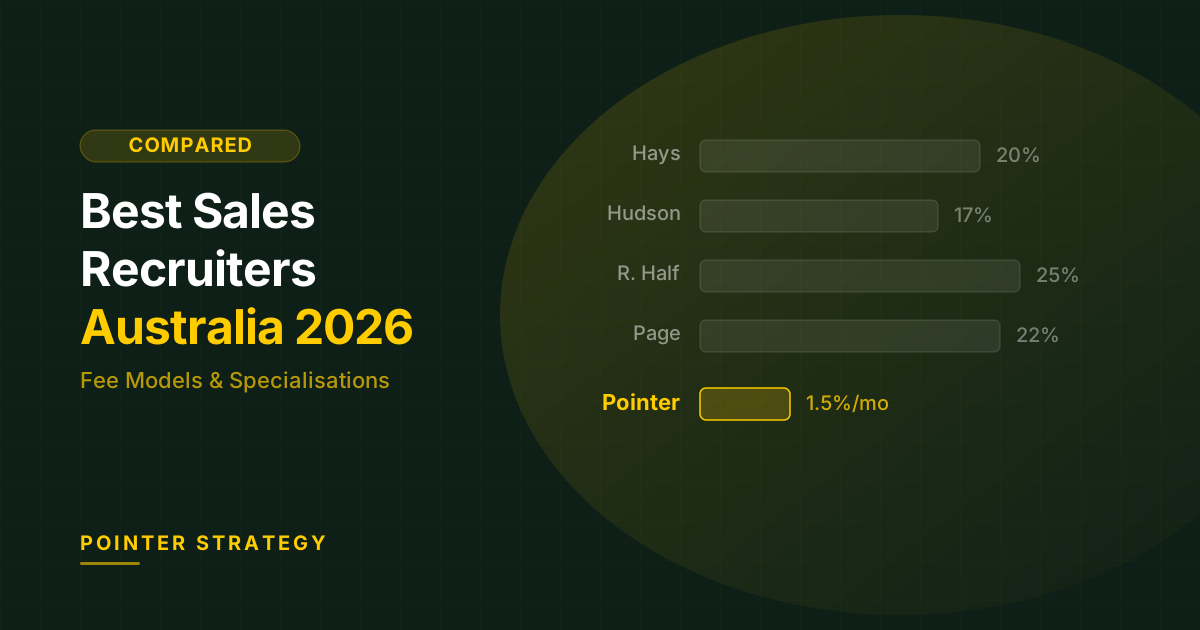
Fee model: Contingency, 15 to 20% of base salary
Guarantee: 3-month replacement
Specialisation: Broad. Covers sales alongside IT, accounting, construction, HR, and dozens of other sectors.
Best for: Companies wanting a large candidate database and brand recognition.
Consideration: Sales is not their core focus. Recruiters may not have carried quota themselves. For a detailed comparison, see Pointer vs Hays.
Hudson
Type: Specialist divisions within a broad recruitment group
Fee model: Flat 17% of annual salary (permanent), retained options available
Guarantee: 3-month replacement (permanent), 6-month for executive search
Specialisation: 14 specialist areas including sales, marketing, technology, and finance. Strong psychometric assessment capability.
Best for: Mid-market to enterprise companies, especially in professional services and government.
Consideration: The Morgan & Banks heritage gives them deep roots in Australian recruitment, but sales-specific methodology varies by consultant. For a detailed comparison, see Pointer vs Hudson.
Robert Half
Type: Generalist (finance, technology, sales)
Fee model: Contingency, 15 to 25%
Guarantee: 3-month replacement
Specialisation: Originally finance and accounting, now covers sales and technology.
Best for: Companies wanting a global brand with local offices across Australia.
Consideration: Sales recruitment is a secondary specialisation. Their deep expertise is in finance roles.
Michael Page / Page Group
Type: Large generalist recruiter
Fee model: Contingency, 15 to 22%
Guarantee: 3-month replacement
Specialisation: Broad. Sales and marketing is one of many divisions.
Best for: Volume hiring across multiple functions.
Consideration: Massive scale means variable consultant quality. Some excellent people, some generalists filling KPIs.
Charterhouse Partnership
Type: Boutique specialist (sales, marketing, digital)
Fee model: Contingency and retained, 18 to 25%
Guarantee: 3 to 6 month replacement
Specialisation: Sales, marketing, and digital roles specifically.
Best for: Mid-market companies in B2B tech and media.
Consideration: More specialised than the large generalists, but still operates a traditional contingency model.
Pointer Strategy
Type: Specialist GTM recruitment (sales, marketing, CS, partnerships, enablement)
Fee model: Pay-on-performance: 1.5% of salary monthly while the hire performs
Guarantee: Billing stops immediately if the hire leaves. Not a replacement guarantee. You keep your capital.
Specialisation: Exclusively B2B SaaS and technology go-to-market teams. Founded by operators who've carried quota.
Best for: B2B SaaS companies that want practitioner-vetted hires with post-placement training included.
Differentiator: Every placement includes 12 months of sales training and enablement. No upfront fees.
Consideration: Specialist only. If you need hiring outside GTM (engineering, finance), you'll need a different agency.
Fee Model Comparison
| Agency | Model | Typical Fee | When You Pay | What If Hire Leaves? |
|---|---|---|---|---|
| Hays | Contingency | 15 to 20% | On placement | 3-month replacement search |
| Hudson | Flat rate / Retained | 17% (or in thirds) | On placement or instalments | 3 to 6 month replacement |
| Robert Half | Contingency | 15 to 25% | On placement | 3-month replacement |
| Michael Page | Contingency | 15 to 22% | On placement | 3-month replacement |
| Charterhouse | Contingency/Retained | 18 to 25% | On placement | 3 to 6 month replacement |
| Pointer Strategy | Pay-on-performance | 1.5%/month | Monthly while hire performs | Billing stops immediately |
Example: Hiring a $150,000 OTE Account Executive
The real cost difference isn't just the percentage. It's what happens when things go wrong. With a traditional agency, a bad hire costs you the placement fee plus the cost of the failed employee. With pay-on-performance, your financial exposure is capped to the months they actually worked.
What to Look For in a Sales Recruiter
They should understand sales methodology
Ask your recruiter: "How do you assess whether a candidate can run MEDDIC?" or "What's the difference between a transactional AE and a consultative one?" If the answer is vague, they're keyword-matching CVs, not evaluating salespeople.
Fee structure shapes behaviour
Contingency agencies are incentivised to fill roles fast because they only get paid on placement. That creates a speed bias. Retained agencies invest more deeply but require upfront commitment. Pay-on-performance models align the agency's revenue with the hire's actual performance.
Guarantees aren't equal
A "3-month guarantee" almost always means a replacement search, not a refund. You're stuck with the same agency, running the same process, hoping for a different result. Ask specifically: "If the hire doesn't work out, do I get my money back, or do you restart the search?"
Post-placement support matters
The first 6 months after placement are where hires succeed or fail. Most agencies walk away at placement. Ask what happens after the offer letter is signed: onboarding support, training, check-ins, performance coaching. If the answer is "we'll check in after 3 months," that's a guarantee policy, not a support program.