

Most companies hire a VP of Sales at the wrong time. Hire too early (before product-market fit, before a repeatable sales process exists) and you burn through $300,000 to $500,000 in total compensation on a leader who has nothing to lead and no playbook to execute. Hire too late (after your best reps have left because nobody is coaching them, after the founder is drowning in deals they cannot close alone) and you lose 6 to 12 months of revenue growth.
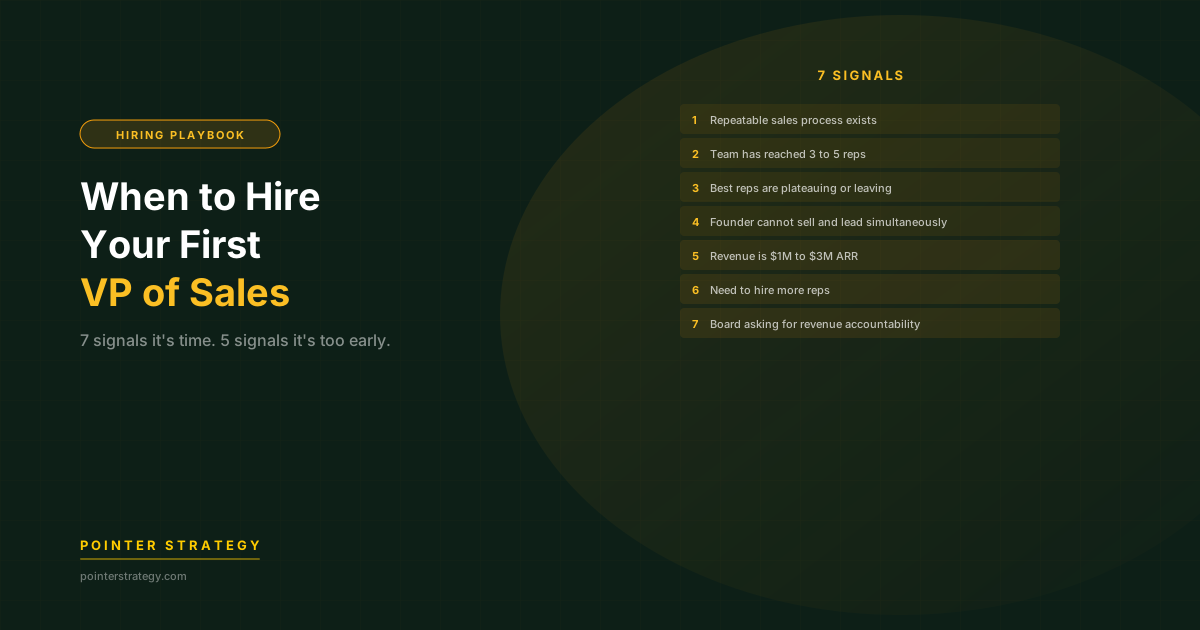
The right time is typically when your company reaches $1M to $3M ARR with 3 to 5 reps, but revenue is only one signal. This guide covers 7 signals that you are ready, 5 signals that you are not, and how to choose between a VP of Sales, Head of Sales, and fractional sales leadership.
The 7 Signals It's Time to Hire a VP of Sales
Signal 1: You Have a Repeatable Sales Process (Even If It's Rough)
The most important prerequisite. If your founder or early reps have closed 20 to 50 deals and you can describe the typical buyer journey, common objections, deal cycle length, and win/loss patterns, you have the foundation a VP needs.
A VP of Sales is not the person who discovers your sales motion. That is the founder's job. The VP is the person who codifies, optimises, and scales what the founder has already proven works.
Test: Can you write a one-page document describing how deals happen at your company? If yes, you are ready. If no, keep selling and document as you go.
Signal 2: Your Sales Team Has Reached 3 to 5 Reps
Below three reps, the founder can manage directly. Above five, someone needs to run pipeline reviews, deal coaching, 1:1s, and performance management as a primary job, not as something squeezed between their own deals and everything else.
The management load inflection point is usually around rep four or five. That is when individual reps start diverging in performance, when process inconsistency creates pipeline leakage, and when the founder's attention becomes the bottleneck.
Signal 3: Your Best Reps Are Starting to Plateau or Leave
High performers need coaching to reach the next level. Without it, they get bored, frustrated, or recruited by competitors who offer better development. If your top reps are hinting at career growth needs or if you have lost a strong rep in the last 6 months, the absence of sales leadership is already costing you.
Signal 4: The Founder Cannot Sell and Lead Simultaneously
Founder-led sales works until it does not. The breaking point is usually when the founder is spending more than 50% of their time on sales-related activities (selling, managing reps, reviewing pipeline, handling escalations) and less than 50% on product, strategy, and fundraising.
Read the full guide to transitioning out of founder-led sales.
Signal 5: Revenue Is Between $1M and $3M ARR
At $1M ARR, you have proven that people will pay for your product. At $3M, you need scalable systems to reach $10M. A VP of Sales bridges this gap by building the processes, hiring plans, and coaching rhythms that transform a founder-dependent sales motion into a self-sustaining revenue engine.
Signal 6: You Need to Hire More Reps (and You Don't Know How)
If the next phase of your plan requires hiring 3 to 5 more reps and you are not confident in your ability to recruit, assess, and onboard sales talent, you need a VP. Great VPs bring a network of reps they have worked with before, a proven interview process, and the judgement to know what "good" looks like for your stage.
Signal 7: Your Board or Investors Are Asking for Revenue Accountability
Once investors are involved, they want a single person (not the founder) who owns the revenue number, presents the forecast, and explains variances. A VP of Sales provides this accountability layer and frees the founder to focus on the rest of the business.
The 5 Signals It's Too Early
Too Early Signal 1: Fewer Than 10 Closed Deals
If the company has not yet closed 10 to 20 deals, the sales process is still being discovered. A VP hired at this stage will either try to impose a playbook from their last company (which may not fit) or spend months doing what the founder should be doing: learning what works.
Too Early Signal 2: No Clear ICP
If you cannot describe your ideal customer profile in specific terms (industry, size, pain point, buyer persona, budget range), you are not ready for a VP. The VP needs a target to aim at. Without it, they will either guess (expensive) or wait for direction (expensive and frustrating for both sides).
Too Early Signal 3: You Are Expecting the VP to "Figure It Out"
This is the number one reason VP of Sales hires fail at early-stage companies. The VP is not a missionary. They are a mercenary who scales proven motions. If the brief is "we need someone to figure out our sales strategy," hire a fractional leader first to do the discovery work.
Too Early Signal 4: You Cannot Afford $250K+ Total Compensation
A capable VP of Sales in Australia commands $180,000 to $250,000 base with $250,000 to $350,000 OTE. Check current salary benchmarks for the latest data. Add recruitment costs ($50,000 to $80,000 for retained search), and the total year-one investment is $300,000 to $430,000.
If that number represents more than 15 to 20% of your current ARR, the timing is wrong. A fractional alternative at $30,000 to $60,000 per year preserves capital for reps and product.
Too Early Signal 5: Your Product Is Still Changing Weekly
If the product roadmap is in flux and the value proposition shifts every few weeks, a VP of Sales has nothing stable to sell. Sales leaders need a relatively stable product and positioning to build processes around. Rapid product iteration is a sign you are still in founder-selling territory.
VP of Sales vs Head of Sales vs Fractional: What's the Difference?
| Attribute | VP of Sales | Head of Sales | Fractional Sales Leader |
|---|---|---|---|
| Typical company stage | $3M to $20M ARR | $1M to $5M ARR | $500K to $5M ARR |
| Team size managed | 8 to 30+ reps | 3 to 12 reps | 2 to 10 reps |
| Focus | Strategy + operations + hiring | Operations + coaching + some selling | Strategy + process + coaching |
| Reports to | CEO or CRO | CEO or VP of Sales | CEO / founder |
| Expected comp (AUD OTE) | $250K to $350K | $180K to $260K | $30K to $60K/year |
| Carries a personal quota? | No | Sometimes (10 to 20% of team target) | No |
| Best for | Scaling proven motion | Building initial team | Designing the playbook |
When to choose Head of Sales instead of VP
If your team is under 8 reps and you need a player-coach (someone who manages the team and closes deals personally), a Head of Sales is often a better fit. They are 20 to 30% less expensive than a VP and more comfortable in hands-on, operational roles.
When to choose fractional instead of either
If you need the strategy work done (process design, comp plans, hiring plan, CRM architecture) but do not yet have enough team or complexity to justify a full-time leader, a fractional VP of Sales gives you 80% of the strategic value at 15% of the cost.
What a Great VP of Sales Does in the First 90 Days
Days 1 to 30: Listen and Diagnose
Days 31 to 60: Build the Foundation
Days 61 to 90: Drive Accountability
How to Recruit a VP of Sales
Define What "Good" Means for Your Stage
A VP of Sales from Salesforce is not the right person for your 5-person startup. And a VP who built a team from 0 to 5 may struggle to scale from 15 to 50. Stage match matters more than logo match.
For $1M to $3M ARR: Look for someone who has built a team from 3 to 10 reps at a similar-stage company. They should be comfortable being hands-on (coaching, occasionally selling) while building process.
For $3M to $10M ARR: Look for someone who has scaled from 10 to 25+ reps, built management layers, and implemented forecasting and RevOps infrastructure.
Use Specialist Recruiters
Generalist agencies fill seats. For a VP of Sales hire, use specialist sales recruitment that understands quota-carrying roles, commission structures, and the specific leadership capabilities required at your stage.
Test for Builder vs Operator
Ask: "Tell me about a sales process or team you built from scratch." If they can only talk about managing existing teams, they may not be right for a building stage. If they can only talk about building, they may not scale with you past $10M.
What Happens If You Get It Wrong
A failed VP of Sales hire is one of the most expensive mistakes a growth-stage company can make.
Direct cost: $300,000 to $500,000 in compensation, recruitment fees, and severance.
Indirect cost: 6 to 12 months of misaligned strategy, process changes that confuse the team, reps who leave because they do not trust the new leader, and pipeline damage that takes two quarters to repair.
Opportunity cost: The revenue you would have generated with the right leader in place.
Total impact of a failed VP hire: $500,000 to $1.5M depending on company size and how long the wrong person stays.
This is why many companies use a fractional leader first. Test the model, build the foundation, and hire a permanent VP when you are confident in the profile and the timing.