

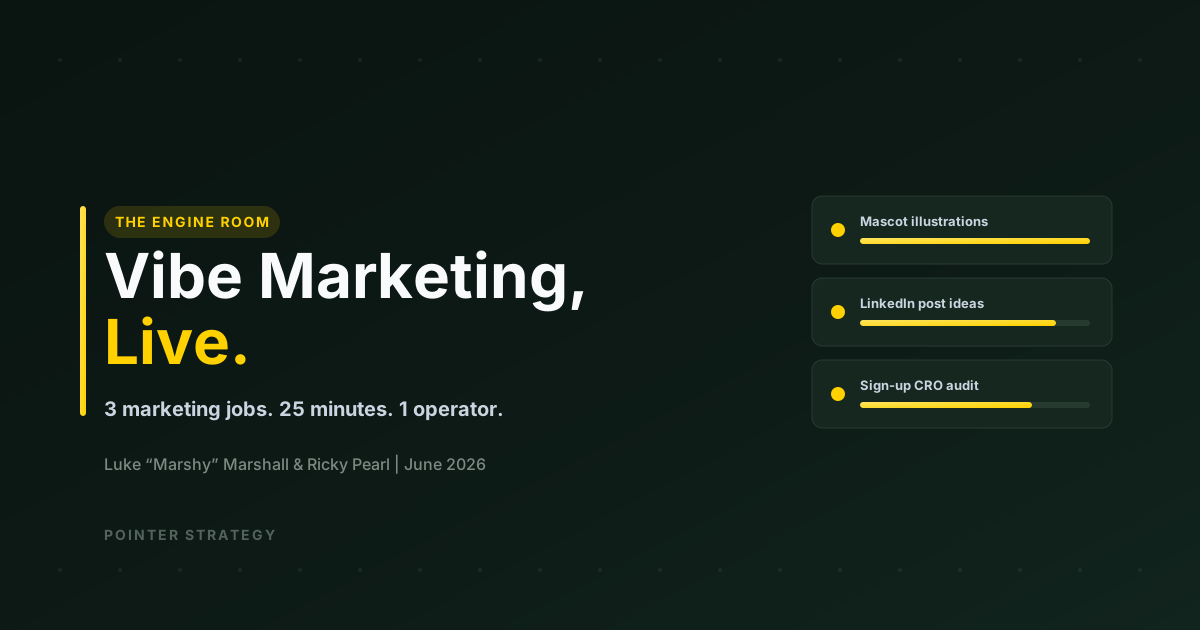
This is a recording of a live session from the GTM ANZ Community, featuring Luke "Marshy" Marshall (Head of Marketing Recruitment, Pointer Strategy) and Ricky Pearl (Founder, Pointer Strategy).
What Is Vibe Marketing?
Vibe marketing is the marketing cousin of vibe coding. Instead of writing every line of code yourself, you describe what you want in plain language and an AI agent builds it, then you steer with feedback. Vibe marketing applies the same loop to marketing work: you brief an AI agent on the outcome you want, it does the research, the analysis, the design and the build, and you direct it the way you would direct a junior team or an agency.
The difference from "using AI for marketing" is the scope. This is not pasting a prompt into a chatbot to write a caption. It is handing an agent a real business goal ("audit our sign-up form and tell me how to convert more of it") and letting it pull live data, reason over it, and come back with a reviewable deliverable. The marketer's job shifts from doing the work to defining the work and judging the output.
"I'm a practitioner and an operator. I practice what I preach. Rather than just talk about vibe marketing conceptually, I'll start doing it and let you judge for yourselves." - Marshy
So that is exactly what he did. No slides. A 25-minute timer. Things broke on screen and respawned. This is the warts-and-all version, which is the whole point, because the staged demos from the hype crowd on LinkedIn do not tell you what this actually feels like to run.
The Setup: One Operator, Three Jobs, a 25-Minute Timer
Marshy works from a short to-do list of marketing jobs that had been sitting unfinished for weeks, the kind of work that normally gets pushed aside in favour of business development. The tools doing the work:
The premise is important: he kicked off three goals and let them run in parallel, then narrated the logic while they worked. This is the shift that makes vibe marketing feel different. You are no longer babysitting one task. You are a manager watching three reports work at once.
| Job | The brief | What came back |
|---|---|---|
| Brand mascot | Pitch illustration concepts for the website using the Pointer mascot, without changing copy | Mockups across core pages, delivered as a concept doc, a deck and a PDF |
| LinkedIn ideas | Mine anonymised sales-call summaries for themes, filter through my posting style, pitch post concepts | 3 to 5 post ideas grounded in real in-market conversations |
| Sign-up CRO | Benchmark the current conversion rate and suggest fixes, using GA4, Search Console and PostHog | A funnel benchmark plus prioritised fixes, with one uncomfortable number |
Job 1: A Brand Mascot, Across the Website, in Minutes
Pointer's website was rebuilt this year, moving off Webflow onto a Claude Code instance. It looks sharp, but it had no illustration and no visual identity beyond logos and copy. Pointer is named after a pointer dog (Ricky's dog), and that mascot was nowhere on the site.
Marshy briefed an agent, by voice, to review the core pages and propose illustration concepts that complement the existing layout without rewriting copy, then deliver a first pass for feedback before anything goes near staging. While he talked, the agent spun up a mascot library, generated overlay mockups on transparent backgrounds so he could see them in place, and packaged the concepts the way an agency would present an initial pitch: a concept doc, a deck and a PDF.
"Three or four years ago I would have had to brief an agency to do all of this. It happened in 25 minutes. That would have taken weeks in old money." - Marshy
The output was not finished art. The angles were off, the sizing needed work, one concept used navy instead of black. But it was a genuine first pass he could react to with his voice, which is the part that used to cost a week and a purchase order.
Job 2: LinkedIn Ideas Pulled From Real Sales Conversations
The Pointer team posts on LinkedIn three to five times a week. The hard part is not writing, it is finding things worth saying. So the second agent was pointed at the company's own sales conversations.
The brief: read the HubSpot call summaries, strip anything identifying, look for patterns and recurring talking points, then pass those through Marshy's own LinkedIn posting style from the last 90 days and pitch three to five post concepts. If it worked, the plan was to turn it into a reusable skill the whole team could run.
It hit a real-world snag live: the agent could not read full call transcripts through the HubSpot connection, only call summaries. Marshy's take was that this is fine, because a genuine trend shows up across many summaries anyway, and you can always enrich with transcripts later. That is the honest texture of this work. You do not get a clean run, you get a problem the agent works around while you watch.
One idea that landed:
"Your shortlist isn't ghosting you. Your salary band is. The best candidates want to know the number, so don't hide it or make it a crappy band." - a concept the agent surfaced from real conversations
The output skewed more toward themes and bullet points than finished copy, and Marshy was blunt that he can tell when something is written by AI. But as raw material, drawn from what buyers and candidates are actually saying, it is a head start that no blank page gives you.
Job 3: A CRO Audit That Found the Leak
This was the one he saved for last, because it was the hardest and he did not know what would happen. Conversion rate optimisation usually needs high traffic and a multi-skilled specialist across copy, design, positioning and code. He had a hunch the sign-up form, with seven or eight fields, was costing him.
The agent pulled live data from Google Analytics 4, Google Search Console and PostHog session data, benchmarked the form, and came back with a number that stung.
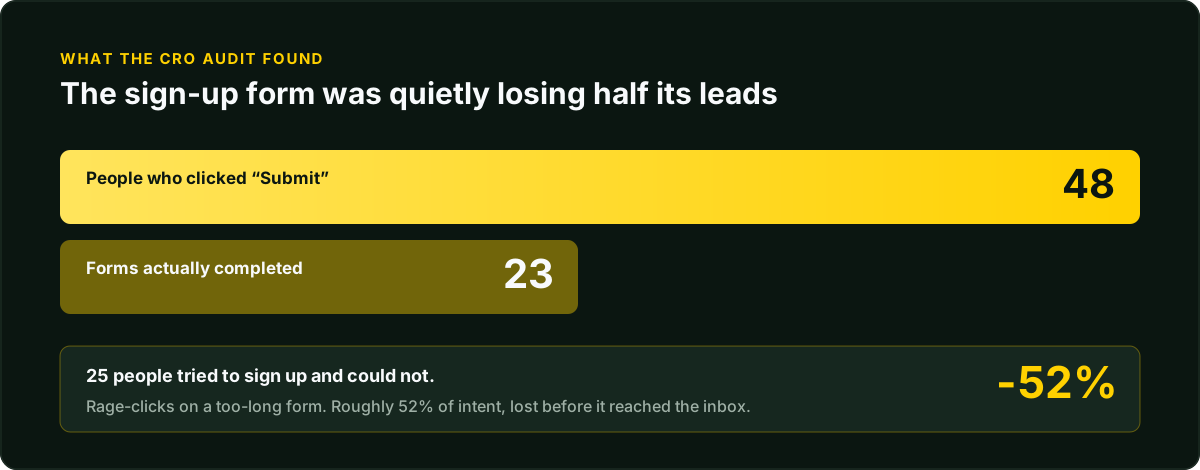
48 people clicked submit. Only 23 completed. The rest were rage-clicking a form that was too long, and that was roughly half the leads from that page gone before they ever reached an inbox. The recommendations were exactly the work he had been meaning to do for months:
The kicker is what happens next. He does not implement any of it by hand. He gives feedback by voice, says "I like recommendation three, go and implement it," and the agent moves the form, drops the fields, and ships it. Give the demo another 25 minutes and a fair chunk of these fixes would already be live.
Bonus: Reading the Competition's Ad Spend
While the three goals ran, Marshy showed a piece of market intelligence he had built earlier with the same tooling. The question: is it even possible to advertise a small recruitment agency profitably? To answer it, an agent scraped the Meta Ad Library using Apify, a grey-market data tool that lets a non-developer run scrapers and actors against sources like LinkedIn, Apollo and ad libraries.
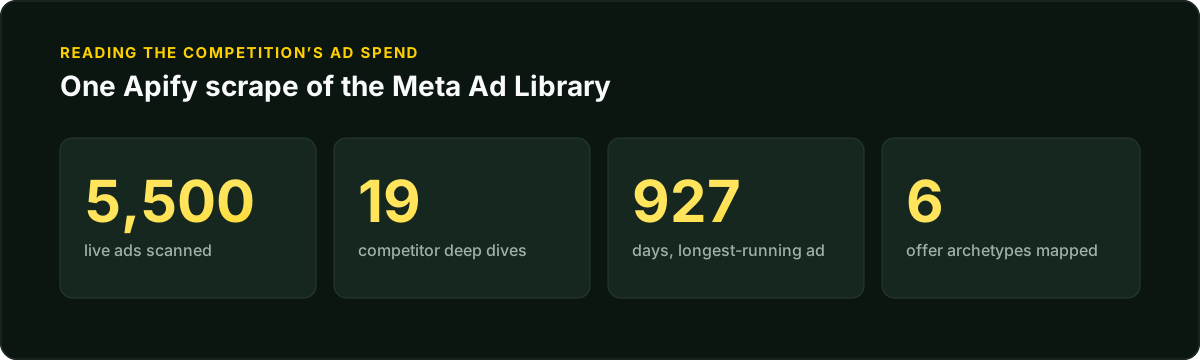
The report read 5,500 live ads and ran 19 deep dives. The signal that mattered: some ads had been running for 927 days, and nobody keeps an ad live that long unless it is working, so duration becomes a proxy for profitability. The biggest lever across every ad was specificity. The agent also mapped six recurring offer archetypes, from evergreen branding to data-driven quiz funnels, which is genuinely useful competitor intelligence for deciding where to play.
"As a non-developer I could never write the JavaScript to pull this. Now I can get the agent to run the tooling and hand me the report." - Marshy
The Real Bottleneck Isn't the Tech. It's Focus.
The most important point came after the timer stopped. The blocker on this kind of work is no longer the technology, your capability, or even the cost. A business like Pointer can comfortably afford the tokens.
"The challenge I'm solving for now is: am I focusing on the right thing? Getting better at filtering is going to be an ever more important skill, because the capability is clearly here." - Marshy
That is the reframe for anyone running a marketing team. When one operator can run a mascot project, a content engine and a CRO audit in parallel before lunch, the scarce resource stops being execution hours and becomes judgement: knowing which of the hundred possible jobs is the one worth doing right now.
"If that's what one person can do in 30 minutes, every leader who employs a marketing team should be asking what more their team could be doing. One person can achieve what 10 used to, not so long ago." - Ricky Pearl
Is This Realistic for a Non-Technical Team?
An honest question came up in the Q&A, from Robbie Ryan: how complex is the setup for non-technical leaders? Marshy did not sugarcoat it.
It is genuinely complex. You need to stand up tooling to host Claude Code (a server, or locally if you have to), connect your software securely with API keys stored in a password manager, and architect it so the agent learns over time and moves toward repeatable workflows rather than improvising as a fresh agent every time, because improvising every time creates far more hallucination. The actual asking-for-things part is the easy bit.
"If acronyms like API, server and virtual machine give you the heebie-jeebies, this isn't the play for you yet. But this is the direction things are going. It is well worth your time learning terminal and Claude Code, because the rewards are magnificent." - Marshy
The painful start buys you a capability that used to require briefing agencies and waiting weeks. For a non-technical team, a friendlier on-ramp like cowork tools is a reasonable place to begin. But the destination is the same.
Key Takeaways
Common Questions About Vibe Marketing
What is vibe marketing?
Vibe marketing is briefing an AI agent on a marketing outcome in plain language and letting it do the research, analysis, design and build, while you steer with feedback. It is the marketing equivalent of vibe coding.
How is vibe marketing different from using ChatGPT for marketing?
Scope. A chatbot writes a caption when you prompt it. A vibe marketing agent is handed a business goal, pulls live data from your own tools, reasons over it, and returns a reviewable deliverable like a CRO benchmark or a design concept deck.
What tools do you need for vibe marketing?
In this demo: Claude Code (on Opus 4.8) running agents, SuperWhisper for voice input, a virtual machine to keep agents running, and secure API connections to your data sources such as HubSpot, GA4, Search Console, PostHog and ad libraries via Apify.
Do you need to be technical?
To run it the way Marshy does, yes, at least at the setup stage. You need to be comfortable with servers, API keys and workflows. The day-to-day asking is the easy part, and friendlier tools exist for non-technical teams getting started.
Your Speakers
Luke "Marshy" Marshall is Head of Marketing Recruitment at Pointer Strategy. Ex-Google, ex-Facebook, he helped launch Instagram advertising in Australia and has spent 15+ years in growth marketing across BMW, L'Oreal, P&G and Unilever. He sees what every serious growth team in ANZ is hiring for and where the real bets are being placed.
Ricky Pearl is the Founder of Pointer Strategy, where he has worked with 200+ GTM teams in APAC on strategy, hiring and implementation.
If this is the kind of operator you want building your growth engine, Pointer hires AI-forward growth specialists and marketers. See how we approach marketing recruitment.
<details>
<summary><strong>Full Transcript</strong></summary>
Marshy: Hi, great. Hey, guys. Thanks for joining. I got told when we were off air that sometimes the LinkedIn live gremlins have been a bit tricky to work with over the last few weeks. So we're going to give it a minute or two and make sure we're connected. But if you are on, thanks for joining. If you're on a recording, thanks for watching in the future.
My name is Luke Marshall. Most people call me Marshy. A growth marketer by trade, last 20 years. And unless you've been hiding under a rock, digital marketing and growth marketing has changed a lot in 20 years. And more recently, over the last three or so, with AI. A term that sprung out of vibe coding, and probably not as popular as that term, but definitely up there, is vibe marketing.
I'm a practitioner and operator, so I practice what I preach, and wanted to just share with the ANZ audience in particular what vibe marketing looks like, why it's what future state will look like, and how you can do it as a practitioner. Live. I've got some notes on my screen about things I'm going to try and vibe market with a timer. I'll talk through the logic and things that come up. I've done my best to hide and protect against any confidential information. I think it will be okay, but apologies in advance if I freak out. And things will definitely go wrong. This is a new way of doing things.
Maybe with that in mind, instead of just talking about it conceptually, I'll just start doing it and let you guys see and judge for yourselves. So we'll switch and share one of my screens on here. What we've got is a list I just basically knocked out this morning. These are things that have been on the to-do list for a little while. Because we're setting up a new marketing recruitment function, marketing has definitely fallen by the wayside into my remit in favor of business development. But these are things that I wanted to do, and thought, what better time to do them than under the pressure of a 25 minute timer and just knock them out for demonstration and learning purposes.
We went through and updated the Pointer website earlier in the year, replaced Webflow with a Claude Code instance. Definitely not without its challenges, but overall now it's very clear the end result was much, much worth it. One of the challenges we had with this website, and I may as well show it to you guys because we're going to be working on it: we got things looking really well, I got logos and some highlights and it looks definitely vibe-coded if you know what to look for. But there's no illustrations. There's no pretty pictures. And Pointer is based off a dog, a Pointer-style dog or hound. I forget the name of the exact dog, but Ricky's dog is a beautiful dog. We've got this Pointer mascot that's not there currently that we want to fix.
Pointer's content strategy: we're all pretty advanced LinkedIn-ers, but there's always more you can improve. So I'll see what we can do on that front. And then on the sign up page on this website, the CRO on the sign up could be better. This is actually quite a lot of work in days gone by, and probably quite a lot of work in present day as well. There's a reason I haven't done these things: because they're time consuming. But with vibe marketing, apart from being able to do things in a different way, you can also bash through certain things quite quickly and do it with a feedback loop.
I'm going to be jumping around and talking through the logic. There's a good chance I might lose some of the audience, there'll be things that don't make sense, and that's fine. We'll help you afterwards or with the Q&A. But this is Claude Code. And it might look a little different to your Claude Code. It looks a bit different for a lot of people. This version of Claude Code that I've got up is the agents window. These are various goals that I can set. I might just make it bring up my list here.
So I'll set a goal, and I'll just talk through what I'm trying to do. I'm in charge of Pointer's website. We're pretty happy with how it looks, and the positioning and the like. But we've realized that it has no mascot, the Pointer mascot. I've got the Pointer image creator now that's set up to do these things. On our core pages, I want to run a review and have some suggested illustrations appear for the core pages that could complement the existing website layout without needing to change copy. Quite happy to change structure, even enhance with visuals and the Pointer mascot. So for a first pass, can I get some pitched concepts for what this could look like on the page? And if I give feedback and okay it, then you can move to staging and then deployment.
You might be looking at that and thinking, oh, Marshy's talking to himself. No, I'm not very good at it when I'm not demoing. But I've just set a goal there with a tool called SuperWhisper. The logic with these voice-to-transcription tools is it's much faster than typing. And by and large, it is. For me, as an old fart who was doing things on a 286, it's taking adjustment to remember to use it. But it's a work in progress. And like everything, AI is a work in progress.
So what I might do is make this a bit bigger now. I've set the goal. I don't need to steer this, it's on auto mode, so it can just figure these things out. But what I might just type here. Ooh. Something did go wrong. Oh, excellent. Respawning. Let's have a look. See that last minute check there? I did it just before. We're good. So I must have typed something wrong. Rename to website illustrations. Cool. Great. So that's the first task underway. We'll do a time check. All right. Looking good.
So the next one is kind of vague here. Let's see if we can do it. The background and context on this: I'll just announce it, actually. Let's just go voice mode. Currently the Pointer team posts three to five times a week in their various LinkedIn channels. And we want to make it a bit easier to come up with concepts and new post ideas based off in-market conversations that we're having. One way we can do this is to look at our HubSpot conversation transcripts. I think these are chats. Anonymize any identifying features, but look for patterns, themes, and interesting talking points that might make sense to feed into a LinkedIn post to attract both talent and new businesses to work with. I don't really know what I'm looking for beyond that. But can you check whether you can access those conversations via HubSpot? Pass it through Luke Marshall's LinkedIn posting style, say last 90 days, and pitch three to five concepts that might make good talking points for LinkedIn posts in the future. And if this works, we can turn it into a skill we can share with the team.
That was so long that it's gone to pasted text. That's fine. You would have got the gist of that. Some of these things that I'm doing, I've got pre-set-up connections to tools that enable this. Obviously HubSpot, but also our website. With the goal feature, this is an Anthropic version of the auto research tool. You do not need to use a Git and then ingest it and set these complicated things up like I've seen some influencers do. With goals, you can literally just ask for what you want. Ideally give it a win condition, so what a final result looks like. A number or an outcome. And then it will just work out the rest. Fueled by Opus 4.8 credits.
I might rename this one as well. LinkedIn post inspiration. I can see some issues here. They're called transcripts. It may not have access to this. We'll see. But it's a problem that it can work out. We do have it connected to the HubSpot API. I actually haven't checked if the chats are fair game there. So we'll learn as we go. Let's do a time check. My, sweating bullets. It's not bad.
So, run CRO analysis on our sign up page. I left this one last because it's hard. I don't know what's going to happen. CRO stands for conversion rate optimization. Because we're very happy with our website, the conversion rate on this one is essentially "book a discovery call." That's the action. It looks neat and pretty. And I've had this hunch that a form of this magnitude with 1, 2, 5, 6, 7, 8 different fields, there is a chance that people are getting to this section and then just bouncing off. They get here, they have to scroll down, there's a welcome, "thanks for joining," and so on. My hunch is that from a CRO perspective, there's improvements that can be done here.
Let's just give that a goal as well. I have a hunch that our core conversion or call to action on the Pointer website is suboptimal. We have a sign up form with 7 or 8 fields, and want to track if there's better ways to drive more effective conversions. In this case, sign ups from interested prospects. There should be some Google Analytics data that can help inform this, and some Google Search Console data. And we've also got API access to PostHog that we set up, although it's a free version, so I'm not sure how much or how little the session recordings can be seen. The goal for this is to basically get a benchmark current conversion rate and suggest some optimizations that could be made based off the data you gather to improve this conversion. And go for it.
Cool. So that one is now underway. And like the other goals. Okay, this is playing funny buggers in this one, and I may have crashed over here, but we'll find out. Cool. So it's working its thing. To get back to the other goals, I just hit left. And now we can see the goals here that I've got. I want to rename this one to CRO.
Now, CRO is its own discipline. It usually only works with high traffic websites. The technical work involved in CRO, it's a multi-hyphenate digital marketer specialist skill that relies on copywriting, design, positioning, code. There's so many things you can do with CRO. And we're just telling Opus: I just want solutions, not problems.
What I'm going to do next is do a time check, about 13 minutes in. And what I'm seeing on my screen here is these three tasks working. You may have noticed that it's asked for no input up to this point. So I'm just sort of waiting. Rather than spend the next 30 minutes of this demo checking in, what I like to do on tasks, particularly when I'm a bit impatient, is go and see what's happening within. What Claude Code does is give you different commentary as it works on the task or goal. It's talking about the mascot library that we've got created. It says it's excellent. Well, thank you. And it seems like it's going through different parts of the page and creating some mockups, which is what I asked for. Pure white on transparent alpha, which makes sense because transparent is, we just want to see how it's overlaid. It seems like it's on track. So I'm just going to let it keep doing its thing there.
The LinkedIn one. Okay. No conversations read. But it can read the call summaries, which isn't quite as good as the exact transcripts. But I'm actually pretty okay with it going off the summaries, because if something's a trend, it's going to appear in more than one summary. And we can always enrich this with transcripts later if we feel like it's giving me less than satisfactory data. It's saying, look, personal Dropbox, that's fine. It's going to pull the call summaries into a local staging file. That's just a temporary thing that's happening. In the meantime, I did not tell it here, but it spun up a subagent that's grabbing my recent LinkedIn posts as well, because I asked it to. It'll save it in a little bit as soon as it can, and then it'll build it to match up to the previous content. You heard the instructions I gave it. I didn't tell it to do that.
Now I'm just going to go to the CRO, which was the latest one, and check on this one. So it's benchmarking Pointer's signup form conversion. We don't have a huge amount of signups via the signup page, by the way. In fact, from a marketing perspective, generally speaking, it's lower quality referrals or leads, because if someone wants to work with Pointer, they'll just talk to someone, call us, there's other ways to get in touch. Having said that, it's still something you want to fix. It sounds like it has the Google Analytics property. Great. I hate looking at GA4. I used to be a fan of Universal Analytics. It's got Google Search Console access, which is fantastic. And in PostHog, it's got that too. So it seems to be doing what I've asked it to, and it's set up on auto mode as well. All 10 read cleanly. "I have a complete concept. Now let's review." It's going to deliver the thing for me to feed back on, in a reviewable PDF doc, a deck, and a written concept doc.
I can see a little background noise. Definitely don't want that. That seems to be all clear as well. Funnily enough, I used to work in an agency, and this is how you would present the initial stuff to the client. You'd come up with your concepts, your strategy, your mocks, and then present it in a PDF as well.
While all this stuff is happening, I'm just going to share something that we've been investigating at Pointer as a bit of a proof of concept as well. Using this same tooling, I asked for a presentation or a deep dive on essentially any small global recruitment agencies, similar to us, but not necessarily our category or niche that we're advertising. The reason I wanted this information is because our suspicion is it's actually quite hard to advertise a small recruitment agency and get a return on investment. So my brief to the agent was similar to what I've shared with you today, asking about what the offer is, what kind of audiences they're going after, any data that powers it, and the unit economics: can it run at a positive ROI?
What it did is scraped them in an ad library. One of the tools that I rave a lot about, if you've seen any of my previous presentations, is a tool called Apify. It's starting me to log in, running in a different tool. I'll bring up the Apify. Apify is essentially a gray market tool that gives you access to various data sets, like LinkedIn, Apollo. There's different actors you can run, web scraping, et cetera. As a non-technical operator, by which I mean non-developer (I'm definitely technical), it would be very hard to write JavaScript that would pull this information. But with Claude you can now get code to run that tooling and generate reports like this. This is how I was able to get the Meta Ad Library. I'll just do a time check as well. I think we're on track.
I'll just have a look at this. It's all going, so let's talk through the report for a second. I'm looking at this from fresh. I don't have a chance to read it yet. 5,500 live ads, 19 deep dives. Cool. So this is what the recruitment ads look like. There are many clearly profitable. I wasn't expecting that. One of the proxies we use for figuring this out is if an ad's been running for a long period of time. 927 days is extreme. It won't be running for that long unless it's working. So that's really useful for us.
There's two different kinds of businesses here. Candidate acquisition, so just getting candidates, which makes sense. But from a business perspective, the client acquisition is the game, so advertising to employers. Specificity is the number one lever. So across all the ads it's seen, being super specific is much better. Not much information on the data here. That's to be expected. We're scraping here, we can't expect that. It seems like they keep ads small and evergreen instead of scaling. All right, cool.
The other bit I was interested in is what kind of offer they're making to the market that would help us. It's come up with six different kinds of offers. Evergreen branding: this would make sense, from any kind of advertising perspective. High volume: not our game, but I can see why that would work from an advertising perspective. Data-driven quiz, VSL funnels: this absolutely works in other segments. I'll want more specificity on this for future. Microagency: I have seen this, but I don't think this is us. We're not a micro or super niche. Offshore: we're not that either. Agency enablement: I guess we've got a lot of enablement materials. So I'm looking at this with fresh eyes, and strategically this one, this one, and this is market intelligence that is super useful to us. I might read the rest of the report, and do the time check here.
We're running low on time. What I've noticed with these goals is that sometimes it has done stuff even though it's still working. So in this case, deck is polished. Great. Markdown and save to this week's notes. So it's saving into the folder now. This will probably be a question: I run Claude Code from a virtual machine. What this means is if this dies, like my computer dies, it'll still run on the server. The reason I have this piped to a folder that's on my computer is I can throw work in and out from this. So this is now saving to the latest weekly notes. I'll bring it up in a sec.
Oh, yeah. We've got answers on this. We can scroll. So let's have a look. Okay, so I broke the resume. So now I make people turn the camera on. I kind of hate, because I'm sort of living and breathing this stuff, I can tell when stuff's written by AI. One of my bits of feedback to this would be: give us inspiration and themes and more bullet points than the actual copy itself. But that's fine. "Eating your number won't save your job." A bit of scare tactics. I don't know what's going on there. Okay, I like this one, and we talk about this a lot actually: "Where's the salary band?" So this one: "your shortlist isn't ghosting you, your salary band is." The best candidates want to know the number. So don't bloody hide it or make it a crappy band. Just be honest. It really saves your own time. A bit generic here, but you can add some specificity. I'm pretty happy with that as a start. What I would do here is just give it more feedback on what useful output would look like.
Just do a time check. If you've ever seen the show "24," I feel like Jack Bauer, except that instead of it being 24 hours, the countdown's happening. So let's look at the website illustrations. Okay, so that's saved. I'll just see if I can pull it over. Cool. So the website concepts. First thing I noticed, and this is from previous work, the navy blue instead of black, which we can fix that with feedback. This is from previous work that we were doing. There's the original mascots. So this is the dog. As a rough mock, I get what they're trying to do here. I definitely want the sizing to be different. And I probably want the angle to be like him pointing across. But I love that it's a concept. I don't mind the confident one either. That's pretty cool. The numbers one might work on a sub page.
Just do a time check. Go faster, Marshy. I like this, the consideration on how we used our hound. Clearly they're mocks, so they're overlapping every minute. These are kind of good. I think the line style might be a little bit different. But we could have a pop-up with the newsletter sign up, for example. Oh, okay, there's a different concept in the background. It's a bit more subtle. I don't hate it. Then it's telling me what to do. Well, I'll tell you what to do, AI. So I'm pretty happy with that as a result, as a first pass. And it seems to be too.
CRO-wise, I'm just going to have a look. Okay, so it's a fairly interesting report. Silent validation. Looks like we've had 48 submit clicks, people completing the form, but 23 completions. So there's some rage clicking here. Whoops. That's something we can absolutely fix. And it looks like it's half our leads. So I want some more info there. But the form is too long for the audience. I agree. You basically, we can just get a LinkedIn profile, for example, and know what to do. I agree with that too. Mobile-first rebuild, 100%, that's very important. Move the form up. Yep. All of this is stuff I've wanted to do. I haven't got the time. So I'm not going to give it feedback, because that's weird. Good work. But this is a great start. We can action this. And I will, with my voice. That's how the vibe marketing works.
So the website illustrations, it seems like it's just doing the last check before you open up Q&A. It's basically finished. So bang on time. That's vibe marketing in action. I'm very curious if anyone was watching the whole thing. If you have, thank you. More than happy to answer questions now, because I don't know what is assumed knowledge and what is like sorcery here. I'd just love to hear from anyone if it raised any questions, either now on the call, or I'm happy to answer off channel if you're shy, for example. Ricky, how is that? Any live feedback? No one's popped any questions in.
Ricky: From my perspective, you know me, I love this stuff. And what I love most about the way we've built this out is if we liked any of those recommendations, we could just go and say, actually, I really like your recommendation number three, will you implement that? And that's the last you have to say. It'll just go and move it above the fold, or decide which fields to take out of the form. So this whole process, if you added on another 25 minutes, you could actually implement quite a fair chunk of this, which is pretty wild.
Marshy: 100%. And I think, actually, you read about this last night as well, I think the challenge now isn't technology limitation or even your capability or costs. A business like ours absolutely can afford the tokens. For me, the challenge I'm solving for now is: am I focusing on the right thing right now that needs to be done? As I said at the start, BD is absolutely a core focus for me, and rightfully so. Focusing on the right thing and just getting better at filtering, I think, is going to be an ever-increasingly important skill here. It's clear the capabilities are here now. It's fun to do, and under some time pressure. I'm kind of proud of the fact it was down to the second. That wasn't planned. It just happened that way.
But if this is eliciting any feedback for our clients, one of the things we're bullish on is hiring for AI-forward growth specialists and marketers. So get in touch if you want some betting on these kind of talent. We clearly know what we're talking about. Otherwise, thanks for your time and attention today. There's no live questions.
Wait, we got one question popped up right at the death.
Robbie Ryan (audience): How complex is the setup for non-tech leaders?
Marshy: It's complex. No question. I don't sugarcoat this. The demos that we see from the hype bros on LinkedIn are very staged. So I'll just talk through it in broad strokes and then give you a place to start. What you need to do is set up some tooling to host Claude Code. I do it on a server, but you can do it locally if you have to. And then you plug in different software. This software needs to be secure, so because you're using variables and environment stuff and API keys and the like, I store it in a password manager. You can also store it locally in a folder that's hidden. And then the simplest part is actually asking Claude Code to do the things.
I've set up my architecture in a way that when I ask for something, it learns over time and moves towards workflows, instead of just doing it as an agent every time, because that creates much more hallucination. But that's the nuts and bolts of it in a nutshell. If words and acronyms like API, server, virtual machine give you heebie jeebies, this isn't the play for you. Robbie Ryan, who's a friend, she does a lot of sessions on Claude cowork, which does some of these things as well, but in a much more user-friendly way.
But my pushback on that is this is the direction things are going in. It is well worth your time trying to learn terminal and Claude Code. Because while it's painful at the start, the rewards you can get are magnificent. What I just showed, I'm a seasoned practitioner, but I would have had to brief agencies, people, et cetera, as little as three, four years ago to do all those things. And it's happened in 25 minutes. That would take weeks in old times. So the rewards are there. And I kind of hate it as well. The tech bros and the high concentrations of power and the like. But I can't fight that. So I might as well learn it and apply it and use it to my advantage as a business owner and practitioner for my clients. So hopefully that answers your question in an honest way. And if you have any follow-up questions, whoever that was, more than happy to help offline.
Ricky: Well, it happened to be Robbie Ryan who asked the question, and she got the shout out. Spa happenstance. So there we go. Thank you everyone for joining. Marshy, thank you as always. Unbelievable what can be achieved. And equally, if that's what you can do in 30 minutes, let's hope that everyone who's watching this who employs a marketing team is thinking, what more can my team be doing? Because one person can certainly achieve what 10 used to not so long ago.
Marshy: 100%. Thanks, Ricky. Thanks everyone.
</details>
*This session is part of the weekly GTM ANZ Community series. Join free for conversations on marketing, revenue enablement, partnerships and AI, every Thursday.*