

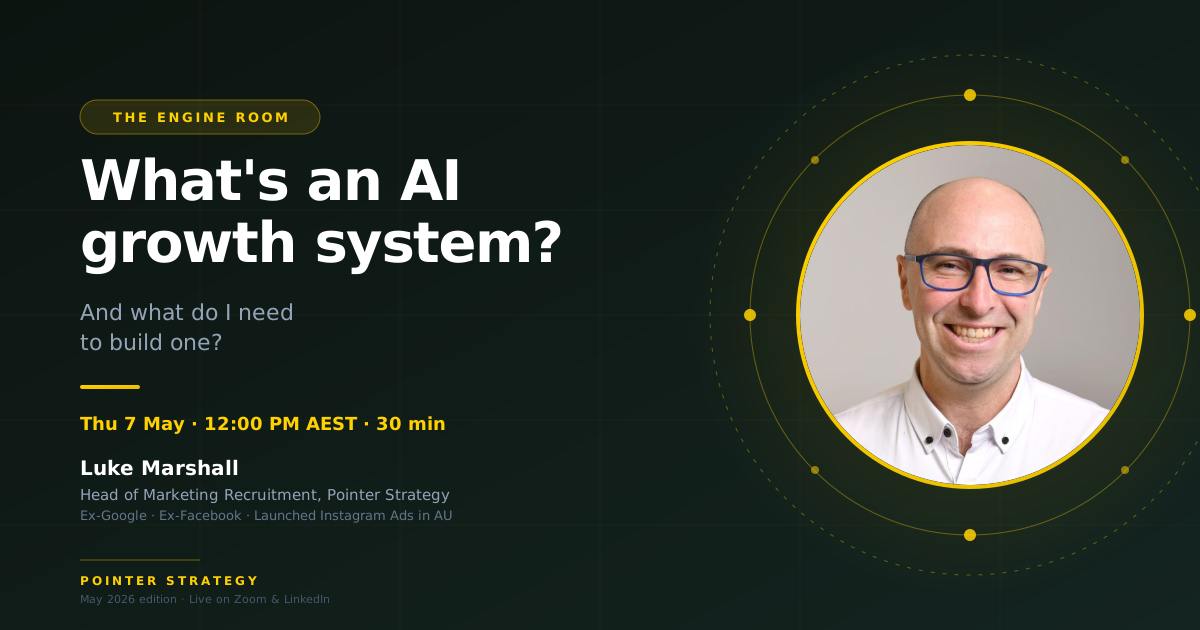
This is a recording of a live session from the GTM ANZ Community, featuring Luke Marshall (Head of Marketing Recruitment, Pointer Strategy) and Ricky Pearl (Founder, Pointer Strategy).
Why "AI Growth System" Needs a Definition
The first four months of 2026 have produced a release cadence that even the loudest thought leaders struggle to keep up with. If you feel overwhelmed by it, you are not alone.
What you see on LinkedIn is the polished demo: one button, outrageous numbers, finalised output. Almost none of it is honest about the weeks or months of iteration sitting underneath. Luke's working definition cuts through that:
"An AI growth system is a sales or marketing campaign mechanism you can run repeatedly, with AI executing some or all of it, in a continuous improvement loop. The last part is the important bit. It is not set and forget."
The real value shows up on iteration four, five, even ten. The first run will stink. If you cannot live with that, this is not the play for you.
These principles apply across paid, funnels, lifecycle, and measurement. This post focuses on outbound, because that is where the iteration loop produces the cleanest signal and where the rewards are biggest for B2B teams selling to hard-to-reach decision makers.
The Reality Check (Before You Spend a Dollar)
A few things every founder, growth lead, or RevOps person should know before they touch a tool:
The Four Components of an AI Growth System
Every system Luke has built or audited has the same four pieces.
1. Audience
This starts with a list, then layers on enrichment and signals.
List sources, ordered roughly by trade-offs:
| Source | Trade-off |
|---|---|
| LinkedIn manual / Sales Navigator | Above board, slow, hard to scale |
| Microsoft Dynamics + Sales Nav integration | 100% above board, expensive |
| Apify and other scrapers | Powerful, faster since Claude Code, sits in a grey zone |
| Apollo | One-size-fits-all, decent if your market is broad |
| Firmable | Best-in-class data for ANZ, especially for niche or licensed categories |
| LLM as list builder | Does not work. Don't bother. |
| In-browser agents and Chrome extensions | Possible, not recommended over the above |
Enrichment and signals is where most teams stop too early. Getting an email or a job title is easy. Getting cut-through is not. Signals are the markers in someone's online world that suggest interest or fit.
Examples that have worked:
"This is where the game is won. But you have to run these things multiple times to unlock that information."
>
Luke Marshall
2. Campaigns and Messaging
The job here is to match what you can find from a signal to messaging that lines up against your target.
The classic "started a new role in the last three months" angle is over-played. It can still work, but it needs an extra signal layered on top. A more interesting one Luke has tested: a *lifer* in a role. Tech moves fast in most categories. A CRM lead who has been in seat for ten years is a legitimate conversation starter for the leader above them.
Or the rotating chair example from above, where the message becomes:
"You are burning through Heads of Sales. Want some help?"
Right message, right time, right signal. That is the loop you are trying to build.
3. Tools
Not exhaustive, but a working May 2026 stack:
| Job | Tools |
|---|---|
| Cold email (sending, warming, account rental) | Smartlead, Instantly |
| LinkedIn outbound | HeyReach (best price-to-value right now) |
| List building (broad) | Apollo |
| List building (precision and ANZ) | Apify, Firmable, Clay, Freckle |
| Orchestration | Claude Code (Luke's pick), Codex (Nathan's pick), purpose-built agent builders, n8n for workflow-style automation |
If you want a sense of what AI-fluent execution looks like at the role level, Luke covered the same theme from the hiring side in Is AI Coming for Your Marketing Jobs?.
4. Feedback Loops
This is the one most teams skip and most teams regret skipping.
A simple version:
Once you have done the heavy lifting on signals and tools, *introducing new campaigns becomes cheap*. A niche conference is coming up? Enrich previous attendees and people who follow the conference page. Hit them up. Same loop, new angle.
The Pointer Stack (For Reference)
Just so this is not theoretical, here is the stack we run today:
Nothing exotic. The leverage comes from running the loop, not from any single tool.
Watch-Outs (the Things That Break)
A few that catch teams out:
Q&A: What People Actually Asked on the Day
What guardrails matter most for agent orchestration?
Three things:
The setup is easier than it used to be. Ask Claude Code (or your equivalent) to design each agent. Have the evaluator return a score and a few lines of feedback. Loop the campaign agent against the evaluator five, ten, fifteen times until the score hits your bar. Run all of this *before* a single real prospect sees a message.
Ricky's add: you can also run loops *across* LLMs. Draft in Claude, sanity check in Codex, then route through an LLM council where each model wears a different hat.
How do you make this work in a small ANZ TAM?
This is the question every ANZ team asks. The North American playbooks assume an effectively infinite TAM. Australia is different. Burn the list and you are done.
The fix is to *dial up the human* rather than dial down the system. With a TAM of 500, you might:
Smaller volumes, but better-targeted, with a tighter human-in-the-loop. Provided the thinking is good, it will outperform a 5,000-contact send to the same audience.
What if LinkedIn is useless for our category?
Common in mortgages, finance, real estate, construction, trades, anywhere that operates more like a walled garden.
Other places to find signal:
Ricky's add: knowing *what* data to target is the creative exercise. *How* to get it is the practical one. The combination of domain knowledge and technical capability is the moat. Marshy will spot signals nobody else sees in a category because he has been in that category for years.
Key Takeaways
Your Speakers
Luke "Marshy" Marshall is Head of Marketing Recruitment at Pointer Strategy. Ex-Google, ex-Facebook. Helped launch Instagram advertising in Australia. 15+ years across BMW, L'Oreal, P&G, and Unilever. He sees what every growth team in ANZ is hiring for and where the real bets are being placed.
Ricky Pearl is the Founder of Pointer Strategy, where he has worked with 200+ GTM teams across APAC on strategy, hiring, and implementation.
*This session is part of the weekly GTM ANZ Community series. Join free for conversations on marketing, revenue enablement, partnerships, and AI, every Thursday.*