

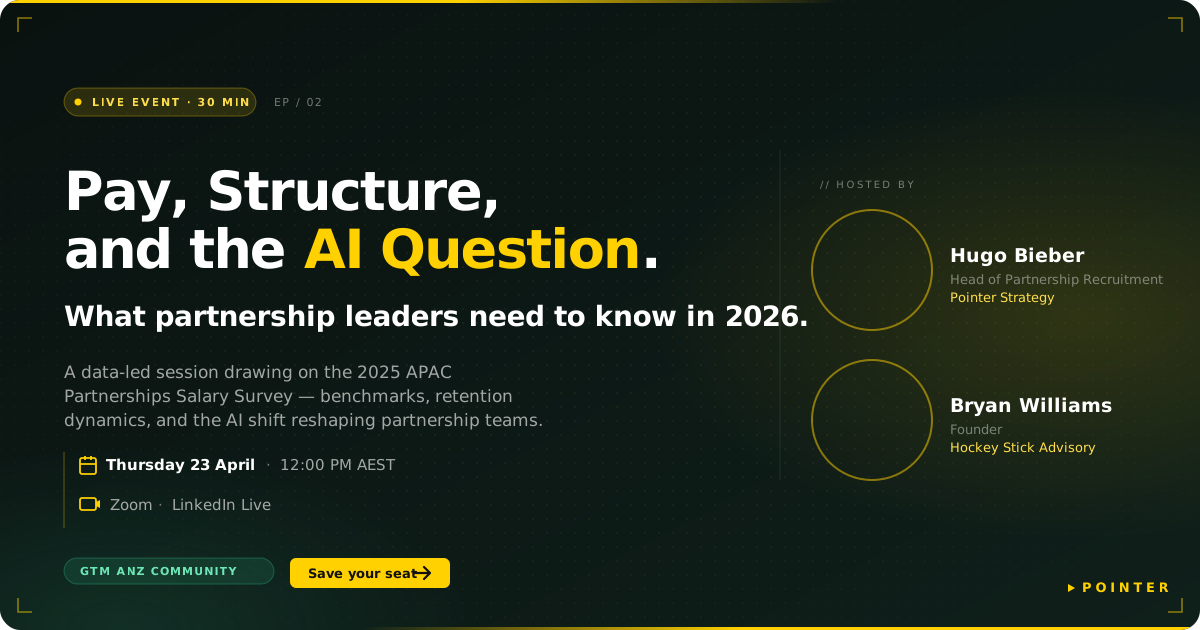
This is a recording of a live session from the GTM ANZ Community, featuring Hugo Bieber (Head of Partnership Recruitment, Pointer Strategy) and Bryan Williams (Founder, Hockey Stick Advisory), drawing on the 2025 APAC Partnerships Salary Survey.
The Headline Numbers
Partnerships in ANZ is in a strange spot. The function is growing fast, the money is up, and the role is being rewritten in real time.
A few data points worth sitting with:
The last two numbers are the ones to pay attention to. The raise worked. The retention didn't.
What Partnership Roles Actually Pay
Most partnership packages in ANZ below the enterprise tier are still heavily weighted toward salary, with a small commission or bonus sleeve on top. That sounds strange for a revenue-adjacent role, but it reflects the stage of the function in most companies.
"Foundational partnership managers or those building partnerships at companies very early on often don't have a line of sight to the ROI of partnerships. It is quite hard from a CRO, founder, or exec level to place a commission structure in place with confidence." Bryan Williams
The shape of the package is a tell for the maturity of the function.
Salary-Led Packages (Early Stage)
Used when partnerships is being stood up. The work is strategy, relationship building, and partner enablement. There isn't a clean revenue attribution model yet, so loading variable comp on top creates bad incentives and bad measurement. Base is the lever.
Mixed Salary + Commission (Growth Stage)
Used once partner-sourced pipeline is measurable. Variable comp is typically tied to partner-sourced ARR, partner-influenced revenue, or partner-activation metrics.
Partner-Led Sales Compensation (Mature)
Used in companies where partnerships is the primary sales motion (channel-first, marketplace-first, or integration-first businesses). Comp looks closer to a direct sales quota structure.
Practical takeaway: if you are writing a job description and you don't know which of these three stages your company is actually in, your comp band is going to be wrong.
The Career Path Is Not Linear
Roughly half of the people in partnerships today came from a sales background. The other half came from everywhere else: product, customer success, engineering, marketing, BD.
That is not an accident. It is a signal about what the role actually requires.
"We're seeing a move from the partner manager role to that of a partnerships operator. They're truly embedded across the organisation, across all touch points. Partnerships as a function is overlayed across the business. It's not something operating in isolation." Hugo Bieber
A good partnership professional is juggling five stakeholder groups at once: their own sales team, their own product team, their own marketing team, the partner's equivalent of each, and the customer caught in the middle of all of it. The skill mix is closer to an internal founder than to a quota-carrying AE.
That is why the sales-only hiring filter keeps producing mis-hires in partnerships.
The Partner Curious Era
One pattern we are both seeing across CRO and founder conversations: companies are "partner curious" but not partner capable.
"There's a gap right now where they all believe in partnerships. They know what it can do. But the how, like how do we actually do this and bring it to life, that's where they get stuck." Bryan Williams
The underlying driver is cost pressure on the other channels. Paid is getting more expensive and less effective. Outbound is harder. SEO is being eaten alive by AI answers. Partnerships is the obvious distribution lever left, but most teams don't have the muscle memory to build it.
That gap is what is driving the 46% team expansion number. But it is also what is driving the retention problem: a lot of those new hires are being parachuted into organisations that believe in the outcome but haven't built the infrastructure to support the role.
The Retention Problem
Here is the number that should make every CRO pay attention:
72% got a raise. 73% are still open to leaving.
Pay is not the lever. Career progression is. Around 40% of partnership pros cite career advancement and lack of progression as the reason they are open to moving.
That's a structural problem. Partnerships is usually a small function inside a much bigger revenue org. There are not many rungs on the ladder. And when the function sits off to the side of sales, the political oxygen goes to the quota carriers.
What Actually Retains Partnership People
From the survey data and the operator conversations, three things show up repeatedly:
If you are a CRO or founder reading this, the retention play is not a 10% comp bump. It is treating partnerships like a channel, not a project.
The AI Shift: Manager to Operator
The most consequential change happening right now is what AI does to the day-to-day of the role.
The admin layer of partnerships (QBR prep, partner activity tracking, signal surfacing, pipeline hygiene, deck building) is being swallowed by AI tooling. That layer used to take 40-60% of a partner manager's week.
What replaces it is context work.
"The value layer is the context, the relationships, the history, the market positioning. On top of any AI research, ideation, or programmatic work, it's still the context which drives the current state and sets the future direction. AI is an extremely powerful tool underneath to accelerate the impact." Bryan Williams
The Bifurcation
The role is splitting into two distinct profiles:
| Partner Manager (legacy) | Partner Operator (emerging) |
|---|---|
| Runs programs and processes | Designs programs, orchestrates systems |
| Manages partner relationships 1:1 | Manages partner ecosystems 1:many |
| Reports on activity | Builds line of sight to ROI |
| Lives in the CRM | Lives across CRM, PRM, product, data |
| Measured on partner count | Measured on partner-sourced revenue |
The operator profile is the one that commands premium comp in 2026. It is also the one most companies don't yet know how to hire for, because the job descriptions haven't caught up with the role.
Why AI-Native Startups Are Pulling Partnerships Forward
A second order effect worth flagging: AI-native startups are hiring partnerships earlier than their predecessors did.
The reason is distribution. Proprietary data, workflow coverage, and network effects are all table stakes for the current wave of AI products. The differentiator is reach. Who is already talking to your ICP, and can you borrow that relationship?
"Distribution and leverage is what these early stage companies are looking to seek, deploy, and enable. You can have all the potential, but if it doesn't go to market rapidly, how impactful can it be." Bryan Williams
The sharper point is what doesn't work. You cannot walk into a partner conversation with "please distribute our thing." Partnerships only function when the other side has something to gain.
The test question, every time: what percentage of the partner's revenue can we move? If the answer is under 2%, you don't have a partnership. You have a logo on a slide.
Career Advice for Partnership Managers
If you are in the middle layer of partnerships right now (senior manager through head of, typically the $150K to $200K base range), Bryan's career advice from the session was the sharpest take we have heard in a while:
"Operate like an intrapreneur. Build your own story and narrative of quantitative impact. When you go to the next job, they're going to buy that story. They're going to want you to deliver that there." Bryan Williams
The new benchmark is concrete: a partnership hire should be driving 3 to 4x their total base + super in revenue impact within 12 months. That is the bar for a top-tier partner manager, and it is the number you should be tracking against yourself long before your next performance review.
If you are hitting it, you have earned the right to renegotiate aggressively. If you are not, the question is whether your function has been set up to let you.
What Partnership Leaders Should Do in the Next 30 Days
For CROs, founders, and heads of partnerships:
Your Speakers
Hugo Bieber is Head of Partnership Recruitment at Pointer Strategy. He works daily with APAC's top partnership leaders on hiring, structure, and compensation design.
Bryan Williams is the Founder of Hockey Stick Advisory, where he helps B2B SaaS companies build repeatable partnership motions. He is one of the most cited voices on partnership strategy in APAC.