

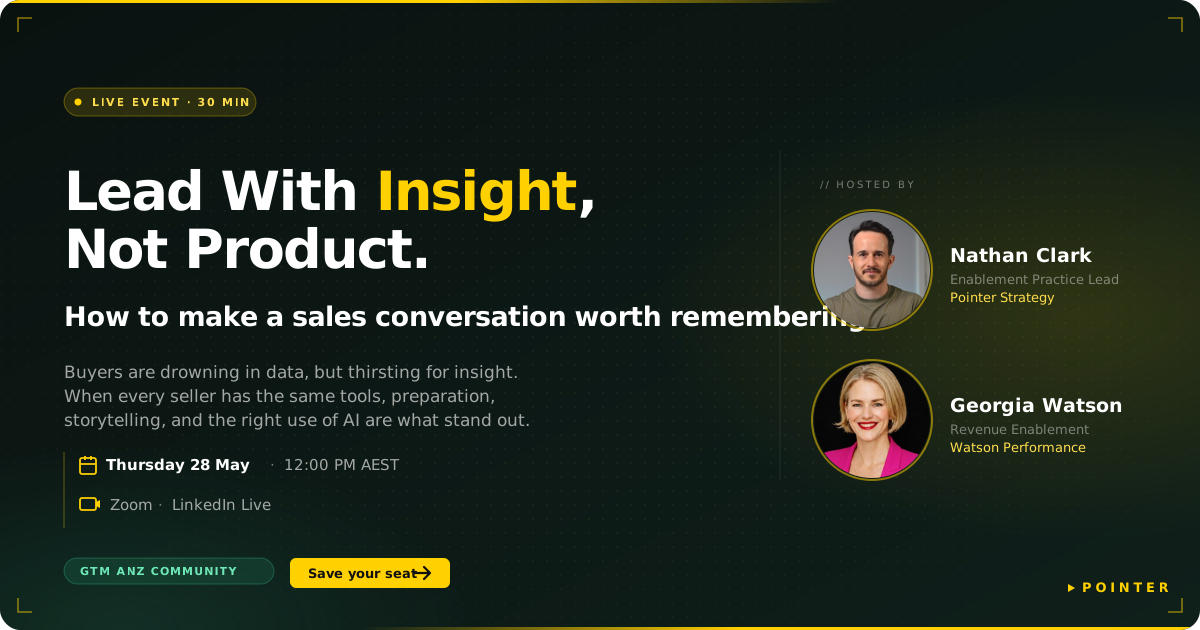
This is a recording of a live session from the GTM ANZ Community, featuring Nathan Clark (Enablement Practice Lead, Pointer Strategy and Founder, Upright Revenue) and Georgia Watson (Revenue Enablement, Watson Performance).
Get the Buyer Research Toolkit Nathan demoed in the session. A drop-in AI skill plus a standalone custom-instructions prompt that turns any company name into three source-backed commercial hypotheses, a buyer tension read, a best opening question, and a discovery path. Works with Claude Code, Codex, ChatGPT Projects, Claude Projects, and Gemini Gems. Download the toolkit (.zip, 150KB) or grab the installation guide (PDF).
"Value is a buyer word, not a seller word"
Nathan opened with a line he heard from Jeff Shore years ago and never let go of: value is a buyer word, not a seller word. It is easy to decide what we think value is. It is much harder to sit across from a buyer and let them tell us.
That distinction matters because the question most sellers walk into a meeting holding ("how do I explain my product clearly?") is the wrong one. Clarity is table stakes. The real question is how you engage in a conversation, and a process across many conversations, that delivers the transformation a buyer actually wants, while delivering value back to your business.
Georgia framed the same idea more bluntly: value is in the eye of the receiver. AI, tooling, decks, demos, none of it matters if the buyer in front of you does not feel like the conversation is for them.
The numbers behind the "drowning in data" problem
Buyers are drowning in data and thirsting for insight. The stats below are the ones Georgia put on the whiteboard, and they sit in tension with each other in a way every seller should understand.
| Stat | What it says | Source |
|---|---|---|
| 70% of buyers do not want to engage with a seller | The default is avoidance | Gartner |
| 90% would meet earlier in the buying process if they thought the seller would bring value | The door opens fast when the offer is real | CSO Insights |
| 77% of B2B buyers want to learn something new from a seller | Buyers are not allergic to sellers, they are allergic to pitches | CSO Insights |
| 86% will listen if you arrive with something that genuinely helps | Earned attention compounds | CSO Insights |
| 76% buy from whoever brings the buying vision | The seller who frames the problem usually wins | CSO Insights |
| 68% say every seller looks and sounds the same | The default state is undifferentiated | CSO Insights |
The story those rows tell together: buyers are guarded, they will open up fast for a reason, and most sellers never give them one.
The TV story (or: what changes when "I'm good thanks" becomes "tell me more")
Georgia told the story of helping her dad buy a TV at Good Guys. She walked past Steve at the door with the standard "I'm good thanks, just looking." Then she stood in front of the giant wall of TVs and felt a small wave of overwhelm. Steve drifted back over and said, "I see you're looking at the Samsung 58 inch. We actually have a promo going."
In one sentence the dynamic flipped. "Oh, Steve. I am ready to listen to you now."
"No one wants to be sold to. But do they want help? You bet." — Georgia Watson
The friction is not the seller. The friction is the seller arriving without a reason for the buyer to care. Steve had one piece of relevant information. That was enough.
What "showing up with insight" actually means
Insight is not "I read your annual report." It is a point of view about the buyer's situation that they were not already holding, or had not yet articulated, plus a credible reason it matters now.
When Nathan asked Georgia how a newer account executive can do this against a buyer with fifteen years in the industry, she gave the most useful answer in the session:
Nathan added the framing he uses with reps:
Your buyer has deep expertise in their domain. You have wide expertise across many domains. The buyer respects depth. They are starved for the cross-section. Bring it.
The buying vision: back the conversation up
A pattern Georgia kept returning to: most sellers enter the conversation too far forward. They are pitching product when the buyer has not yet agreed there is a problem worth solving.
Her sketch on the whiteboard, paraphrased:
That sequence is what earns the 76%. The seller who shapes the buying vision wins the deal. Not the seller with the better widget.
What buyers actually remember (10% in 24 hours)
If you only take one number from this session, take this one:
Now consider the average B2B sales cycle. Nathan put it at 14 days on the very low end, 60 to 90 days as the realistic range, often six months in tech. You are designing meetings that need to survive in 10% of their original form for months.
Two implications most sellers ignore:
How to be remembered: visuals, whiteboards, stories
Georgia walked through the science of recall and what to do about it.
Picture superiority effect. Brains remember pictures. Strong visuals attached to your message lift recall from 10% to 65%.
Not all visuals are equal. Research by Dr. Zakary Tormala at Stanford for Corporate Visions compared three formats:
Whiteboards won, decisively.
That second number is the one to sit with. You become 8% more credible the moment you uncap a marker. No deal closes on 8% alone. But every deal closes through accumulated credibility, and there are not many things in the seller's toolkit that move credibility by 8% in a single gesture.
The whiteboarded number, story, or framework also travels. It is the thing your champion can sketch on a napkin for their CFO. It is the 10% that survives.
"If they can take it and share it internally, that is gold." — Georgia Watson
Stories anchor emotion to recall. Case studies as data points are forgettable. Case studies as before-and-after narratives are not. The contrast structure ("here is what their world looked like, here is what it looks like now") is what turns a slide into a memory.
The AI prep workflow: from zero context to three hypotheses in under two minutes
Nathan demonstrated a research workflow he uses to walk into any first meeting with a real point of view. It is the meeting-prep equivalent of taking the buyer's situation, your company's belief, and the wider market pressure, and triangulating something useful enough to test in conversation.
The setup. A reusable prompt (works in ChatGPT, Claude, or any frontier LLM, or as a Claude Code or Codex skill) configured with:
The input. One company name. That is it. (Optionally: the buyer's role, prior context, the meeting agenda, a URL.)
The output. A meeting-prep brief, not a company profile. Specifically:
In the live demo, Nathan ran it against Australian Retirement Trust as an UpGuard-style cybersecurity AE. In under two minutes, the model surfaced three credible angles, including the genuinely sharp insight that cyber risk is becoming an operating model problem, not a control uplift program, anchored to recent APRA regulatory movement.
The reusable principle, not the specific tool:
If a seller cannot articulate their company's point of view, that is a deeper problem than any AI workflow can solve. The AI is only as differentiated as the inputs you feed it.
Nathan's challenge to anyone watching: talk to your product team, your product marketing team, your founder. Extract the real point of view. Then bake it into your prep loop so every research session compounds.
Download the Buyer Research Toolkit
Everything Nathan demoed is packaged and free. No gate, no email capture. The session promised "send me the thing and you'll get it," so here it is.
Download buyer-research-tools.zip (150KB)
What's inside
| File | What it does |
|---|---|
| `buyer-insight-research/SKILL.md` | The Agent Skill entrypoint. Compatible tools auto-activate it when you ask "research Atlassian" or "prep me for a CFO meeting at Canva." |
| `references/seller-context.md` | Where you write your company's point of view, what you sell, who you sell to, and where you should not overclaim. Edit this once. |
| `references/research-method.md` | The signal categories and implication prompts the agent uses. Adjust if your market, region, or sales motion needs different signals. |
| `assets/buyer-insight-brief-template.md` | The 7-section output format every brief follows. |
| `agents/openai.yaml` | Optional Codex UI metadata. |
| `buyer-insight-custom-instructions.md` | A standalone prompt-style version for tools that only support a single instruction document. |
| `README.pdf` | The full installation guide. |
Two ways to install
Agent Skill tools (Claude Code, Codex, anything supporting the Agent Skills format). Drop the `buyer-insight-research/` folder into the tool's skills directory. In Claude Code, that's `~/.claude/skills/` (personal) or `.claude/skills/` (project-only). Then just ask:
Research Atlassian.
Prep me for a CFO meeting at Canva.
Build a point of view on Telstra for a platform consolidation conversation.
Instruction-only tools (Claude Projects, ChatGPT Projects, Gemini Gems). Paste `buyer-insight-custom-instructions.md` into the project's custom instructions, fill in the Seller Company Context block, and start new research chats inside that Project.
First-run setup (do this once)
Open `references/seller-context.md` (or the Seller Company Context block in the custom-instructions file) and fill in at minimum:
That is the input that makes every subsequent brief useful instead of generic. Skip this step and the agent will give you a company summary. Do it properly and the agent will give you a commercial hypothesis your buyer can correct, sharpen, or reframe in the meeting.
What good output looks like
A good brief gives the seller a useful opening perspective while leaving room for the buyer to push back. The voice is commercially curious, evidence-led, and humble. "My read is..." not "Their problem is...". "One possible tension..." not "They definitely need...". That tone is built into the skill so reps cannot accidentally turn it into a pitch.
If you want the toolkit configured against your specific GTM motion, that is exactly the work Pointer Strategy's enablement practice does inside every placement.
"There is no excuse not to anymore"
The closing exchange between Georgia and Nathan landed cleanly: with AI handling the grunt work of prep, the seller's job is no longer to know everything. It is to show up with a point of view, back it up, and run the conversation differently.
The reps who do not adapt will keep producing the same eight-slide deck and joining the 68% who all sound the same. The reps who do will start landing inside the 90% who get the earlier meeting and the 76% who shape the buying vision.
Key Takeaways
Grab the toolkit. Download the Buyer Research Toolkit (.zip) and the installation guide (PDF). Free, no email gate.
>
Want your reps to show up like this consistently? Pointer Strategy's enablement practice embeds discovery, insight selling, and AI-powered prep into every placement. Book a discovery call.
Your Speakers
Nathan Clark is the Enablement Practice Lead at Pointer Strategy and Founder of Upright Revenue, where he works with founders and GTM leaders to turn revenue uncertainty into repeatable performance.
Georgia Watson leads Revenue Enablement at Watson Performance. She has delivered sales enablement programs and transformative learning across APAC, Europe, Africa, and the Middle East, with teams repeatedly recognised for innovative learning experiences and driving exceptional business outcomes.
<details>
<summary><strong>Full Transcript</strong></summary>
Nathan Clark: Thanks to those joining on Zoom. Today, the session is about having value-driven conversations, and a lot of that comes from being able to put aside leading with your product and instead leading to it through the path of understanding your buyer's needs, understanding the value we can deliver.
I actually watched a video like five or six years ago by a guy named Jeff Shore. He's got a YouTube channel. I just remember him signing off the video saying, "Value is a buyer word, not a seller word." That really stuck with me, because it's very easy for us to define what we think value is, but the reality is it's our buyers that define that.
There are some ways we can go into those conversations, find that out, and then be there to deliver value. The question for sellers is not "how do I explain my product clearly?" While that is important, it's just not enough. The question is, how can I engage in those conversations, drive a process throughout a sale, not just that first conversation but all of those that lead thereafter, to get an outcome for a buyer that delivers the transformation, the improvement, the getting rid of the pain they might have today, and also delivers value back to your business as well, because that's the job that we have.
Today I've got Georgia Watson with me, and she's had a lot of experience driving the human skills and the commercial processes that get sellers to be able to do this effectively. Thank you for joining me, Georgia. Would love to throw to you and say hello and kick us off.
Georgia Watson: Thanks Nathan. Really excited to be here with you, and thanks for the invitation. This value and how as salespeople you show up articulating value and bringing insights is an area I'm so passionate about. We have AI now, and there's so much tech and great things that are available to help you as sellers, but the reality is it really comes back to some of these human skills that are making the difference.
A key one of those is how you show up and bring insights and value, and that's value to your audience, the buyer. In the eye of the receiver, what is valuable and what is not.
Nathan: I put a video up yesterday hoping to get more people on here, and hopefully a few of you have watched it. I said this term that you may have seen, "Buyers are drowning in data but thirsting for insight." When we say looking for or thirsting for insight, what is the problem that's actually at hand?
Georgia: It's such a relevant topic. There is just more information than ever, and so people are overwhelmed. How do you navigate through that? How do you get to what's actually going to help you? The stats from Gartner say something like 70% of people don't want to engage with a seller. But if you know they're going to show up in a way that's going to help you through the buying journey, help you navigate all that information, then it's a completely different kind of approach.
On the weekend, I actually helped my dad get a new TV. He'd been using this big square box for the last 20 years, and the thing finally conked out. I did a bit of research online and figured out, okay, we need something a bit like this. Dad wanted to see it. He wasn't happy with me buying it online. So we jumped in the car and drove out to the country, and we went to the local Good Guys.
As soon as we walked in, someone's at the door greeting you, "Can I help you with anything?" I'm like, "No, I'm good. I know what I want." We headed over to the TV area, and there's this giant wall of TVs. Just looking at the wall, it's a bit like, oh, gee, there really are a lot of options.
We talked about the ones I looked at online. I was looking at the prices and the promos and comparing it to what was on my phone. Over came Steve, the one who we met at the door, who I said "No, I'm fine" to. Steve came over and said, "Hey, I see you're looking at the Samsung 58 inch. We actually have a promo going." Immediately I'm like, "Oh, Steve, I'm ready to listen to you now." Steve got chatting to Dad. He told us about this promo. After I brought the TV, Steve helped me get it into the car. So Dad's decided he's always going to go to Steve to buy any electronics moving forward.
Why am I telling you this? No one wants to be sold to. But do they want help? You bet. As soon as Steve had some bit of information or an insight that could help me in my end goal, getting a TV for Dad at the best price possible, I wanted to talk to him and learn from him.
A few stats I want to share. People are so much further down the buying process than ever before they even engage sellers, if they do at all. 90% of the time, B2B buyers, this was a survey done by CSO Insights, said they would happily meet earlier in the buying process if they thought that seller was going to bring value. Think of the difference that would make to your buying processes. If they think you're going to bring value, they will meet with you earlier 90% of the time.
I've spent the last 10 years working in this space, helping sellers and organizations maximize their results, trained over 7,000 sellers. I always hear, "Oh, no, they don't want to hear different things from me. We just want to focus on what they're interested in." But 77% of the time, B2B buyers say they want to actually learn something new from sellers. They want to learn from you.
If you show up with information that's going to help them, 86% of the time those same B2B buyers said they're going to actually listen to you as well. If you can show up bringing value, a different point of view, a perspective to help them learn something they didn't already know, or a meaningful insight, 86% of the time they're going to listen.
And what we know statistically is if you show up with that point of view or that new need they were perhaps not thinking about, 76% of the time buyers actually buy from whoever brings the buying vision. So don't hesitate from showing up with new information and showing up with something compelling. It's so powerful when you do it, and large scale research has been done that shows it really works.
Nathan: Let me dig into the 77% on learn. Take the view that I've been an account executive for two and a half years, maybe four years, but I was in a different industry for the first three. Now I'm in my new role and I know about it a little bit, but I'm about to talk to someone who's been in it for 15. How do I square that circle and engage in a conversation that's meaningful, where I'm clearly not the expert?
Georgia: One thing I often advise sellers is, first of all, don't pretend you're an expert in the actual buyer's company. You will never know the company as well as the actual person within the company. You want to do as much research as possible to understand their realities, but you're never going to know the company as well.
Where possible, if you do have the industry expertise, this is where you need to draw on it. Share what we're seeing happening in the industry, what other companies in the industry like you are doing, give that overall industry perspective. What sometimes people forget, particularly those in sales, is you are dealing with so many different clients. You gather so much information. You get all these different perspectives on what is happening within the same industry, and from other industries as well.
If you don't have the industry expertise, first of all, you want to be trying to close that gap as much as possible so you can show up in a credible way. But if it is a complementary industry, we're seeing more and more things that happen in one industry are directly relevant to another. Don't underestimate yourself where you have experience and expertise. And AI as well, there's lots of great ways to gather meaningful information and shape which insights and value you can bring to the table, even if maybe you don't have 20 years in finance and you're selling into finance.
Nathan: I couldn't agree more. My mental model is your buyers often have deep expertise in one domain or their business or both, and you've got this very wide look across industries right now. The other part of that equation is the solution you're talking about is a subset of their world. But it's kind of your whole world because that's all you sell, and you're having a conversation about this every single day with people that have all these varying different problems. There's a very good chance you can actually raise some things that are current, cross-sectional, cross-industry.
Georgia: When you can raise something they're not already thinking about, but they need to be, that's so valuable. If you can articulate why they need to be thinking about this and why now and why they need to make a change, you're in such a strong position. Then once they kind of agree, "Ooh, yeah, I do need to make some kind of change," that's only then when you can suggest what they can actually do about it, and what does that mean for the business. But it's nothing to do with your products and services still. You're not talking features and functions. You're still talking about if they take this change, what it can do for them, and what it means for the business in terms of the bigger business impact and goals. Then once they're hooked, that's when you say, "Well, that's available with product XYZ, and here's how." That's the very last step.
What I see again and again is sellers showing up knowing what they want to sell and just talking product and features and functions way too early. The buyers are not interested. They don't want to make any change. They're happy with what they've got. They don't see the need to change anything. You're just wasting your time and energy. And heaps of other sellers are having those exact same conversations.
When we think of these B2B buyers, so these ones who said they would meet earlier if there's value, and they want to learn from you, and if you show up with something they can learn from, they will listen, 68% of those same buyers said you all look and sound the same. Every salesperson, you show up no different from anyone else. You have the same slides. You talk about the same stuff. Your technology or whatever you're selling isn't really that different. Everyone likes to think their tech's amazing and special, but often in the eyes of a buyer, it's not that different.
So 68% of the time they said there's no difference in the sellers who are showing up. This comes back to why this need to show up bringing insight and value is a key way to differentiate yourself. There are other ways too, but it's so important now with the information overwhelm and busy lives people have. You need to show up in a differentiated way that's also memorable. If it's not immediate, but down the line they're like, "Oh, who was that person I spoke to who had something..." You want them to think of you. Attention spans and memory and recall are getting shorter and shorter.
Nathan: Dig into that. What are some of these things, deeper than just a colorful hairpiece, that you can do to run a different meeting and be a differentiated rep?
Georgia: Lots of things you can do. How are you presenting? How are you using stories? What visuals are you using? Before I jump into it, come back to this point around memory and recall. Imagine this bit of paper is everything that you share in a client meeting. One hour after you're done with that discussion, they're only going to remember 50% of what you shared. If you fast-forward, if you met them at 9:00 AM, end of the day, 25% is all they are going to remember. Fast-forward to 24 hours after that conversation, you're down to 10% of everything you shared being remembered statistically. So it's a tiny amount of information that is shared. This is why it's so important to show up in that differentiated way and be memorable.
There are many things you can do to boost this 10%. One I'm passionate about is the visuals that you use. Most sellers show up with the same PowerPoint decks based on what marketing created, and they're long. I could probably guess the first five slides in every sales deck you've ever presented.
There's a thing called picture superiority effect. It's a wanky term, but basically it means our brains are wired to remember pictures. If you have strong visuals supporting your message, this 10% recall immediately jumps up to 65%.
But not all visuals are created equal. There was a guy called Dr. Zakary Tormala who did research at Stanford for Corporate Visions, and he looked at three different kinds of presentations: a traditional PowerPoint, a zen presentation Steve Jobs style with one picture and a couple of words, and whiteboarding. Nathan, which of those visuals do you think had the best recall?
Nathan: I'm a reformed consultant. Well, I'm not even reformed. I'm back in the game. I've been on my feet on whiteboards for a long time. The company I mentioned in the video yesterday, we were no slides, all whiteboards. So whiteboarding is my default response.
Georgia: This is exactly what the research said. Whiteboards are absolutely key if you want to make a memorable impact. The research showed your recall jumps by 13%, and your credibility from just picking up a pen jumps by 8%. I don't know any seller who doesn't want to have more credibility. Statistically, just because I wrote these numbers up, you're 13% more likely to remember them, and you think I'm more credible because I picked up a pen.
This works in all kinds of situations. If you're sitting down having a coffee with someone, you can put down some numbers, you can do a really short visual to simplify something complex, that's gold. They're going to remember that, and they can take that back and share it internally as well. Nathan, you deal with a lot of different clients. What's an average sales cycle these days?
Nathan: It's all over the place, but for the ones I'm talking to, anywhere from 14 days on the low end, but more realistically 60 to 90 days.
Georgia: In tech we're even talking about months. Six months on average. So it's a hell of a lot more than this 24 hours and 10%. If you have a catchy visual or some numbers you can draw or write, it's gold if the person gets up beside you and starts adding. They can take that and share it internally. It's rare you have everyone you want in that meeting, but if someone is equipped to take that message to the other stakeholders within the business, and they can do it with a really quick, short, catchy visual, that's really impactful.
Memory and recall are really linked to emotion. As well as visuals, think about stories. How can you bring stories into your presentation? It doesn't need to be talking about buying a TV with your dad. In a business context, how can you use stories? You can turn a case study into a story. You can build the contrast: what was the situation before and after. That builds the emotion in it as well.
I've gone along to client meetings where I've cringed because the absolutely amazing, insanely intelligent technical guy has been up there presenting, but he hasn't been able to communicate effectively the key messages. He's gone into the details. It can't be clearly understood. Get back to your basics. Are you communicating in a clear way? In a memorable way? Are you triggering some kind of emotion that aids that recall, so people want to move ahead with you? Just a couple of basic things, but it's got to be led with value.
Nathan: I love it. Perfect setup because I want to change gears and talk about getting into those meetings. You've helped set us up really well for what does the experience look like when you're in there. Can I be more memorable? Can I drive a conversation that's differentiated? Can I deploy some of these human skills, presentation skills, storytelling, so I can be more remembered and hopefully compel a buyer to move forward with me versus one of my competitors? But we need to get into those conversations. When we're in there, we need to be circling the thing that matters.
I want to give everyone who joined something they can put in practice today. I'm going to step us back into the research part where you've got a prospect, maybe you've been able to land the meeting, maybe you're just trying to reach out to them, and you're wanting to form an insight here. I'm going to share my screen.
What you should be seeing here is, I happen to be in ChatGPT. We're going to go the AI route. If you use Claude, that's fine. If you use some of the developing tools like Codex or Claude Code, this will work just fine. The principle matters far more than the execution, and I'll give everyone a template for whatever they want to use.
I've taken the view of being an account executive at my previous employer UpGuard, who works in cybersecurity. I've created a document around how you can form hypotheses and points of view and reach out and engage in conversations much better than just the call and response of typing into a chat box. I've given it some project settings, and because I've got more than 8,000 characters, I've just not put it in the instructions box. I've just said follow the document.
I'm going to take the view that my prospect is the Australian Retirement Trust. I'm just going to put that in. You'll notice I'm not even saying what I want. There's no sentence here. I've set up the template so that you could say, "Hey, I'm talking to Georgia. She works at Australian Retirement Trust. We've already discussed this thing. We've got this meeting about X." That's fine. But at minimum, I've just said, "Hey, your job is to take a company name, maybe a URL, and do this work for me."
While that's off searching, I want to show you why you're going to get a different type of response than the typical search. What you're looking at here on the screen are the instructions I've given this for the research assistant. I'm saying we're going to help you form useful commercial hypotheses, not produce generic account summary, because I don't think they're that useful. You can Google a summary. The most important part is actually injecting it with the company context. Here's where we're strong, here's where we're not so strong, here's who we sell to, and here's our point of view as a company.
If you're a seller that can't get that, I'd be concerned. You should be able to talk to your product team, your product marketing team, a founder, a CEO, whatever it is, and extract out of the business what is our point of view. Where does our product actually help? UpGuard is shifting their language to meet the changing threat landscape driven by AI itself. I've injected that into here, and then I've said here's the priorities, here's what to expect, and when you output this.
I want you to give three hypotheses and break them down. At minimum, all I need to do is just give it a company name. And when I do that, what I get back are three signals. Australian Retirement Trust is now operating at major national scale. It's been affected by these new cyber incidents. That's really interesting. There's new APRA ruling and regulations.
What I get to at the bottom here is a breakdown of here are some hypotheses you might want to take into that conversation. Cyber risk is becoming an operating model problem, not just a control uplift program. If you know a little bit about meeting compliance controls, that's actually quite a good response. I hadn't even tested it for the company. This is quite good. What we're seeing here are three fairly strong hypotheses, and you should be able to interrogate those and say, actually like this is a little bit off, but now I'm ready, I can go into a conversation. What you've got now is buyer-facing conversation questions ready to go, discovery, things to watch out for, and best opening question recommended here.
That's the takeaway for everyone. I'm going to give you a template you can use as custom instructions for your favorite LLM or a skills file. The work to do is to fill it out with the company point of view and information. My goal is that it gives sellers a little bit more firepower to go in with a point of view, with a hypothesis, rather than just saying, "Hey, I've got this best widget. We're better than competitor X." It's, "I've done my research. I'm showing up, and let's engage in a meaningful conversation."
Georgia: I love that, Nathan. There's no excuse not to now. You've got Nathan's awesome template. Why not? A couple of minutes, you've got a really good starting point to go with.
Nathan: Maybe the best thing to do is leave a comment on the live stream or in the chat. Type "send me the thing," and you'll get it. If not, send me an email or a message on LinkedIn and we'll make sure you get the files. Georgia, loved the conversation. We're right on 12:30. Give me the one thing people should take away. What's the line you'd like everyone to have here?
Georgia: It's got to be lead with value and make sure you're differentiating yourself. Invest in building those human skills that are essential to sales, and leverage AI to do the grunt work for you so you can show up in a different way.
Nathan: Love it. We'll leave it at that.
Ricky Pearl: Guys, this has been genuinely insightful. I think everyone here is leaving realizing, even though I'm working so hard, I'm just working as hard as the rep at our competitors. That's fine. I'll win 50%, they'll win 50%, or maybe we'll win 60% because we are a better product. But if you really want to elevate yourself above the competitors who are also trying, you have to go somewhere different. All of this really resonated. I think everyone's going to bring themselves differently to their discovery calls. How can I take them backwards? How can I get to that fundamental why? How can I form a different opinion? How can I build that trust in a way that's deep-rooted as opposed to they just trust me because I showed up on time? How can I stand out? Everyone's also going to think, how does this apply one step further? If they only remember 10% after 24 hours, that puts my follow-ups into a different context. I'm not just following up because it's my deal and I need to move it across the pipeline. I'm following up to remind them about the 90% they've forgotten, and how am I adding value in those follow-ups, reiterating those points. You've covered so many fundamentals here that everyone needs to extrapolate. Genuinely insightful.
Nathan: Happy to hear it. For those that were around, we'll make sure we get out that template for you. Thanks for joining. Enjoy the rest of your Thursday. Good luck in those next calls.
</details>
*This session is part of the weekly GTM ANZ Community series. Join free for conversations on sales, marketing, revenue enablement, partnerships, and AI, every Thursday.*