

*By Cameron Morgan, Pointer Strategy*
Most candidates walk out of an interview thinking it went well. Then they get the rejection email and have absolutely no idea why.
Here is the uncomfortable truth: the hiring manager had already made up their mind. And you never got a chance to change it.
The Hidden Game Being Played in Every Interview
Here is something most candidates do not realise. Interviews are riddled with biases, assumptions, heuristics, and gut instinct. Hiring managers are human. They build impressions fast, and then they spend the rest of the conversation unconsciously validating them.
You will hear it in debrief conversations all the time:
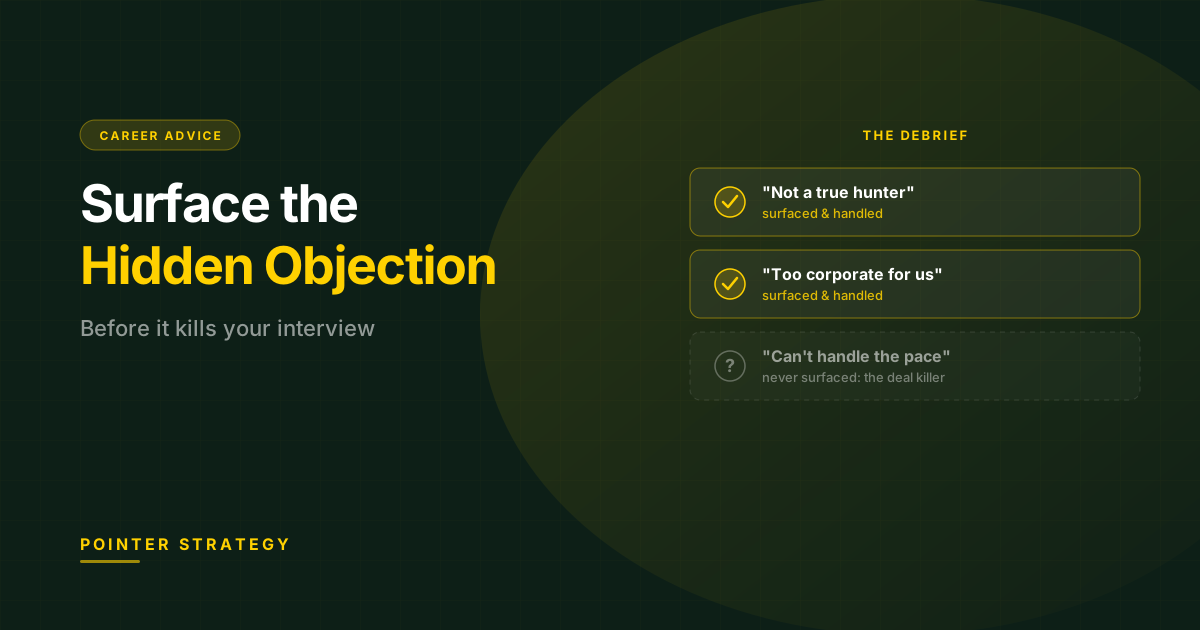
*"Really liked them, but I just got the feeling they're not a true hunter."*
*"They seem a little too corporate for our environment."*
*"I'm not sure they'd be able to handle the pace here."*
Are these concerns always valid? Not always. But they are real. And they are being formed whether you know about them or not.
The interviewer is observing everything, not just your answers, but how you answer. Do you lean in when they describe the role, or do you lean back? Do your eyes widen or glaze over? Is there a flicker of a smirk when they mention the cold calling targets, or do your lips tighten up slightly? A good interviewer is reading every signal, layering it on top of the assumption they had already started forming. This is confirmation bias in real time, and it is working against you throughout the entire conversation.
Why They Cannot Just Ask You Directly
Here is the catch. For a lot of these concerns, the interviewer *cannot* ask you about them directly. Not because it is rude, but because the question becomes meaningless the moment it is asked.
Think about it. If you are going for a new business sales role and the interviewer asks:
*"This role involves a lot of cold calling and self-generated pipeline. Are you comfortable with that?"*
What are you going to say? No? Of course not. The answer is yes, full stop. You have just told them what they already knew you would say. The question is completely redundant.
This is a particular challenge in sales hiring, because salespeople are, by nature, excellent at reading a room, crafting a narrative, and saying what needs to be said. Great storytellers. Which makes them incredibly hard to assess, and even harder to catch out on a hidden concern.
So the interviewer falls back on their intuition. They note the body language. They recall the slight hesitation when you talked about prospecting. They connect dots. And by the time you are asking about commission structure and career progression, they have already made a call.
The Problem: You Cannot Solve for Something You Do Not Know Exists
This is the sales parallel that makes total sense once you see it.
In a sales process, the deals that fall over are almost never the ones where the objection was raised and handled. They are the ones where the concern was never surfaced, where the prospect said "yeah sounds good, we'll be in touch" and then went quiet. The hidden objection is the deal killer.
Your job interview is the biggest deal of your career right now. And you are running the same risk.
You finish the conversation. You think it went well. You ask about the team culture and the OTE and the path to leadership. You shake hands and walk out. Meanwhile, the hiring manager is heading into the debrief with a nagging feeling they cannot quite articulate, and that feeling is going to make the decision.
What To Do When They Hand You the Microphone
When you get to the "do you have any questions for us?" part of the interview, most candidates treat it as an information-gathering opportunity. Do not do that. Or at least, do not *only* do that.
Before you ask about anything else, flip it back. Give them the chance to tell you where you stand. Because they might have gaps they have not filled yet. They might have concerns they have not fully formed. And you have a window right now to surface them before you walk out the door.
Here are the questions that do the job:
Yes, these take confidence to ask. That is the point.
Once the objection is on the table, you handle it like any good salesperson would. Isolate it. Understand it. Address it.
*"What made you feel like that might be the case?"*
*"Other than that, is there anything else that's giving you pause?"*
*"Can I share some context that might change that picture?"*
You cannot do any of that if you never knew the concern existed.
The Best Play: Get In Before the Bias Locks In
Everything above is good. This is better.
If you can anticipate the likely objection *before* you walk into the room, handle it upfront.
Think about it from the interviewer's perspective. They are going to build on their initial assumption across the entire conversation. Every answer you give, every pause, every piece of body language either validates or challenges the concern they formed in the first five minutes. By the time you get to the Q&A at the end, that concern has had 30 to 40 minutes of confirmation bias to harden into a conviction.
But if you surface it early, before the bias has had time to compound, you get to control the narrative. You disrupt the pattern. And you demonstrate the kind of self-awareness and confidence that immediately differentiates you.
Example: you are coming from a large corporate into an early-stage startup. You know that is going to raise eyebrows. So you bring it up yourself:
*"I want to address something upfront. I've spent the last five years in a large enterprise environment, and I know that can raise questions about whether I'd adapt to a faster, leaner setup. Here's how I think about that..."*
Now here is the thing. Even if it *was not* a concern of theirs, you have not lost anything. They will simply say it is not a concern, and in saying it out loud, they have reinforced that in their own mind. You cannot lose.
If it *was* a concern, you have just demonstrated exactly the kind of awareness and confidence that makes a great salesperson. And you have given yourself a chance to handle it before it calculates against you for the next forty minutes.
The Takeaway
Never finish an interview without surfacing the objections.
Before you go in, put yourself in the interviewer's shoes. What are the likely concerns about your candidacy? What assumptions might they form in the first few minutes? Where are the gaps in your background relative to what they are hiring for?
If you can identify them early, bring them up early.
If you cannot, make sure you surface them at the end.
Either way, do not let the hidden objection be the reason you do not get the job.
Work With a Recruiter Who Tells You the Truth
The hardest part of surfacing objections is that you are doing it blind. You are guessing at what the hiring manager is thinking. A good recruiter closes that gap, because they are in the debrief conversations you never see.
Pointer is an operator-led GTM recruitment firm. We place sales, marketing, customer success, partnerships, and revenue leadership talent with high-growth companies across Australia and New Zealand. When we represent you, we run the loop properly: we know what each hiring manager is really weighing, we surface concerns before they harden, and we coach you on the objection you did not know you had.
If you are a go-to-market professional looking for your next role, or a leader building a revenue team that performs, let's talk.