

Issue 23 of The Pointer Index · Week ending 20 September 2026
Every few weeks someone asks us how to get into sales. This week we asked the ads. We took every ANZ sales ad first seen since 20 April, 51,240 of them, and read each one for the experience it asks for: the years figure in the requirements, the phrase "no experience necessary", the word junior or graduate in the title.
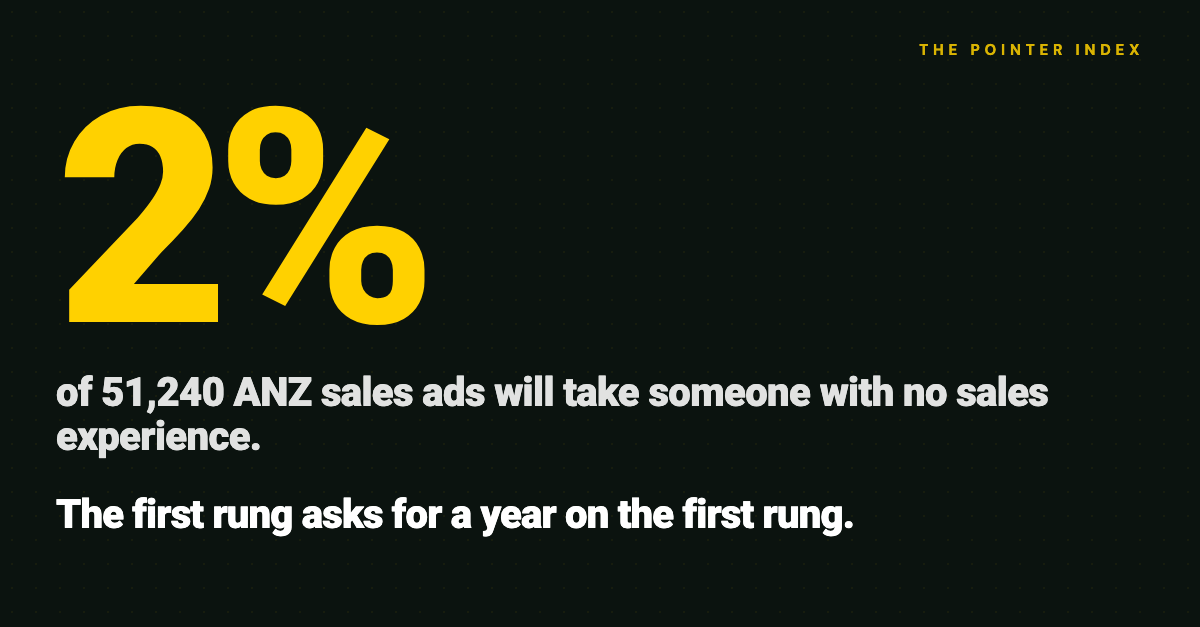
The door is 2% wide
1,014 of the 51,240 ads are open to someone with no sales experience. That is 2.0%, from 460 companies. We counted an ad as open if its title says junior, graduate, trainee or entry level (773 ads), if the text says no experience is needed (297), or if it states a requirement of zero years (63). The three overlap.
Who posts them is as telling as how few there are. The biggest posters are a graduate job marketplace, an HR outsourcer advertising on behalf of its clients, a cluster of field-marketing and fundraising outfits, and solar and insurance phone sales. Software is in there, but thin: two tech employers make the top fifteen, and one of them is an outsourced SDR provider. The classic first sales job, the one that leads somewhere, is a small part of a small number.
The open-door ads print their price more often than any other sales cohort: 300 of the 1,014 disclose a range, and the median range is $70,000 to $91,000.
The first rung asks for a year on the first rung
The SDR or BDR seat is the job the industry describes as the entry point. 2,215 ads carried that title over the window, 4.3% of all sales ads, from 846 companies.
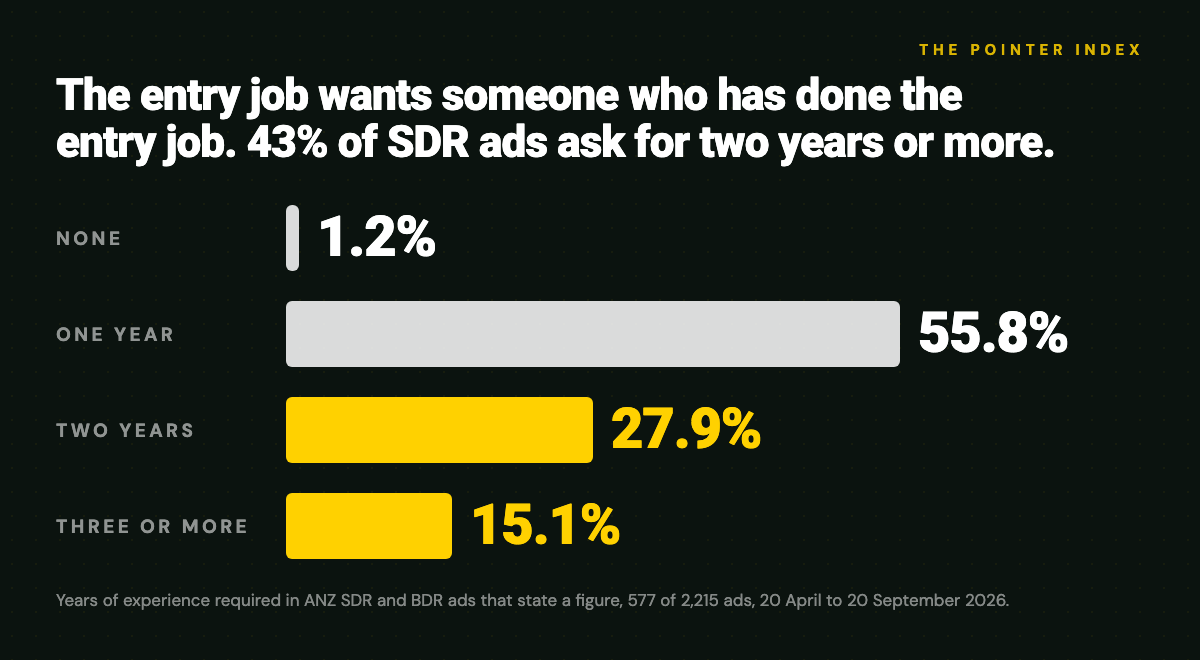
A quarter of them (577) state a years figure. Of those:
| years required | share of SDR ads stating a figure |
|---|---|
| none | 1.2% |
| one | 55.8% |
| two | 27.9% |
| three or more | 15.1% |
43% want two years or more. 1% will take none. And the year is not a year of anything: 76% of the ads that state a figure specify that it be spent in an SDR, BDR, outbound, B2B or software sales seat. The entry job wants someone who has already done the entry job.
The rest of the SDR ad says the same thing quietly. 1.9% say no experience is needed. 4.2% carry a junior title. 4.4% mention graduates at all. 13.4% mention a path to Account Executive, which is the one line a genuine entry role would lead with.
This is not new and it is not moving. Month by month across the window, the share of SDR ads asking for two years or more ran between 36% and 49% with no direction. It is a settled level.
One more thing the ads do not do: pay for the requirement. Among SDR ads that both state a figure and print a salary, the ones asking for a year or less advertise a median base of $80,000 and the ones asking for two or more advertise $79,000. Both samples are directional (49 and 63 ads), but the two numbers sit within a thousand dollars of each other. Asking for the second year does not come with a second number.
The ladder, in years
Widen the lens to every sales ad and the ladder is orderly. We grouped ads by the seniority our classifier reads from the whole ad, then took the median years figure where one is stated.
| seniority label | ads | state a figure | median years asked | ask two or more |
|---|---|---|---|---|
| entry | 8,320 | 16% | 2 | 53% |
| mid | 31,087 | 20% | 3 | 90% |
| senior | 7,507 | 34% | 5 | 98% |
| director | 2,942 | 28% | 5 | 100% |
| VP | 270 | 33% | 8 | 100% |
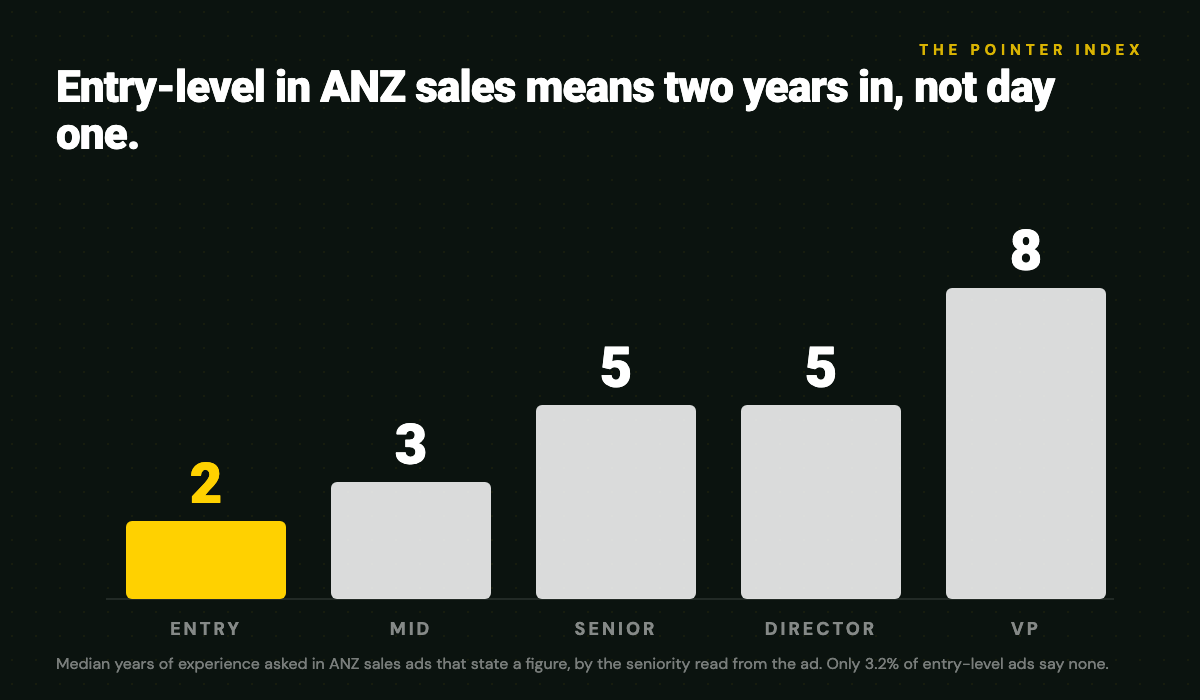
Read the entry row again. The ads that look entry-level by every other signal in the text still ask for a median of two years, and only 3.2% of them say zero. Entry-level in ANZ sales means two years in, not day one.
The Account Executive ad, for comparison, states a figure 49% of the time and asks for a median of four years. So the published path is: two years to be entry-level, four to close. The step nobody advertises is the one from zero to two.
If you are hiring: if your SDR ad asks for a year of SDR experience, you are recruiting from the 4.3% of the market that already holds the seat, and paying the same base as the ads that do not ask. If you can train, say so in the title. Only 4.2% of your competitors do.
If you are trying to get in: the ads that will take you are 2% of the boards and mostly not in software. The route that works is the one the ads do not print: a year in any role the requirement sentence recognises, customer-facing, target-driven, phone-heavy, then apply to the 56% of SDR ads that ask for one.
The numbers this week
The active ANZ pool closed at 6,411 GTM roles, down 267 on the week, with 4,786 opened and 4,964 closed. A 4.0% weekly move is the median for this series, so there is nothing to script in it. Median advertised base: $100,000 on 1,011 disclosing ads, quartiles $82,500 to $127,735, transparency 16.1%. Sales is 2,706 of the active pool, marketing 1,563, account management 888.
Singapore's pool closed at 828 tracked GTM roles, 673 opened, 963 closed.
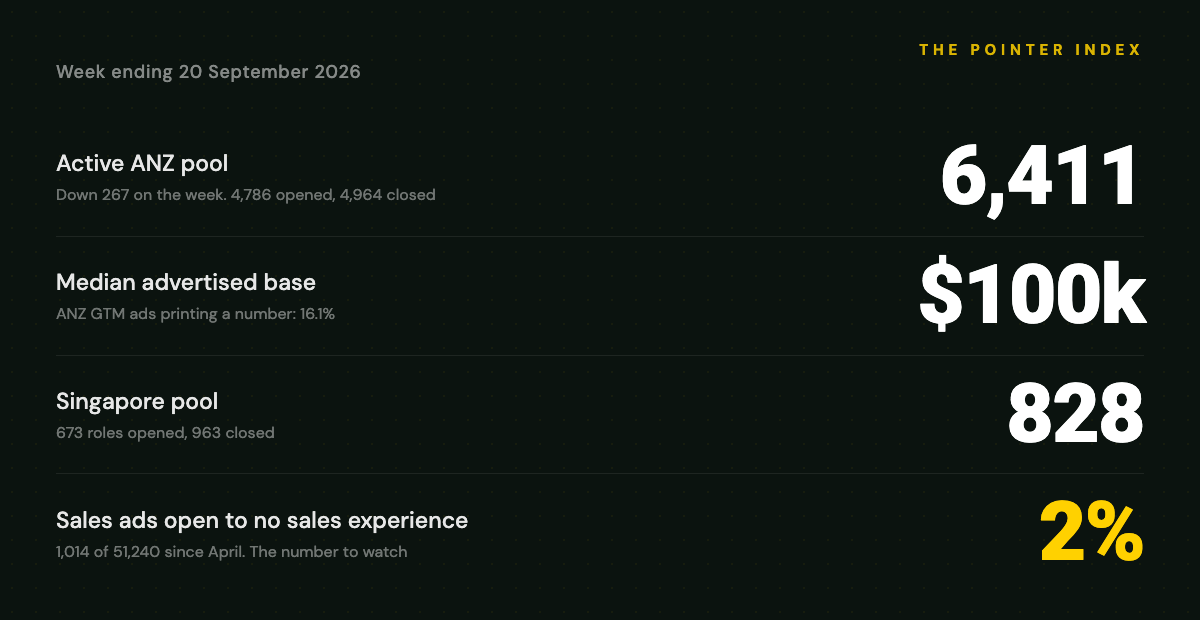
The number to watch: 2%. The share of ANZ sales ads open to someone with no sales experience. It only rises if employers start writing the word train into the title.
Ricky Pearl, Pointer Strategy
pointerstrategy.com/market-data
<small>
*Methodology.* "GTM" means Sales, Account Management, Marketing, CS, Presales, RevOps, Enablement, Partnerships, Growth, PMM, and GTM Engineering. Numbers come from live ANZ job listings scraped from public records. Recruitment agency listings are excluded from market-index figures. Market-index figures are point-in-time snapshots at the close of the reporting week, recorded in an insert-only weekly index that is never recomputed. The live dashboard updates continuously and may differ slightly.
*On the experience analysis.* Every ANZ sales-function ad first seen between 20 April and 20 September 2026 with a readable description: 51,240 ads. The years figure is read from the ad text by a fixed pattern (a number, a range or a plus, followed by years and a requirement phrase such as experience, background, track record or "in a sales role"), with spelled-out numbers one to six converted. Where an ad states more than one figure we keep the lowest. Figures above twelve years, and figures preceded by company-history phrasing ("over 30 years", "the past 10 years"), are discarded as describing the employer rather than the candidate. 11,419 ads (22.3%) state a figure by this reading; the shares reported for each cohort are shares of ads that state one, and the ads that do not are treated as silent, not as zero. Cohorts are title-text matches on word boundaries: junior, graduate, trainee, entry level (773 ads); SDR, BDR, sales development representative, business development representative, excluding manager, lead, head, senior and team titles (2,215 ads); Account Executive (4,256); Business Development Manager (10,196). The "no experience" flag matches "no [prior/previous/sales] experience [required/necessary/needed]" and "no experience" as a standalone phrase. "Prior SDR experience" means the requirement sentence names SDR, BDR, sales development, outbound, prospecting, lead generation, cold calling, SaaS, software sales or B2B within 80 characters of the years figure. The seniority ladder uses the seniority our classifier assigns from the whole ad and is a cross-section, not a trend: we do not publish direction claims on classifier seniority. Pay figures are advertised AUD bands from disclosing ads; the SDR pay-by-requirement comparison rests on 49 and 63 ads and is directional. Agency-posted ads are retained in every cohort (8.9% of SDR ads, 7.6% of open-door ads). The description of who posts open-door ads is drawn from the fifteen employers with the most such ads; candidate marketplaces and HR outsourcers post on behalf of unnamed clients and are counted under their own names.
*On the weekly figures.* Salary medians are advertised AUD bands from disclosing listings (16.1% disclosure): levels, not a movement claim, which is why repricing is only assessed quarterly. The median absolute week-on-week move in the active pool since 8 June 2026 is 4.6%, range 0.3% to 21.2%. Pool readings are like-for-like Sunday snapshots. Last week's backfilled listings have aged out of the pool on the normal schedule, so this week's comparison is clean. Singapore is tracked as a separate stats-only region and is never pooled with ANZ.
*Corrections.* If a number looks wrong, reply to the newsletter or contact us. Corrections run in the next issue.
</small>