

Issue 19 of The Pointer Index · Week ending 23 August 2026
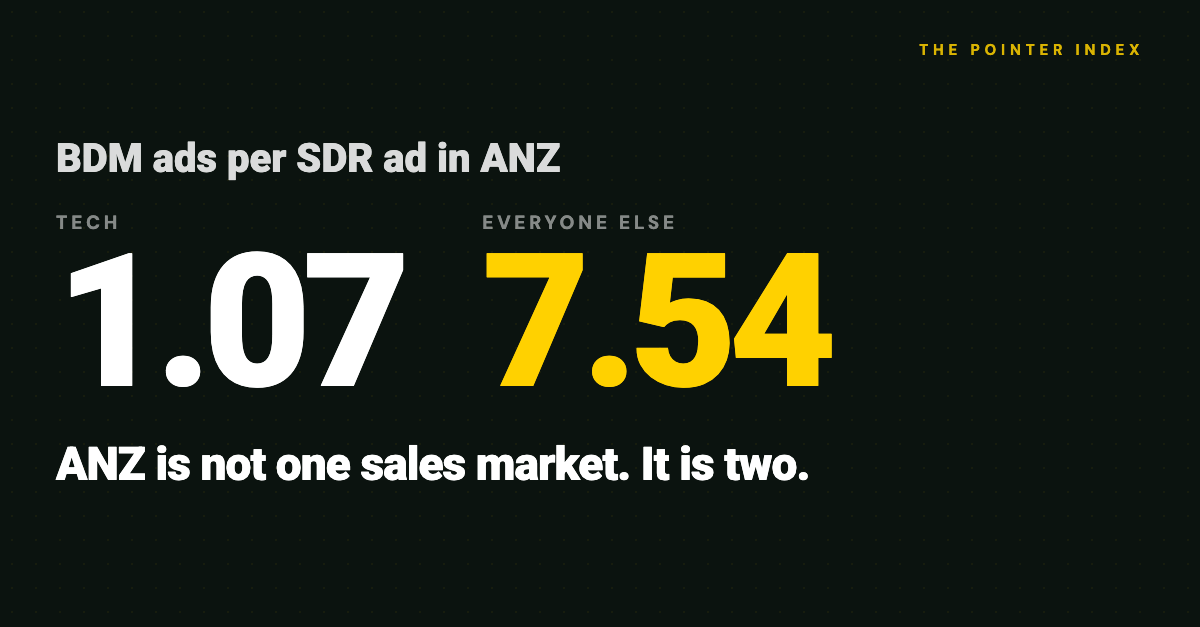
ANZ is not one sales market. It is two, and the average between them describes neither.
Only Tech embraced the SDR
The obvious cut of this data says ANZ never bought the two-stage sales model. Employers posted 4.3 Business Development Manager ads for every SDR or BDR ad. That number is real. It is also an average of two markets that behave nothing alike.
Split the same ads by industry. In tech, the two-stage model is running normally: 1.07 BDM ads per SDR ad, and 2.15 AE ads per SDR. Book the meeting, hand it over, close it.
Outside tech the model barely exists: 7.54 BDM ads per SDR ad. Non-tech ANZ did not reject the SDR-to-AE ladder. It never considered it.
The two worlds barely share titles. Tech posts 54.4% of AE ads and 45.7% of SDR ads, but only 10.6% of BDM ads. The BDM market is roughly 89% non-tech, and BDM itself is a cross-sector catch-all spanning software, insurance, industrial and property. One caveat: industry is unknown for about 10.5% of sales ads, mostly career-site listings.
The aggregate for tech is 2.15 AE roles per SDR/BDR role.
The company-level count says the same thing. 1,060 companies advertised an AE in the window, 821 advertised an SDR or BDR, and only 219 advertised both, a floor rather than a measurement, since an eighteen-week hiring window shows hiring, not existing headcount.
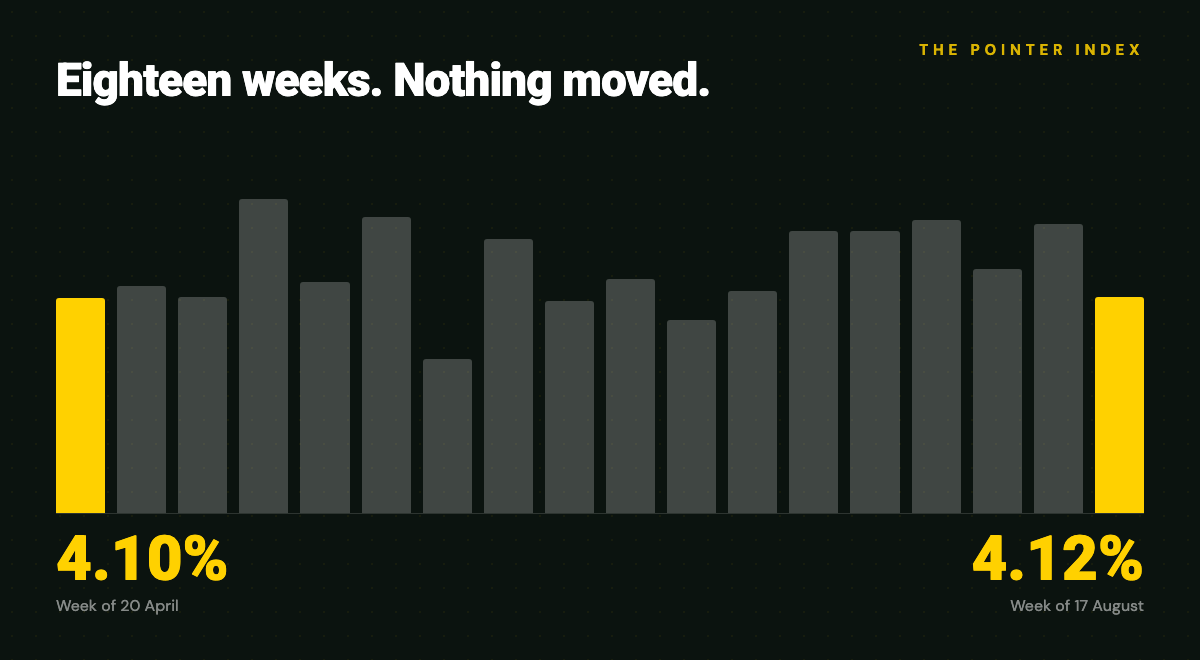
And neither world is converting to the other. SDR/BDR ads were 4.10% of new ANZ sales ads in week one and 4.12% in week eighteen, ranging 2.94% to 6.00% with no trend, on a typical week of 86 to 153 ads. Two settled markets, holding their shape.
Who actually posts SDR ads
The 1,965 SDR/BDR ads came from 821 companies. 454 of them posted exactly one, 612 posted one or two, and recruitment agencies placed just 8.3%. The ten biggest employers, with agencies and candidate marketplaces stripped out because neither is building a team of its own:
| employer | ads |
|---|---|
| Employment Hero | 59 |
| Remote | 35 |
| Metcash | 33 |
| Martian Logic | 31 |
| Sitemate | 21 |
| Deel | 20 |
| Nearmap | 15 |
| Salesforce | 14 |
| HiBob | 13 |
| Stripe | 12 |
Nine of the ten are tech companies. The exception is Metcash, a grocery wholesaler, and its ads read differently: the brief is managing key customers and developing new business across FMCG and foodservice. That is a territory seat, not a pipeline seat feeding a closer. The two-market split shows up in the names.
And the biggest of them, Employment Hero at 59 ads across eighteen weeks, is roughly three a week from one company, which reads like churn or backfill rather than growth. Nobody is standing up benches. The seat gets bought one at a time, when it empties.
If you are weighing up the model: the question is no longer whether ANZ buys it. It is which market you sell in. In tech, running SDRs is the standard play. Outside tech you would be an outlier, which is not the same as wrong: almost nobody else in your industry is competing for those candidates.
The junior role prints its price
The cheapest title on the sales boards is the only one that tells you what it pays. SDR/BDR ads disclose pay 25.3% of the time, at a median base of $75,000 and a $90,000 top of range. Account Executive ads, 3,633 of them, disclose 11.8% of the time, which means the AE market hides its number in roughly nine ads out of ten. BDM sits between at 22.8%, Account Manager at 19.0%.
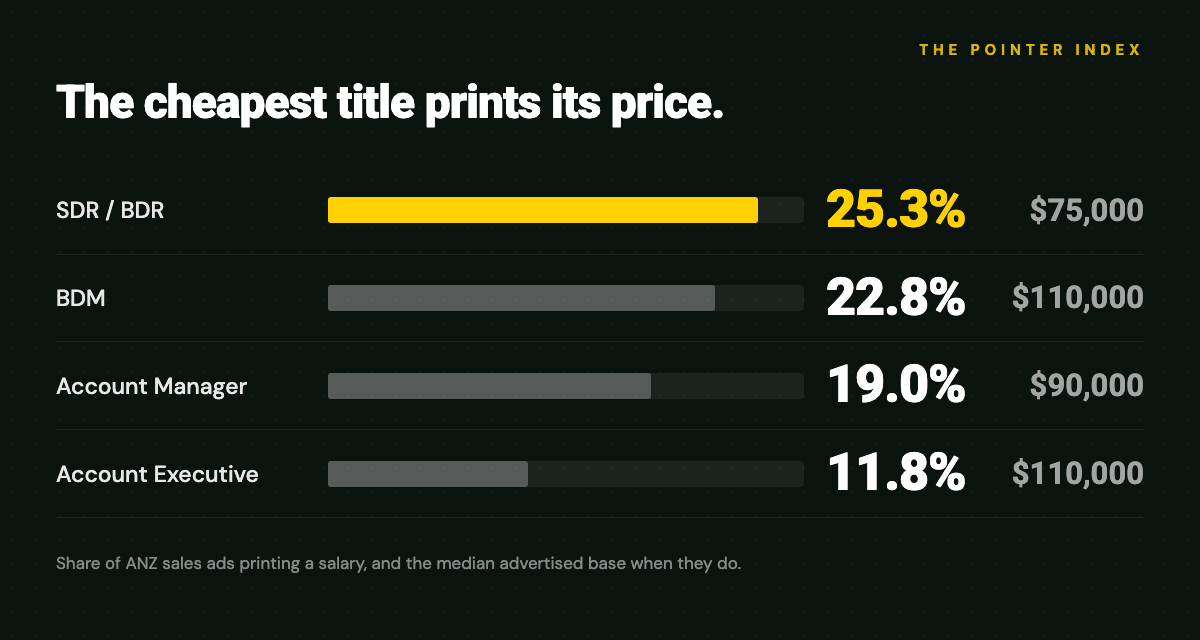
Employers print the price when it is a filter and hide it when it is a negotiation. At $75,000 the number's job is to screen: it tells anyone who needs more not to apply, for free, before a CV lands. At AE level the number is the negotiation itself, so it stays off the page. Same boards, same employers, opposite behaviour.
If you benchmark: $75,000 base, $90,000 top, printed on 498 of 1,965 ads. The cleanest advertised price in ANZ sales.
The numbers this week
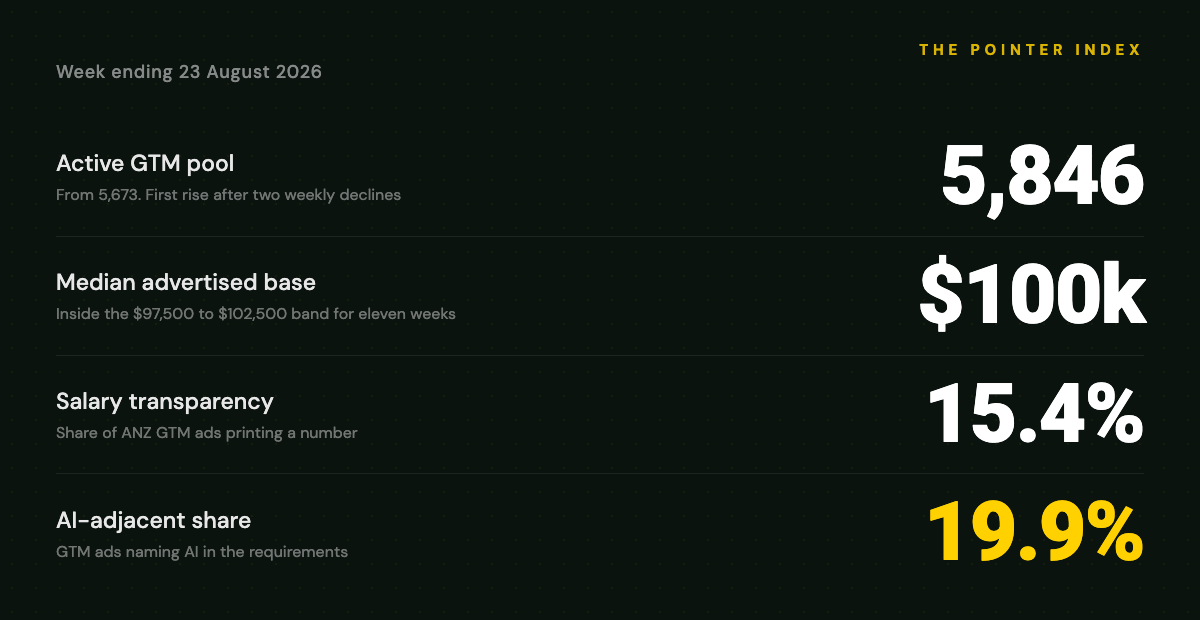
Last week's number to watch was 5,673: a third straight weekly decline in the active pool would have been the first since April. It did not happen. The pool rose 173 to 5,846. Median advertised base sits at $100,000, inside the $97,500 to $102,500 band it has held for eleven straight weeks, a level rather than a move. Salary transparency: 15.36% of ads.
One number to watch
4.3 to one. The all-market ratio of BDM ads to SDR/BDR ads. It is a blend of a 1.07 world and a 7.54 world, which is exactly why it is worth watching: it only falls if the non-tech world starts buying SDRs.