

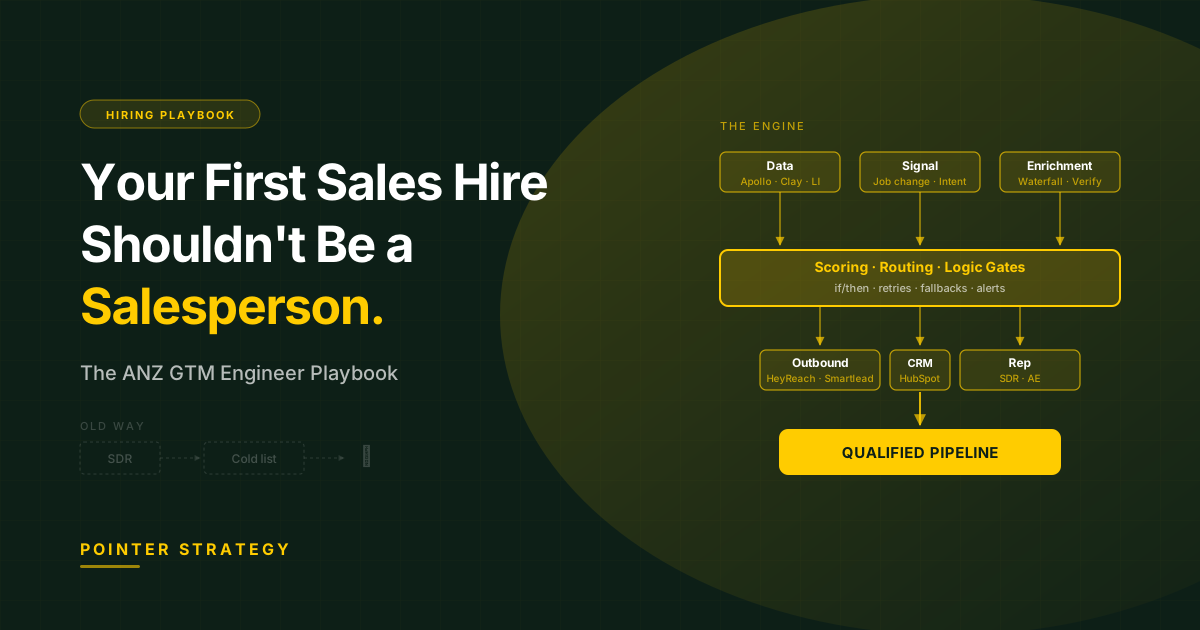
The default first sales hire in ANZ is still an SDR. In 2026, it's also the most expensive mistake a founder can make. The SDR will sit there, fully ramped, watching their inbox not reply, while the founder watches the burn and wonders why the pipeline never showed up.
The problem isn't the SDR. The problem is that cold outbound, as a motion, no longer works on its own. Spam filters got smarter. LinkedIn tightened its limits. Buyers triaged their inboxes. The volume game became unviable two years ago and most ANZ founders are still hiring as if it weren't.
What works in 2026 is a growth engine: data, signal, infrastructure, and orchestration, built before a single rep starts dialling. The person who builds it is not a salesperson. They are a GTM engineer. And they should almost always be your first revenue hire, not your tenth.
This guide is for ANZ founders, RevOps leaders, and CROs deciding what to hire next. It covers what a GTM engineer actually does, the five-role pod that delivers pipeline at scale, the four skills that separate architects from operators, the red flags to screen out, ANZ comp benchmarks, and the sequence we recommend at Pointer.
Why SDRs Don't Work Without the Right Data
The textbook outbound playbook from 2019 looked like this: buy a list, write a sequence, hire a rep, hit send. By 2024 it was already broken. By 2026 it's an active liability.
Three things changed.
Inboxes got harder. Microsoft and Google rolled out stricter sender authentication and behavioural filtering. Sending 200 cold emails a day from a primary domain is now a fast way to torch your domain reputation and tank your transactional email at the same time.
Buyers triaged. The average ANZ tech buyer receives somewhere between 40 and 90 cold messages a week across email and LinkedIn. The ones that get a response are personalised, signal-led, and arrive at a moment of intent. The ones that don't, look like everyone else's.
The data layer fragmented. No single provider has accurate ANZ contact data anymore. Apollo, ZoomInfo, Cognism, RocketReach, Lusha, ContactOut: each one is wrong about a different subset of the market. Hitting any single one of them as your source of truth produces garbage at the top of the funnel and bad meetings at the bottom.
The implication is that the rep is no longer the bottleneck. The data, the signal, and the infrastructure are. Hiring an SDR to "do outbound" before that layer exists is like hiring a driver before you've built the car.
What a GTM Engineer Actually Is
A GTM engineer is the person who builds the car. They sit between the data world (Apollo, Clay, LinkedIn Sales Navigator, web scrapers, intent providers) and the activation world (HubSpot or Salesforce, HeyReach, Smartlead, Instantly, n8n, Slack). Their job is to make those two worlds talk to each other reliably enough that a rep can pick up the phone and call someone who actually wants to buy.
The role is not new. RevOps has done parts of it for years. What's new is the volume of tooling, the sophistication of signal, and the fact that the work is now too technical for a generalist marketer and too sales-shaped for a pure data engineer. It needs its own seat.
There is a critical distinction inside the role that almost everyone gets wrong.
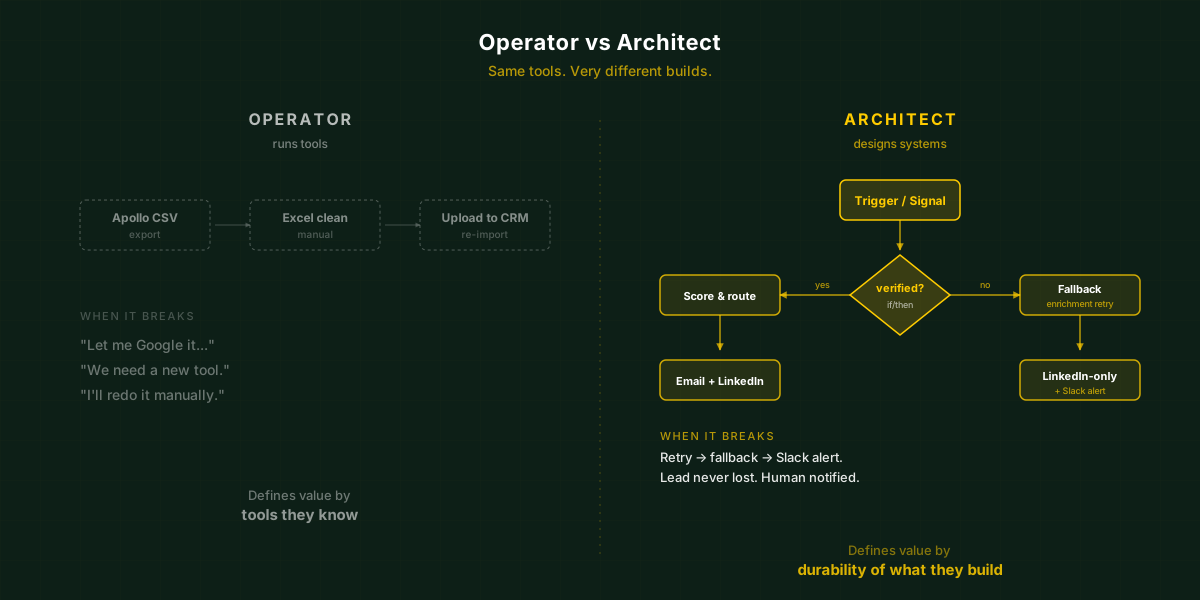
Operators run tools. They've done a Clay course, they can build a table, they know how to push a list to HubSpot. When something breaks, they Google it. When the API changes, they're stuck. They define their value by the software they know.
Architects design systems. They think in logic gates, error states, and fail-safes. They know that when LinkedIn returns a 429, the workflow needs to retry, alert Slack, and route the lead somewhere else. They define their value by the durability and economics of what they build.
The market is full of operators dressed as architects. Three months of Clay in a screenshot folder is not seniority. The screening section below covers how to tell them apart in 30 minutes.
The Five-Role GTM Pod
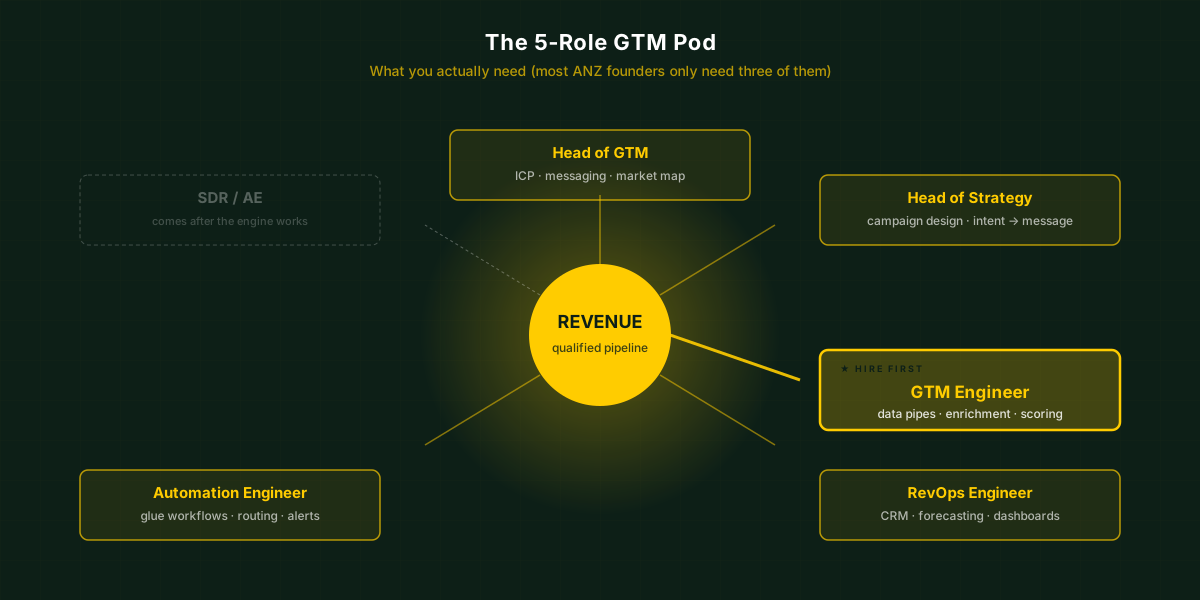
One person cannot run a modern GTM stack. The role has fragmented into five seats. Most ANZ companies don't need all five at once, but founders need to know what each does so they can hire the right one first and not duplicate later.
| Role | Owns | First hire when |
|---|---|---|
| Head of GTM | ICP, messaging, market map | Pre-PMF or post-Series A |
| Head of Strategy | Campaign design, intent-to-message | Once you have 2+ revenue motions |
| RevOps Engineer | CRM, forecasting, dashboards | Once you have 3+ AEs |
| GTM Engineer | Data pipes, enrichment, scraping, scoring | Before your first SDR |
| Automation Engineer | Glue workflows (n8n, Make), routing, alerts | Once volume exceeds manual triage |
Head of GTM owns the revenue narrative. Who do we sell to, why, and how. This is usually the founder until you raise.
Head of Strategy turns intent into messaging. They take a signal (job change, funding round, hiring spike, tech stack shift) and design the campaign that lands. Often a senior marketer with sales empathy.
RevOps Engineer owns the CRM as a system of record. Pipeline hygiene, forecasting, attribution, dashboards. The highway, in HeyReach's framing.
GTM Engineer owns the data pipes and the activation layer. Waterfall enrichment, intent scoring, account scoring, deduplication, the connection between Clay and the CRM, the connection between the CRM and the outbound tool. This is the role this guide is about.
Automation Engineer owns the boring glue. The Slack alerts when a champion changes companies, the n8n flow that updates a lead score when someone visits the pricing page twice, the Make scenario that pushes a Calendly booking into the right pipeline stage. Often the same person as the GTM engineer in a small company.
For most ANZ founders below 5M ARR, the right first hire is a single person who covers the GTM engineer and automation engineer seats. The Head of GTM is you. RevOps comes later. Head of Strategy can be a fractional or an agency until volume justifies in-house.
The Four Skills That Separate Architects from Operators
When you're interviewing, four competencies tell you whether the candidate is an architect or an operator. Test all four. Don't accept tool screenshots as evidence of any of them.
1. Visual Workflow Planning
The first sign of an architect is that they can draw their last build on a whiteboard from memory, with the data path, the logic gates, and the failure modes labelled.
Sniff test: "Walk me through your most recent end-to-end build. Use a whiteboard or Figma. I want to see where the data lives, how it routes, and what happens when something breaks."
What good looks like: They draw boxes for each system (Clay, HubSpot, HeyReach), arrows for data movement, diamonds for if/then logic, and red lines for error states. They volunteer trade-offs without being asked. They can answer "what happens if Clay rate limits you" without flinching.
Red flag: They open a Loom and walk you through their Clay table.
2. Business Acumen
GTM engineering is not a craft skill. It's a revenue function. Architects know the unit economics of what they build. Operators know the open rate.
Sniff test: "Your last campaign got a 12% reply rate but zero booked meetings. What's the next call you make and why?"
What good looks like: They talk about ICP misalignment, message-to-pain mismatch, the gap between curiosity replies and qualified replies, and the cost-per-meeting math. They name the specific cohort they'd cut. They mention the AE feedback loop.
Red flag: They suggest A/B testing the subject line.
3. Email and LinkedIn Deliverability
This is the highest-leverage technical skill in the role and the one most candidates fake.
Sniff test: "We need to scale fast. Should we buy 50 domains and start sending tomorrow?"
What good looks like: A flat no, followed by a 90-second explanation of DKIM, SPF, DMARC, sender warmup curves, subdomain strategy, ESP diversification, sender rotation, and the reality that 50 domains hot off the rack will all land in spam by week two. For LinkedIn, they should mention multi-profile distribution to stay under Commercial Use limits and avoid behavioural flags.
Red flag: They say yes, or they don't mention DKIM, SPF, and DMARC inside the first answer.
4. The 2026 Toolbox
Tool fluency matters, but only as orchestration, not as usage. Anyone can drive a single tool. The job is to make tools work together.
What you want to hear:
Red flag: They list tools as a CV skill rather than describing how they connect.
Five Red Flags in GTM Engineering Interviews
If any of these show up in the first 30 minutes, end the interview. None of them improve with onboarding.
Red flag 1: Tool-first vocabulary. Their first response to any problem is "I'd buy a tool for that." In 2026, tools are commoditised. The skill is in connecting them. A candidate who reaches for a credit card when something breaks will burn your stack faster than they build it.
Red flag 2: CSV porter mentality. "I export to CSV, clean it in Excel, and re-upload." This is a 2018 workflow. It's manual, it's lossy, it doesn't scale, and it tells you the person has never built a persistent pipe between two systems.
Red flag 3: No questions about deliverability or domain reputation. A real architect will ask about your sending domain, your warmup status, your current inbox placement, and your CRM hygiene before they propose a single campaign. A hustler will propose 1,000 sends a day from your primary domain.
Red flag 4: Zero error-handling logic. Ask "what happens if your LinkedIn automation returns a 429" or "what happens if n8n fails halfway through a webhook." If the answer is a blank stare, they've never run anything in production.
Red flag 5: Prompts without data cleaning. Modern outbound leans on LLMs for personalisation. Operators show you a 500-word prompt and a screenshot of a clever first line. Architects talk about regex, normalisation, fallback logic, and how they handle "GOOGLE CLOUD SERVICES PTY LTD" before it goes near an LLM.
ANZ GTM Engineer Salary Benchmarks (2026)
ANZ comp for this role is about 15 to 25% below US, slightly above UK, and significantly above EU. The biggest gap is at the senior end, where ANZ's smaller talent pool drives a premium for proven architects.
| Tier | Years equivalent | Base (AUD) | OTE if commissioned | Notes |
|---|---|---|---|---|
| Junior operator | 1 to 2 | $90K to $120K | $100K to $135K | Tool-fluent, learning architecture |
| Senior operator | 2 to 4 | $120K to $150K | $135K to $170K | Independent on builds, weak on systems thinking |
| GTM Engineer | 3 to 6 | $150K to $190K | $170K to $215K | Architect-grade, owns the data layer end to end |
| Senior GTM Engineer | 5+ | $190K to $250K+ | $220K to $290K+ | Sets stack strategy, mentors others, often in a Head of GTM Eng or RevOps Eng title |
Sydney premium: add 8 to 12% on base for Sydney-based hires versus Melbourne, Brisbane, or remote.
Equity: at Series A and B companies, expect 0.1% to 0.4% for an early architect-grade hire, vesting on the standard four-year cliff.
Contract rates: $180 to $350 per hour for fractional or project-based GTM engineering work. Most ANZ founders should start here before committing to a full-time hire.
A note on seniority. The market is full of two-year operators asking for senior architect comp because they have a Clay certification. The differentiator is not certifications. It's whether the systems they've built still work without them. Ask the question. Architects can answer it.
For a deeper read on adjacent roles, see our Account Executive salary benchmarks, BDR comp guide, and the monthly Pointer Index for the wider ANZ GTM hiring picture.
When to Make the Hire: Sequence by Company Stage
The single biggest mistake ANZ founders make is hiring an SDR before the GTM engineer. The second biggest is hiring no one and trying to do it themselves on top of a CEO job.
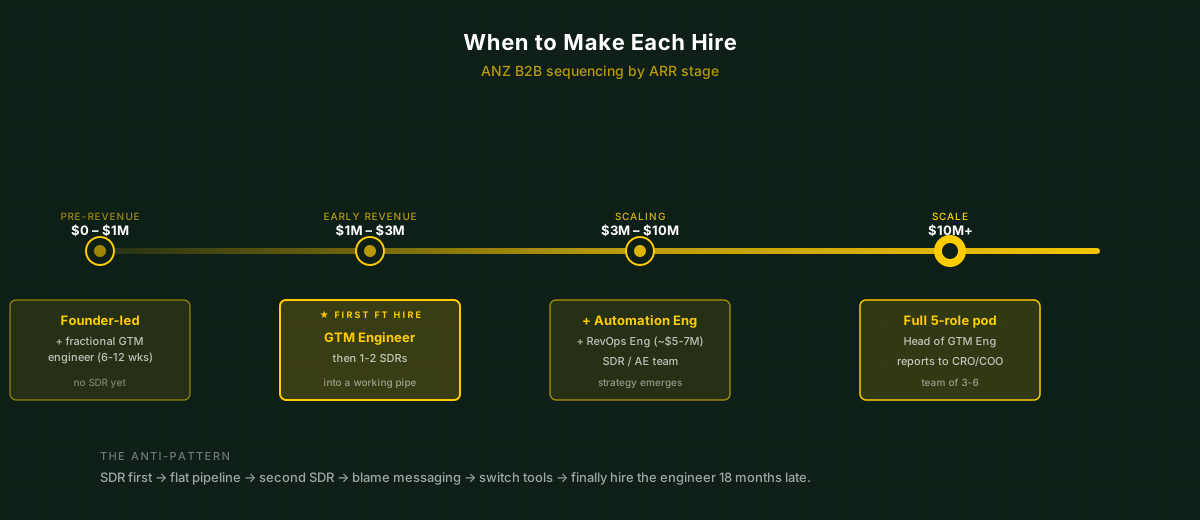
Pre-revenue to $1M ARR: founder-led sales, fractional GTM engineer or agency for the data and infrastructure work. Don't hire a full-time SDR. Don't hire a full-time GTM engineer either. Buy 6 to 12 weeks of contract architecture work to set up the foundations.
$1M to $3M ARR: first full-time GTM engineer. They own data, signal, infrastructure, and outbound orchestration. You can now hire one or two SDRs against the system they've built, knowing each rep is firing into a pipe that actually delivers qualified intent.
$3M to $10M ARR: GTM engineer plus dedicated automation engineer (or split inside one team). RevOps engineer comes in around $5M to $7M ARR to own the CRM as a system of record. Head of Strategy emerges, often promoted from inside.
$10M+ ARR: the full five-role pod, with a Head of GTM Engineering reporting to the CRO or COO.
The pattern that does not work: hiring SDRs first, watching them miss quota for two quarters, hiring a second SDR to compensate, blaming the messaging, hiring a marketer, blaming the tool, switching from Outreach to Salesloft to Apollo, and finally, eighteen months and $400K later, hiring the GTM engineer you should have hired on day one.
The Live Build: Three Whiteboard Challenges
A 30-minute live build during the interview is non-negotiable. These three challenges separate architects from operators with high confidence.
Challenge 1: The Waterfall. "Your primary email enrichment provider just went down. Walk me through how your build handles it." A good answer involves named fallbacks, cost-per-record awareness, a circuit breaker, and a Slack alert to the human on call.
Challenge 2: The Half-Failed Webhook. "Your n8n workflow takes a new lead from the website, enriches it, scores it, pushes to HubSpot, and sends a Slack alert. What happens if the enrichment step fails halfway through?" Good answers involve idempotency, retry logic, partial-state handling, and a fallback path that doesn't lose the lead.
Challenge 3: Job Change Signal to Action. "A high-value contact in your CRM just changed jobs. Design the workflow." A junior operator will say "send a congratulations email." An architect will design a flow that marks the old contact as left, finds and validates the new email, looks up who replaced them at the old account, opens two parallel pipelines, and alerts the AE owner with full context. They'll also mention how often the signal source is wrong and how they'd verify before acting.
If a candidate clears all three with diagrams and trade-offs, hire them. Don't make them do a take-home. Don't drag the loop out across four weeks. Architects in ANZ have options.
Hire the Engine, Not Just the Rep
Pointer places GTM engineering, sales, customer success, and revenue leadership talent across ANZ. We see the consequences of bad sequencing every week: founders who hired three SDRs and wonder why pipeline is flat, RevOps managers stitched together from misfit AEs, growth motions that stall the moment the founder steps off the phone.
The fix is almost always the same. Build the engine, then hire the operators. Hire the architect before the rep. Get the data, the signal, and the infrastructure right, and the rest of the GTM org compounds.
If you're sequencing your first or next GTM hire, or you've already hired the wrong way around and need to course-correct, book a discovery call. We'll map your current stack, your stage, and what to hire next.
For broader sales hiring context, see our guides on hiring AEs in Australia, the cost of a bad sales hire, and how to hire salespeople in Australia. For ongoing market intelligence, the Pointer Index ships weekly.