

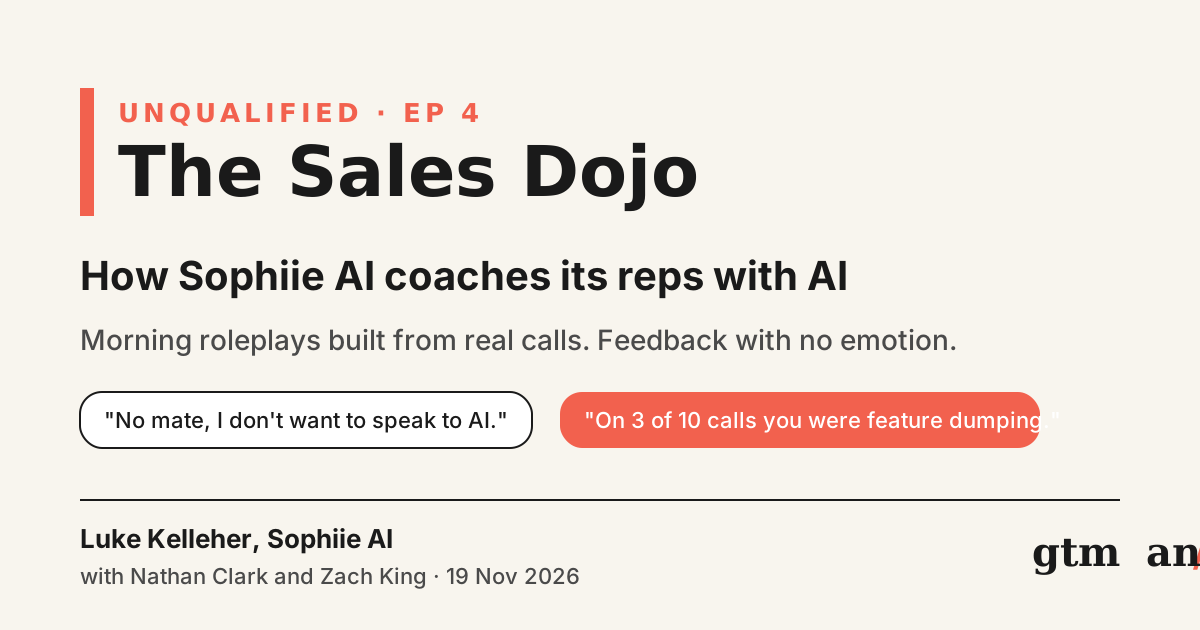
This is a recording of Unqualified, the weekly live show from the GTM ANZ Community. Ricky was away this week, so Nathan Clark (Enablement Practice Lead, Pointer Strategy, and Founder, Upright Revenue) hosted with Zach King (Founder, Founder Works HQ) on the AI update. Our guest was Luke Kelleher, co-founder and COO of Sophiie AI, dialling in from San Francisco.
Luke Kelleher on Building a Sales Team That Trains Against an AI
Sophiie is an AI office for trade businesses. It answers the calls, writes the quotes and invoices, chases the follow-ups and runs the marketing, from the first enquiry through to the final invoice and the follow-up after the job.
It started with a problem Luke and his co-founders kept hitting in an earlier business. They generated leads for tradies, and the tradies didn't answer the phone.
"They're really great when it comes to being on the tools. However, when it comes to any of the admin side, they're not very good. So we could generate the leads for the businesses. They weren't very good at picking up the phone."
The only fixes were offshoring the phones or hiring someone full time. Sophiie is the third option.
Most people still think ChatGPT is a search engine
Luke's first point was a reality check for anyone in the GTM ANZ bubble. Inside it, the world feels like it's changing every week. Outside it, most people Luke talks to use ChatGPT as a search tool. One told him it found three great restaurants.
"I don't think people quite understand how limitless this world is."
Luke doesn't come from a technical background. His career has been sales, marketing and "getting on the horn". He has still built his sales team's coaching tools himself.
The dojo
Every morning before they start calling, Luke's reps do roleplays against an AI voice agent built with ElevenLabs. It's called the dojo.
The objections come from data. Luke's transcription tools read the team's real calls and give each rep a dashboard of the ten main reasons prospects are objecting. In the dojo, the agent says things like *"No mate, I don't want to speak to AI"* or *"my customers don't want to hear that"*.
Why this matters: most roleplay is a manager pretending to be a buyer, working from memory. This one is built from the team's own calls.
Coaching without the emotion
Agents also send each rep a daily update: leads generated, where they fell short, and notes from their calls. A typical one might say that on three of ten calls, the rep was feature dumping before they'd found the pain.
"There's no emotion involved. I don't need to go to the team and say, hey, you're feature dumping, and they can't go, well, it's because of this and this and this. It's like, here's the stats. Here's the data. Here's what happened, and now we can do something better."
Luke trained the coaching agent on elite Australian B2B SaaS phone salespeople, using frameworks from a sales-training business he'd worked with before, plus Sophiie's own product documentation. That runs on a constant loop, because the team ships product updates all the time.
Reps can also ask product questions in a Slack channel called Sophiie brain. *What happens if the customer links up their Xero?* They get an answer in the moment.
How he got reps to trust it
People resist change at the best of times, Luke said. So he doesn't pitch it as "you're doing it wrong". He pitches it as compounding:
"If we learn 1% every single day, and we're 1% better every day, that compounds over time. And at the end of the day, it's designed to help you sell more, which is going to give you more money."
The turning point came when the AI's coaching started showing up in revenue. Luke would hear reps use lines the agent had taught them, and those lines converted.
"Once they've been able to see the results from the training and they're like, oh, this has actually made me money. Okay. Now I trust the guy."
Zach's version: salespeople are simple. Show me the incentive and I'll show you the action. The best operators he's worked with were "animals for feedback", because feedback turns into commission.
The leaderboard on the wall
Luke also put the numbers on a TV at the back of the office: talk time, sales, leads, demos booked, average demo length.
"I'm watching my team. They're like, I'm not letting Dale beat me. And I'm like, this is fantastic. Just keep going."
Nobody wants to sit at the bottom of the board consistently. Luke's reps look at who's behind them and think: I'd better pick up my dials.
Selling to tradies in the US
Luke was speaking from the Antler office in San Francisco, partway through a US trip. Some of what he's learned:
The three-minute phone menu
His sharpest US observation: whoever he calls, it seems to take about three minutes to get through the phone menu before you reach "press 1 for sales". He isn't sure that's the norm, but the problem is real.
Someone with a leaking pipe doesn't want to wait three minutes. Luke is sure plenty hang up and call the second or third business on the list.
Zach asked whether that means changing the product or changing the message. Luke: not necessarily a product change, but definitely a messaging change. Show a business its average wait time and ask whether it wants that gone.
The takeaway for GTM teams going offshore: in Sophiie's case, the same product meets a different pain in the US, and the messaging has to change to match.
Nathan's sign-off on the team: "It's not just AI. That's just the surface level symptom of what is really going on in that business, which is just full steam ahead." (He mentioned he's worked with Sophiie before, but isn't working with them now.)
Also on the Show
ChatGPT for sales: new, or just easier to install?
OpenAI has rounded up around 30 partner plugins for sales in ChatGPT: Salesforce, HubSpot, Gong, Clay, Apollo, Outreach, Granola, Close and others, switched on by an admin. Nathan's view was that it's being billed as a new capability when it mostly makes existing connectors easier to install. Zach: if you're starting from zero, it's a good place to start.
Founders are coming back
Brian Halligan is back as HubSpot CEO, replacing Yamini Rangan, and HubSpot is calling it a refounding. The day after, Deputy's co-founders Ashik Ahmed and Steve Shelley returned as interim CEOs. Nathan's read on both: seat-priced, pre-AI software companies are under pressure, and you can't bring in a professional manager and call it a refounding. He quoted Jason Lemkin's post: "A hired CEO does not get to refound the company. A founder does."
Zach's bigger point was about CRMs in general. They made their margin on modules: want to do that, buy an upgrade, and upgrade the whole team. He thinks that model is going away. You still need a source of truth, but CRMs will look more like a database, with your AI of choice doing the work on top.
Check your commission contract
A former NextDC enterprise account manager has gone to the Federal Court alleging his commissions on five deals were underpaid. The figures reported have been revised down since, and none of it has been tested in court yet. Nathan's advice, whichever side of the table you're on: make sure the contract is tight and everyone understands what does and doesn't get paid, especially when a windfall clause is involved.
The AI update
Prospect with something you built for them
Nathan thinks this changes prospecting. Instead of asking whether you can send something, you send a finished artifact: the people you found in Firmable, what you scraped on their competitors, your analysis, and a short video on how you'd approach it.
"It's like, yeah, I'll take that meeting."
Zach added a survey figure showing that only a small share of Australian SMEs spend money directly on AI. Nathan's point: in marketing and sales, the edge has always come from windows that don't last, like underpriced Google Ads and underpriced social. AI tools are that window now.
Key Takeaways
Your Speakers
Luke Kelleher is co-founder and COO of Sophiie AI, the AI office for trade businesses that answers calls, books jobs and runs the admin from first enquiry to final invoice.
Nathan Clark is the Enablement Practice Lead at Pointer Strategy and Founder of Upright Revenue, where he works with founders and GTM leaders to turn revenue uncertainty into repeatable performance.
Zach King is the Founder of Founder Works HQ and brings the AI update to Unqualified.
Full Transcript
Auto-generated and lightly edited for readability. Speaker labels were assigned by ear and may slip at turn changes. One news segment and the funding round list have been removed.
Zach King: And we are live.
Nathan Clark: We are live. Ricky, you look different today.
Zach King: I've shaved. Yeah. And I'm not wearing pink.
Nathan Clark: Nice. But, of course, for those that are watching in, we've got Zach King filling in. We say upgrade. Is that what it is?
Zach King: Oh, upgrade. Well, I like it. Yeah. I got what you said. I'm gonna call up. The twelfth man has been called out of the field.
Nathan Clark: If you can't make it, that's just how it goes. No. Well, we will have these from time to time, you know, on some weeks. It's it's actually nice to get some fresh faces. And I think next week, I actually can't make it, so a little bit of a lead in there.
Zach King: Wait. Does that meet up Nathan next week?
Nathan Clark: Hey. It might work. It might work. Whenever you just grow it out a little bit, and we're close.
Zach King: I'll have to get a better camera set up.
Nathan Clark: Yeah. Sure. We both got the mug, though, so we're ready to go. This is a little shout out to my favorite. I don't buy these very often. I've got two. My favorite cafe is in Sydney.
Zach King: I thought they said Ledger. I thought this would become a crypto show.
Nathan Clark: There you go. Federal Deli in Auckland. They do a great New York cheesecake. So shout out to my friends across the ditch there. We got a fun. I think we got a fun one today. You know, you're gonna hang out for a little bit. You're gonna give us the AI update, but, of course, let's let's talk, kinda news. I'm gonna walk through some of the, I've I've got a little bit of details around some, capital updates as well. Gonna step in as Cam for a little bit on the job side of things. And then we've actually got soon dialing in from the West Coast Of The US, but, Queensland native, Luke Kelleher from Sophiie, who's gonna give us a little bit of an update of what they're up to over there, so he'll join us, for a little bit as well. Yeah. So we'll start with the news, man. Look. I. Maybe the first item, I won't go into too much, but, you know, we're we're talking to the GTM ANZ, community. It. It's pretty hard not to say ChatGPT for sales. So Yeah. You know, I won't go into that, but, obviously, they've launched a plug in, 30 partners wrapped up. I have my views, partly positive, partly, like, is this just marketing? So I wanna
Zach King: I haven't I haven't even looked at it. Why don't you. You said you're not gonna say anything. Let's get into it, man. That's what we're here for.
Nathan Clark: Looked at it at all?
Zach King: No. I haven't looked at it. I saw that it's been announced. Man, I just had not had a chance.
Nathan Clark: Mate, you're here for the AI update. GTM ANZ. We're gonna have to reevaluate this setup.
Zach King: It's, it's been a busy week. It's been a busy couple of weeks. There is so much news out there. There's so much going on. I have looked at previous iterations of this, like, kinda small business stuff that. That's come out before. Yeah. Yep. What are your thoughts on how to look at it?
Nathan Clark: A quick look. So as far as I can tell, so we. We've got these plugins in the ChatGPT ecosystem. News this week or just literally yesterday, so I'd excuse you for actually not diving into it, is, they've rounded up or may. I guess, maybe expanded. We're making a big fuss about it now. We've got 30 partner plug ins. So all the usual players, Salesforce, HubSpot, Gong, Clay, Apollo, Outreach, Granola, like, you know, Close, I think, is in there. Got a couple of friends that'll be happy that Close are in there. So, you know, you can turn it on as an admin.
Zach King: Friends don't let friends use Close. I'm sorry. I hope they're not a sponsor of the show.
Nathan Clark: No. I'll I'll I'll keep out of it. But, my view. Like, they're they're they're billing this like it's, you know, this brand new capability. I'm like, hang on. You just made it easy for the existing connectors to get installed. That's my take.
Zach King: I mean, that's mostly the bundles. Right? Yeah. May. Maybe a little skill wrapped in there with some connectors in a bundle and away we go. Yep. But, you know, if you're coming from zero, sure. It's a good place to start.
Nathan Clark: Yeah. It's a good shout. And I shouldn't be quite so negative as, obviously, like, I think this does make it easier for admins on these contracts if you're, you know, wanting to connect a bunch of these together and run some prospecting play or whatever. You can. But, yeah, we can we can maybe, come back to it. So that's kind of the update on ChatGPT for sales. This one's interesting. You know, I'm I'm a fan of Dharmesh and Brian and what they did over at HubSpot. I think if you've been in and around the HubSpot ecosystem, and I don't think you're the. Necessarily the biggest fan of HubSpot these days, but, you know, I want, I want a healthy HubSpot. I want a healthy comp. Big competitor to Salesforce, and I'm happy for the others to flourish around it, Attio and whoever else. But the big news is Brian Halligan back in as CEO as of the November 12. So already seven days in, replacing Yamini.
Zach King: Stepping back in. It's so hot right now.
Nathan Clark: Yeah. Well, look. They're calling it a refounding. Right? And I think, you know, you can't bring in. I don't think you can bring in a professional manager and call it a refounding. And so it makes some sense to me. Also, if the vast majority of my net worth was tied up in it, maybe I would too. So, you know, like, they group. You know, a few stats, though. Like, they did grow customers under the previous. The professional CEO, Yamini. I think she did a. Like, if you park the market for a second, which you can't fully do. Right? But if you say, like, this is once in a generation AI thing that's happened to the world in SaaS, if you park that for a second, she grew customer count from a 135,000 to 311,000. Right? Significant revenue from 1.3 to an expected 3.7, but the markets have not rewarded that. It's down 50% this year. And then, obviously, there's this macro situation. There's the AI trend, you know, eating away at everything. We've got Monaco, you know, out there doing their thing. So it makes sense. They definitely need a shake up, and I think founders are just showing back up and, you know, Dharmesh is not gonna step back. Like, he's he obviously was still heavily involved, but famously wants no direct reports.
Zach King: Yes. I love it. Yeah. I'm just gonna do what I want. And he's been out. Look. Fair play. You know, you probably undersold, my views on HubSpot, but, fair play to Dharmesh. Like, he's been on the leading edge, like, tinkering with stuff, and then taking his tinkering projects and just jamming it into prod. God bless him. Yeah. So. Yeah. No. He's he's really been, kinda leading the way. But, you know, I think the big macro picture here is where HubSpot made all their fat, their profit. Like, all CRMs was, oh, you wanna do that? Yeah. You need a module. Yeah. Here's an upgrade. Oh, you wanna do that? Oh, you wanna type something? Here's another module. Oh, you wanna type two things? That's two modules. You need to upgrade everybody on the team. I think all of that is going away with all CRMs. They are gonna be, unseen. They still need to exist a 100%. You need a source of truth, but I get it. I think they're gonna be a lot closer to, a database than some kind of full featured get you in the upsell, pay $70,000 a year for, because, you know, plug in your AI of choice, and it can do all of those things smoother, better, faster, quicker, and you only. You don't even have to pay, for that. It's it's it's already paid for. So, yeah, tough times when they're gonna be alive.
Nathan Clark: Yeah. I mean, they're gonna fight for it, but, yeah, I. I'm like, godspeed. You know? I'm like, great. Let's have a. A great HubSpot is good for everyone is my view. And we need someone with a little bit of sway to keep the thumb on Salesforce. So in this vein of, like, headless, Deputy, you know, cofounders, Ashik Ahmed and Steve Shelley, I don't I don't know them particularly well, but, obviously, Deputy, you know, long held name in, Australian tech back in as interim CEOs as of the day after, Brian stepped back in. They specifically, to my understanding is like, you know, stepping in, like, there's no real reason given in, but it's very clear that this is the same dynamic. Right? It's like a lot of people are, you know, biting at our at our market share, and we're not gonna, you know, stay from the sidelines watching professional managers not able to, like, really re kick start, refound, you know, have a phoenix moment, to these companies. And I saw a post from Lemkin. I grabbed a little thing here and just said, like, founders are coming back to run seat priced pre AI, you know, B2B companies because it's the last stand. A hired CEO does not get to refound the company. A founder does. So he's right as he often is. I. Yeah. I found Look.
Zach King: I'm a I'm a massive Lemkin fan, man. I reckon pound for pound. Pound for pound, he's got the best alpha on the planet. And his podcast where they talk about what they're doing with AI is probably the most criminally underwatched podcast of anyone doing anything in sales related, anything anyone doing anything AI related. You need to get on his podcast and see what they're doing because, he has been right on the forefront of, rolling out AI for anything sales related in his own company, and really just opening the kimono. Massive fan.
Nathan Clark: Yep. Agree. I will say the one little knock is because I've almost treated a lot of what he's spoken even in the last company we were in. There were so many things that we were at a certain inflection point in our business and dealing with how we were building out our GTM and running into certain problems and, you know, moments where scale breaks something and you go, oh, that way doesn't work anymore. You could always find this, like, piece of Lemkin, you know, gospel that I was like, oh, he's right. And if we do that, and we did, and then it worked. You know? They were just like over and over and over. The issue I have now is I'm feeling like some posts that I'm reading are, like, very clearly, very clearly, you know, like, AI written, and I was like, I don't. This isn't him. And I'm like, I want your insight. Not robot's insight. So we'll see. We'll see. On a bit of different note, like, still in tech, but, you know, to round out the kinda news updates, I saw this a f. AFR headline, and I'm actually not a subscriber. I messaged him. Like, give me the give me the skinny on this because I know you are. What. What's the breakdown? A former enterprise sales account manager for NextDC has lodged a claim in the federal court. He is suing that he's alleging that they underpaid his commissions by $11,000,000 across five major deals. Right? And it's been revised down. Lord. Been revised down. Here's the gap from 11 to two, 11.3 to 2.2. Even still, he's gonna chase 7 figures. And, basically, it's been wrapped up in one of those windfall clauses, which we've all seen and been around or written in. I know I know you've you've you've led sales teams before, so they kinda get paid outside the kind of, standard, commission rules. But the allegation says a NextDC executive reviewed his commissions in January and told him he could accept the commissions or leave the company and that no basis or rationale for the determination of the commissions existed or was ever identified. Allegations still needs to go through the proceedings, all of that stuff, but I figured if you're watching in from the GTM ANZ community, whatever side of that table you're on
Zach King: Those are good numbers, man.
Nathan Clark: Well, yeah. Surely. If that's just the underpaid component, I'm sure he did alright. But I would just say, like, make sure that your contracts are tight. Make sure that you have a shared understanding of, you know, what is and what isn't getting paid out on. Yeah, I think, I think, many salespeople have been caught on the wrong side of maybe a commission structure they weren't quite happy with, but, Yeah. I would, that's Yeah. I would.
Zach King: Yeah. NextDC. Alright. Let's go and check their jobs page, see what they got going on there.
Nathan Clark: Yeah. They're they're doing well. I think, you know, they're in data centers. In data centers, obviously, and then now the world's constrained on compute, and, hey, guess who's there and available. So, in a in a great position. Last post kind of rolling into in a minute some of the AI stuff as well. Meta, Muse has showed up. We'd love to get your comments on that in a in a minute. I would just say I loved the video. Did you see the launch video?
Zach King: Yeah. Drop? They've done a couple, actually. I saw, there was the first one, which was, the, muse the muse bot fighting the kangaroo and rescuing his dog.
Nathan Clark: That's the one I saw. Yeah.
Zach King: The next one was, there's another Aussie classic of a, kid on a scooter. It's muse on a scooter getting swooped by a swoopy boy magpie, and crashing off. So they're obviously. They're they're going heavy on the meme marketing, which is right in my sweet spot. Love to see it.
Nathan Clark: Yeah. I think he's a generational poster, this guy. He's he's
Zach King: He's good, isn't he? He is very good. Like, whatever else he does, he will go down in history as one of the great posters of all times.
Nathan Clark: Definitely. So we'll come back to that one. I know a little bit about your thoughts on Muse, in the breakdown. Kinda on a on a on a similar vein on the on the news front, I'm not Cam. I can't be Cam. I'm not dialed into the talent situation. So I got a few notes here, but, twenty. Just showed 21,000 GTM ads in the last thirty days, 15,000 unique from seven and a half thousand employees. Obviously, we're talking about the, GTM ANZ community here. At the kind of trend level with 4,600 new ads last week, against the median of four eight nine, we're just a little, just that tiny bit, soft, I think. On that side, no notable shifts in, advertised salaries, but we are seeing 29% of GTM ads on LinkedIn and company career sites mention AI. It's it's inescapable. Obviously, we've. It's it's already dominated half of our conversation. It is what it is. And, top five tech companies, as you might imagine, Microsoft, Uber, Google, Amazon, etcetera, though Salesforce. What have we got here? No, I'm not reading that right. Oh, yeah. They have started, job cuts globally. Unknown size. So Intel, also another round of hits as well. So it's a real mixed bag. You know? Locally, we've got companies doing well, hiring, growing a little bit more. Globally, we're seeing, some softening on the roles. I think, broadly speaking, we're still seeing GTM roles quite attractive even with this shift, so good place to be at the moment, from my perspective. Rounding it out on the capital side of things, [A run of this week's funding rounds follows. Names and figures are omitted because the auto-transcript could not capture them reliably.] There's one out of Hobart I don't know. Have you come across that?
Zach King: No. Never heard of them.
Nathan Clark: New one for me. Seed rounds are getting bigger every day. And Mulga, split between Brisbane and Austin, raised a pre-seed round.
Zach King: Hey. For the record for the record, Mulga is not Brisbane. Mulga sits at our hub. They're about 10 feet that way. God bless the boys. Couple of serious heavyweight founders there. All three have had serious exits before, and they're building something very cool in the Yeah.
Nathan Clark: What are they up to? Defense.
Zach King: They're building something very cool in the defense tech space, which is like. If I get this right, it's a modular platform that lets you run, effectively all of your drones, your comms, your systems in the absence of WiFi. So the first thing, that somebody will do is hit you with a little Ukrainian style EMP, to knock down all drones and all activity, and they're building a platform that lets you run everything in a secure way that doesn't require somebody like uncle Elon turning on Starlink Oh, yeah. Or turning off Starlink if he doesn't like what you're doing. More importantly.
Nathan Clark: Okay. Wild. Alright. I love to see it. And, also, just love people operating at the intersection of, you know, bits and atoms. I think we're gonna. I wanna see more of it. It's awesome. Yeah. Very cool. It pretty much takes us to, you know, I want the update, Zach. Like, what's going on the on the AI front? Keep us on top of it, and, obviously, let's skew a little towards, like, what do I care about if I'm a salesperson, sales leader, account manager, customer success manager here? Like, I'm not sure.
Zach King: Look. There's so much going on, and, obviously, I missed last week. So some of this stuff might be ten days old, which is the equivalent of ten years in AI time. But in AI, so much going on, but the. I'm I'm gonna kick this off with, the high level, which is Anthropic IPO is launching in a matter of minutes. So this is the first kinda mega hyper super scaler, IPO that we have seen. It's priced, at about $83 a share. They're gonna raise about $81,000,000,000, at evaluation of about $1,500,000,000,000. This is absolutely insane. And what I wanna call out here is, if it goes ahead of that price, which it sounds like it will, it'll probably go a little bit higher than that. A couple of couple of things that we'll call out particularly around. This is what employees are going to make. So there's about 2,800 current and former staff with more than a million dollars. 600 nonfounder employees are gonna make 9 figures. For those of you at home counting, that's a $100,000,000 or more. This goes ahead, one in five people in The US worth a $100,000,000 or more will come from Anthropic. This is a company that's been around for how long? Six years? Good lord. There's about $216,000,000,000 being shared across the three and a half thousand staff at an average of 41,000,000. So that's obviously pushed up, pushed up by the by the early employees, but they're just gonna. It's just a huge amount of cash, which is gonna wash through. They can only sell 10% of it, but that's fine. You know? If you can only send $10,000,000 worth, in a secondary immediately after your company launches, then you are doing okay. So what's the lesson here? I don't know. Get a job in Anthropic. What's the next hyperscaler gonna be? Good lord. These are just insane numbers.
Zach King: [A news segment has been removed.] Other AI news across the board, so many. ChatGPT have released their latest round of models 6.2 for Astra and Sol. Reports on these models have been, and I'm gonna be very polite here, mixed. Nathan, I think you described them as spiky, the spikiest model you've ever used. Patches are brilliant, with patches of fable speak, unusable garbage that comes out of it. Unfortunately, for ChatGPT, it looks like this has been really helpful primarily for Anthropic's IPO, because at the moment, it's all it's all Claude at the moment. If you're using both, and most people, are leaning heavily on Claude. And nothing gives me more pleasure than to throw to you at this point, Nathan, and give you your opinion.
Nathan Clark: Yeah. You're right. I mean, like, exceptionally intelligent, new 6.2 Astra and Sol. Also, you know, like some, you know, 160 IQ people have struggled communicating. Same thing with the model. I think, you know, the reason I wanna talk about it, the takeaway is, like. And I think there are many people here that are either on a phone, on a laptop, and they're gonna, whether they're watching this or not, they're gonna ask Codex, ChatGPT, whatever, to make them a proposal or, reply to an email. And I would just say be very careful with that. Double check its work. Make sure your skills are dialed in and not to defer too much because the reliability that you might have had in, you know, trying to skip some of their LLM speak, has vanished at least for now. I think they've lifted the intelligence layer. Now they just gotta catch up on what it's like to deal with the model. Yeah. I would just say, like, if you if you send enough prompts, just watch that model selector and be careful with what comes back, especially if you're sending it off to a prospect or a customer.
Zach King: Yeah. Totally. Anthropic also launched yet another kind of product. They continue to expand their product landscape with, docs effectively. This is the Microsoft Office slash Google Docs killer. You can create Word documents, presentations. They have their own native format of that. I think this is this is kind of a race towards locking people into the ecosystem, and it's it's increasingly hard because these tools are so goddamn good now to spin up a site. ChatGPT sites is amazing. Nathan, you've been building a pretty sick, customer dashboard portal that I've seen firsthand, which is pretty amazing. Mate, do you wanna do you wanna talk a little bit about what's powering that?
Nathan Clark: Yeah. G. GPT sites, you know, obviously, under the hood, it's Cloudflare for the most part. But they, you know, they put a nice little layer over it to tie a bow around and take away. Abstract away all the difficulties. And, yeah, we've got a shared client, obviously, and, just building another client portal and surprising, like, just how good it can. Functional and, you know, good it can look in the space of. And we'll call it an afternoon. It's pretty incredible. So. Yeah. But it is a it is a great example of, you know, me. I like to hop across these tools. It's like, well, no. If I wanna update the site now, I need to be in that account in there. You know? It's it's. I'm not building that in another tool now. It's, yeah, gotta be a little bit Yeah.
Zach King: It's good looking. But in terms of, you know, I think you're underselling how amazing this kind of piece of. This tooling is for an internal. Actually, it's not even internal tooling. It's external tooling now. It's customer facing. It's got dynamic content. It lets the client manage the customer journey all the way through. And for anyone who is dealing with, at least mid level or up, there's no reason why you can't spin up a completely bespoke customer portal using these amazing tools.
Nathan Clark: Yeah. And I think we're gonna see more creative sales approaches around this, actually, even on the kind of the prospecting layer. I think now it's like. Before you might have asked, hey. Is it okay if I send you this thing? You know, it's like, hey. I prebuilt you this whole artifact. I've I've I've I've ran a. I've used Firmable, and I found all these people, and I've got this data. And, I also went and scraped, you know, your competitors, and I got this bit of information. And here's some analysis that I've got and, a video about how I would approach it, if you use my widget. And it's like, yeah. I'll I'll take that meeting. You know? So, you know, so I think if you. If you are in sales, like, this is how you and I both got into it, is using it in our own practices.
Zach King: 100%.
Nathan Clark: There's so much so much available here. Yeah. Nice. Yeah. Any other options that we get Luke on?
Zach King: Yeah. Mate, that. Yeah. That's one more small data point, a recent survey which showed that only 5.7% of Australian SMEs are spending money directly on AI. So it's it's still ludicrously small. I think it's doubled in a year, but, yeah, that's still incredibly small. We did in this year. Yeah.
Nathan Clark: Yeah. I mean, if we stay there, we were at 10%, obviously, or more. Yeah. But, yeah, huge upside. And I would say marketing and sales has almost always been your. Particularly on the marketing side, though, your ability to cut through, has often been about exploiting windows that are limited. Mhmm. You know, it's like underpriced Google ads, you know, underpriced social. Now I would say there's a set of capabilities at your fingertips if you lean in, that can separate you from others, and, I would be taking advantage of that because I don't think it'll last forever. Forgot Lucy on the production desk. Let's get Luke in. I know he's, hey. There he is.
Luke Kelleher: Hey. How's it going?
Nathan Clark: Hey. Thanks for thanks for joining. I gave I gave a very little, a very quick, like, hello right at the start to say, you know, you'll be joining us, but, I don't know how many people I know about Sophiie and you and what you. What you're up to over there. So, mate, happy to have you on, but give us the little intro because, I wanna chat about what you're up to over there.
Luke Kelleher: Oh, awesome. No. I appreciate that. Hey, guys. My name's Luke. I'm one of the cofounders of Sophiie AI. So, essentially, we've built an out of the box revenue engine specifically for service based businesses. My business partner and I have had a previous escapades in being able to generate leads for, service based businesses. They're really great when it comes to being on the tools. However, when it comes to any of the admin side, things like that, they're they're not very good. So we could generate the leads for the businesses. They weren't very good at picking up the phone, but there was not really a way to bridge that gap except for, like, outsourcing to, offshore or hiring somebody full time as well. So with Sophiie, what we do is we take care of any calls, generate, the quotes, invoices, following up, marketing. I mean, anything from the first inquiry all the way through to the final invoice and the post sale follow-up, all sorted using Sophiie. That's that's I guess, but one thing that we've done. Like, we've been building Sophiie over the last couple of years, working closely with the tradies and understanding the challenge that they're facing with their businesses, what we've realized is, you know, these problems aren't necessarily unique to Australia. So we wanted to go and penetrate the market in The US as well. I mean, it's around 500. Circa 500,000 trades businesses in Australia. That's circa six to 7,000,000 trades businesses in The US. So it's, it's
Luke Kelleher: I think building something in Australia is great because you kind of build with globalization in mind at the at the beginning. Whereas if you're building something in The US, like, it's such a huge market, but it's it's a world of its own. Right? So they don't really care too much about, you know, penetrating the Australian market. So I think Yeah. 100%. Having it from Australia here has been great.
Nathan Clark: So Yeah. Interesting. Well, tell me a little, so, just so we've got it clear, like I've got, I'm actually listening. Like I've got this on the desk, my phone on my desk waiting. I need my Sparky to reply to me. And he hasn't because we've got, you know.
Nathan Clark: Yeah. Exactly. My neighbor's got a EV charger going in. I'm like, while you come out, I need you to change some switches and stuff for me. Great god. I'm like, get. Call me back, mate. Send me a message. So this will help solve for a bunch of that. Give me a quote, all of that. Yeah, obviously, I've got I've got some, intimate understanding of your business, Luke. But, like, what have you. Like, let's say last twelve months or so, what have you been learning as far as, like, growing the business here? What are you seeing from, like, market. Like, challenges with frontline teams selling? You know? If I can get a little bit of commentary, that'd be interesting for the for the GTM ANZ community, I think.
Luke Kelleher: I think one of the one of the one of the points that you guys were talking about previously was, you know, how little amount of people are still using AI. I think, you know, being amongst GTM ANZ, like, being around these, you know, these kinds of people, we feel like, you know, the world is changing so fast. But you speak to 95% of people outside of that area, and they're like, oh, ChatGPT, I've heard of that. Typically, they'll say ChatGTP. Right? Yeah.
Zach King: And then they're like, oh, I understand. Good. Yeah. I know where you're at. Yeah. Daddy, I was talking to Chatty the other day, and, yeah.
Luke Kelleher: Yeah. It got. It was able to refer me three great restaurants, and I was like, they're using it more as a search tool, and I don't think people quite understand how limitless this world is. It's it's unbelievable. I don't really come from necessarily a technical background myself. It's always been kinda sales marketing and just getting on the horn. But nowadays, what we've been able to build has been unbelievable. So, you know, for example, with my team, I've been able to build, like, transcription tools that we'll be able to give live coaching. They'll be able to have their own personalized dashboard of, using the transcripts from the conversations that they're having to identify what are the what are the 10 main reasons why people are objecting. And then I've used, like, ElevenLabs and a and a series of different tweaks to it so that, you know, they hit the dojo every morning. So it will say, oh, no, mate. I don't wanna speak to AI, or my customers don't wanna hear that. And they're just doing role plays every morning before they get into it, and it's all built based on data.
Nathan Clark: I was gonna say give us the name because I love dojo. That. He's he's he's not just saying that. It's it's called the dojo.
Zach King: It's called the dojo. Yeah.
Luke Kelleher: Yeah. And it's been really helpful. Like, we've been using it, you know, pretty AI agnostic. Like, whatever tool is best fit for the job, we'll we'll we'll use it. Right? And Yeah. You know, having agents that have been going out to kinda give my team, you know, their daily updates to say, hey. You generated this many leads today, or you were falling short here, or on three of these 10 calls, you were feature dumping too heavily without identifying the key parts of the pain. It gives them. There's no emotion involved. I don't need to go to the team and say, hey. You. You're feature dumping, and they don't. They can't go, well, it's because of this and this and this. You know? There. There's no. There's there's none of that. It's like, here's the stats. Here's the data. Here's what happened, and now we can now we can kinda do something better. Yeah.
Luke Kelleher: Yeah. And so it's been a. An awesome tool for the team, but not only for the team, it's also been a really helpful tool for our for our customers as well.
Nathan Clark: Yeah. That's very cool.
Zach King: Mate, I've I've. Look. I haven't met you before, but I've met, a few members, of the team and had a couple of chats with Jacob recently. I gotta say that, man, what you guys are building is amazing and probably has to be in consideration for the most AI-pilled, company in Australia, from. For you guys are doing from what Warwick's building in the back end. But how are you finding the sales team responding to that kind of, you know, that kind of support? Are they are they lapping it up? Is there is there a bit of is there a bit of mindset shift required?
Luke Kelleher: A little bit. Like, I think I think human beings have, you know, a natural adversity to change even at the best of times. Right? But, you know, I. It's it's kind of about the way that you communicate with them. Right? It's like, this isn't to try to say, you know, you're doing the wrong thing. My focus is, like, if we can tweak ourselves and we learn 1% every single day, and we're 1% better every day, you know, that compounds over time. And, you know, at the end of the day, it's designed to help you sell more, which is gonna give you more money. It's a self fulfilling prophecy.
Zach King: Right. Salespeople are pretty simple. Right? Show me the incentive. I'll show you the action. And Exactly. I found the best the best sales operators were just animals for feedback. Like, just can't get enough. Like, give me give me some, you know, some critique. Give me some feedback. How can I do this better? Because that translates into more sales, more money in my pocket. Let's go.
Luke Kelleher: Exactly. And one of the things that I've built, for the team. Because as well, salespeople are very hungry, but they. They're also very competitive. So on my on my TV at the back, I've now got, like, you know, the stats when it comes to, like, the talk time, the sales, the leads, the demos booked, what's the average demo time. And I'm watching my team. They're like, I'm not getting. I'm not letting Dale beat me. And I'm like, this is fantastic. Just keep going. And that in itself has been able to result in, you know, I guess, being transparent with the way that the numbers are, and it's all on the board so people can actually see. You know? That you don't you don't you don't wanna be on the bottom of the of the board, you know, consistently. You know? And then you look at. You look behind, like, I better pick up my dials. But one really one really cool thing that I found has been. So I trained my I trained my agent on, like, elite phone B2B SaaS salespeople in Australia. Like, that was the knowledge base that I fed to that as well as what Sophiie does. So it's it's got some nuance about it. But oftentimes, I can listen to a call, and I and I wanna pick up on some of the things that the AI will. And the team will actually go. Like, the AI will give them their kinda, like, training notes, and they. Sometimes they just. They're they're blown away by it. And I hear some of the new things that they're saying, which was which was trained to them by the by the AI, and I'm hearing them say it, and it's converting more sales.
Zach King: I'm like, this is beautiful.
Luke Kelleher: And then now once they've been able to see the results from the training from, like, the AI agent and they're like, oh, this has actually made me money, okay. Now I trust the guy.
Zach King: Yeah. Same old, same old. Right? You test it first. Is this okay? Is it gonna work? I mean, look at. Okay. That's good. Yeah. That's cash in my pocket. Let's go. More. More. More. Yeah. Nice. Mate, where did you get that? When you said you trained, originally, you trained on, kinda gun, B2B sellers in Australia. What sort of data were you feeding into it? Is it data from what you've done or frameworks that you liked?
Luke Kelleher: Couple of different frameworks that we were using from a previous business that I had, been working with, which was for sales training specifically, and then as well as the Sophiie AI documentation. So we just kinda keep that on a constant loop. Our team's making updates, like product updates all the time. So it's important for my team to question. Like, we have in our little Slack channel, like our so. Sophiie brain. So the team can go in and say, what happens if I link up my Xero? Or what happens if the customer wants to link up to Xero? So they always know they can get that kind of feedback loop coming through, but at the same time, it's always trying to find. I mean, at the end of the day, sales just follows the process. Right? It's like this. It's it's it's all the discovery, and then it's about presenting the right option based on their, you know, based on their pain points. So it's it's it's following pretty simple frameworks and making sure that it all resonates with Sophiie.
Zach King: And, mate, how are you finding selling into particularly tradies in The US? Like, culturally, if I were to say the number one difference would be that, man, they just think big. It doesn't matter if you're a tradie or a builder or a tech guy. They're thinking about, yeah. I'm not I'm not that ambitious, man. Just a $100,000,000 company, and, you know, I'll just do that in Colorado.
Nathan Clark: Yeah. Give us for the. That is here selling that way.
Luke Kelleher: Man, I was blown away by the sheer magnitude of growth. And, also, the thing is, like, you know, in Australia, I'm so. Like, we're so used to speaking to, like, you know, one, two, three man bands, like, you know, medium sized ish businesses, mainly SMBs. But in The US, it's generational. Like, I was talking to a few people, and they're like, I've been handed this down from my father's father. You know? We're we're we're. We've got a long lineage of plumbers. And look at sometimes, like, I've used AI to scrape a whole bunch of data for The US so I can, you know, get my audiences right. And I'm looking at some of the reviews these guys are getting. They're getting, like, 15,000 reviews for a pest control business, and I'm like, how on earth is that even like. I didn't even know there were so many pests.
Zach King: It's insane. Yeah.
Nathan Clark: Yeah. It's like you find it. You find one franchise that just operates in, like, a part of Texas, and it's bigger than the industry. It's unbelievable.
Luke Kelleher: I think that's one of the GTM strategies that we wanna do is, you know, specifically concentrate on specific regions. So kind of, like, based on our analysis so far, Texas and Florida is the markets that we wanna penetrate to begin with. However, one thing that's been, one thing that this trip has been really helpful with has been more kinda like, joint ventures or strategic partnerships as well. So, like, working with different finance companies. You know? Every. We're in San Francisco right now, and there's more there's probably. Around me, there's probably more tech startups within, you know, within a one mile radius to speak like a local than there is in the entirety of Australia. So it's been great to try to, you know, be surrounded by people in that space. We're We're actually at a at an, I'm in the Antler office right now, but we were in one of the events, yesterday for, like. It was like a Claude, like an Anthropic night. I had actually run, or spoken at one of them in Brisbane, But the different types of mines that were in this particular one, I was in so far over my head. I was like, I've got no idea what. Half the words that you guys are saying is foreign language to me, and I loved every minute of it.
Zach King: Nice.
Luke Kelleher: But what I think one thing that I find with The US is no matter who you call, it takes, like, it takes, like, three minutes just to get through the typical phone menu. Like, just to get to the IVR section where it will say press 1 to speak to sales, press 2 to speak to this. It takes, like, three solid minutes. And I don't know whether or not that's the norm, but the problem still obviously exists. I'm sure as the sky is blue that the, you know, that a person that's got a leaking pipe does not wanna wait three minutes just to press 1 just to say, hey. I've got a block drain. You know? So it's just a. How do we how do we kinda tweak and how do we fine tune our product so that it falls and it fits into, you know, the pain points that these guys might be facing right now.
Zach King: Yep. And is that. Do you think that's looking like a product change or just a messaging change? It's just, hey, man. Are you sick of talking to IVRs? Like, we can solve that. Yeah.
Luke Kelleher: Well, correct. I mean, if you. If they go into the numbers to see, like, what's the average wait time or what's the average length of the. Of a call going through, like, do you wanna eliminate that by a lot? Because I. I'm sure people will be hanging up and calling the second or the third person on the list anyway. You know? Happy to turn that into value for their business as well. So I would not necessarily say it's a product change. I think it's definitely a messaging change.
Nathan Clark: Love it. Well, thanks for giving us the summary, man. I saw the booth. I got the I got the picture in Slack. I saw the setup. It looked great. Repping Sophiie. I should've worn my Sophiie hat, actually. I should've just went all out. Done on the call today.
Luke Kelleher: We've got plenty of hats as well, so let us know if you guys want one. We'll send them out.
Nathan Clark: Yeah. Bring them on.
Zach King: Love it.
Nathan Clark: Alright. Well, I wanna hear from you in the future again. Thanks for jumping on. We're gonna get out of there. Thanks for talking. Cheers, man.
Zach King: Mate, good luck over there. Conquer. Go forth and conquer.
Nathan Clark: Thank you. Thanks, mate. Do it. Bye. Zach, you're absolutely right. The team there, are awesome. They're just, like, full steam ahead 100. It's not just AI. It's like that is. That's just the surface level kind of symptom of what is really going on in that business, which is just full steam ahead. How do we grow? How do we build a great product? Like, even the product evolution has been ridiculous. I don't wanna sound like a shill. I'm I'm not being paid by them. I should state I have worked with the team at Sophiie historically, but not right now. But, yeah, just, happy we could get him on.
Zach King: Not only that, but as, kind of Luke alluded to there, they have been working on this problem or at least solving problems for this market for a long time, longer than this company's been around. And so this is just the next iteration of it. So you've got a couple of founders who are deeply obsessed with solving, the problems for this market segment. They're absolutely, insanely AI-pilled, and charging at a million miles an hour, bullish on, bullish on Sophiie. If I had any money, I'd be investing.
Nathan Clark: Nice. Well, where are our time, man? It's 12:44 in a real time zone in Australia.
Zach King: 11:44 in Bananas.
Nathan Clark: In Bananas up there in Queensland. But I will shout out just for some events and the for the show next week. The Melbourne lunch, the community lunch is at Reid House. It is sold out, but, you know, if you signed up, there's your reminder. On the Sydney side of things, we've got a drinks on the twenty sixth, which I can't make. I'm actually in Melbourne ridiculously, so, I can't make. We've got a wait list. I'm sure some people will drop off. I will say, if you know you can't make it, let us know so that we can accommodate that wait list, and you can use the QR code now to sign up. Next week, we're gonna have Natasha Dunn from Ojo on. That is the plan. Still finalizing, the totality of that conversation, but really keen to be hearing from all sorts of people, you know, active in the in the Australian tech and startup community. So that's it for today. Thanks for coming on, Zach. I'm. I think I'm talking to you later today anyway or something else. So,
Zach King: See you on another channel. Yeah. Thanks for having me.
Nathan Clark: Thank you, mate. See you.
Unqualified is the GTM ANZ community's weekly live show, every Thursday at 12pm Melbourne/Sydney on LinkedIn Live. Join the community to call in. GTM ANZ is powered by Pointer and Firmable.