

Skip to content
    Pointer Strategy
    Back to Blog
    Revenue Leadership7 min read5 Mar 2026 · Updated 12 Apr 2026

    Revenue Enablement in an AI World: What's Now Possible

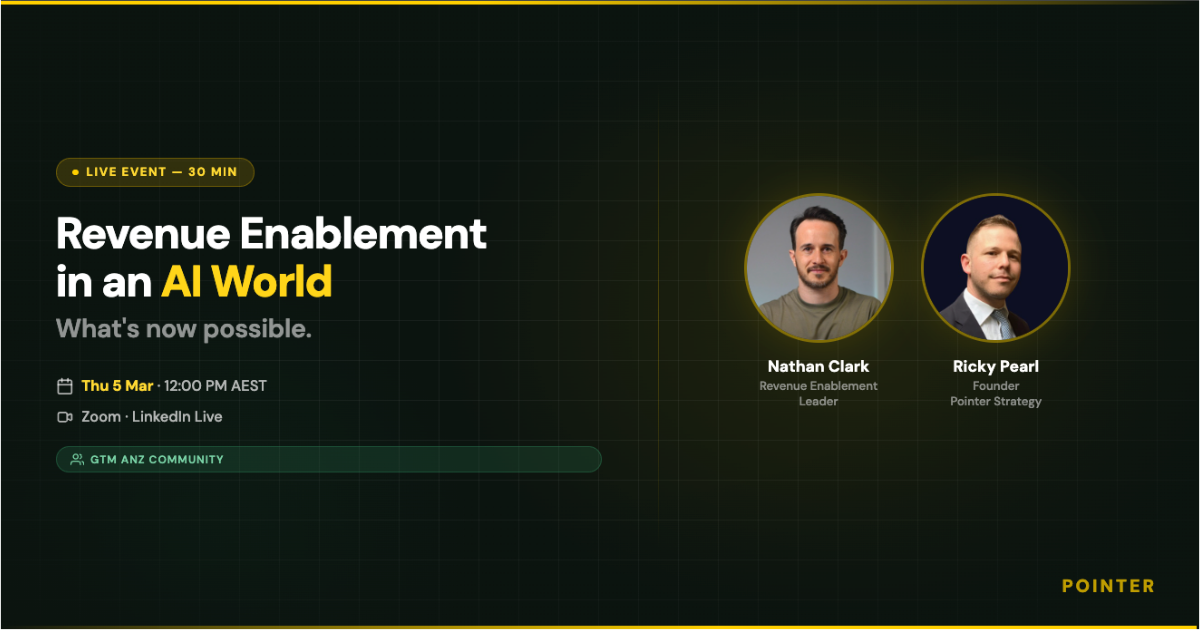
    Nathan Clark and Ricky Pearl break down how AI is reshaping revenue enablement — from autonomous agents that capture coaching IP to data-driven presentations built in minutes.

    Revenue Enablement in an AI World: What's Now Possible

    This is a recording of a live session from the GTM ANZ Community, featuring Nathan Clark (Enablement Practice Lead, Pointer Strategy & Founder, Upright Revenue) and Ricky Pearl (Founder, Pointer Strategy).

    The Big Shift: Revenue Enablement Must Be AI-Empowered

    The AI landscape changed dramatically in December 2025. A wave of model releases created an explosion of actual capability — what was weekend tinkering for tech enthusiasts is now weekday work for revenue professionals.

    The models are smart enough now that prompt engineering is becoming less critical. What matters is context engineering — giving AI the right information, at the right time, in the right structure.

    And that maps perfectly to enablement. Revenue enablement has always been about getting the right context to the right people at the right moment. AI just made that infinitely more scalable. Teams that don't embrace this will be left behind — as Nathan puts it, your competitors are going to run rings around you.

    Building Agents That Work For You

    Nathan walks through the primitives of any AI agent — whether you build it in Notion, Claude Code, Codex, or anywhere else:

    1
    Triggers — What makes the agent start working? (A daily schedule, a Slack mention, a new file)
    2
    Instructions — What should it do? (Clear, specific directions about the task)
    3
    Tools & Access — What can it use? (Slack, Notion, call transcripts, CRM data)
    4
    Context — What does it know? (Company data, methodologies, past conversations)

    Example: The IP Builder

    Nathan demonstrated an agent called "Bob" (as in Bob the Builder) that runs daily at 5am. It:

  1. Listens to all his recorded coaching calls
  2. Extracts principles, frameworks, and tactical advice
  3. Creates structured training content — complete with when to use it, how to execute it, and illustrative examples
  4. Stores everything in a searchable database
  5. The enablement implication: Every coaching conversation, product meeting, and deal review in your org could be automatically captured, distilled, and turned into reusable training content — with zero admin time.

    Example: The Slack Coach Bot

    In under 60 seconds on screen, Nathan built a sales coaching agent in Notion that:

  6. Lives in a Slack channel
  7. Responds when mentioned by reps
  8. Uses MEDIC methodology to assess deal health
  9. Gives practical next steps on live deals
  10. The agent wrote its own instructions, set up a MEDIC checklist, and started replying in Slack — all from a single sentence prompt. With 10 minutes of proper instruction-writing and access to your company's value proposition, this becomes a genuinely useful coaching tool that scales enablement's reach.

    Data-Driven Enablement at Machine Speed

    Nathan showed a workflow using Codex (OpenAI's CLI agent) that:

    1
    Read a folder of deal data (100 opportunities with win/loss reasons, seller performance metrics)
    2
    Analysed a transcript from an enablement leader's conversation with a sales manager
    3
    Identified that pricing pressure was accelerating — from 19% of deal losses to 54%
    4
    Found that win rates dropped from 40% to 29% over three months
    5
    Generated a branded presentation in Gamma with the analysis and recommended interventions

    The whole process took minutes. Previously, this kind of analysis-to-presentation workflow would take days of manual work across spreadsheets, slides, and multiple review cycles.

    What Doesn't Change

    Both speakers were clear: AI amplifies enablement — it doesn't replace the human layer.

  11. Reps still need behaviour change. AI can generate 100x more content, but if it's the wrong content, you've just scaled bad advice.
  12. Strategic design matters more, not less. The question isn't "what more can I add?" — it's "what's the least that needs to happen to achieve this outcome?"
  13. Conversational intelligence tools like Gong still have their place. But you can now extract data via APIs and build very specific workflows on top of them.
  14. Human coaching and judgement are irreplaceable. The worst thing you can do is 100x bad things. Don't scale what shouldn't be scaled.
  15. "I can't imagine a version of running really high quality enablement now without this. Your competitors are gonna run rings around you." — Nathan Clark

    The Accessibility Story

    One of the most striking points: this isn't enterprise-only technology anymore.

  16. Notion ($14–20/month) + Granola ($14/month) = a complete agent-building stack for an enablement leader
  17. You don't need a licence for every user — just the enablement lead
  18. Chat GPT, Claude, and other tools can do similar things through Zapier integrations
  19. Everything shown can be built on local AI for organisations with strict security requirements
  20. For small and mid-market companies, this is where you catch up. For enterprise, the argument is: your engineering team already has security clearances to run tools locally — go fight for the same access.

    Key Takeaways

  21. Context engineering > prompt engineering. Give AI the right files, the right instructions, and the right access — the models handle the rest.
  22. Agent primitives are simple: trigger, instructions, tools, access. Master these and you can build anything.
  23. Enablement should be data-driven. AI makes it trivial to marry deal data, call transcripts, and manager conversations into actionable insights.
  24. Sales enablement must become revenue enablement. If you're building these tools for sales, there's no reason not to extend them across the entire bow tie.
  25. Start small, stay commercially focused. Build for the biggest blocker to hitting your number. Experiment on weekends. Bring what works into production.
  26. Don't output everything to AI. Have a heavy hand in discernment. The worst thing you can do is 100x bad things.
  27. Want AI-powered enablement for your team? Every Pointer placement includes 12 months of structured training. Whether you're hiring your first SDR or scaling a revenue org, we embed enablement from day one. Book a discovery call.

    Your Speakers

    Nathan Clark is the Enablement Practice Lead at Pointer Strategy and Founder of Upright Revenue, where he works with founders and GTM leaders to turn revenue uncertainty into repeatable performance.

    Ricky Pearl is the Founder of Pointer Strategy, where he's worked with 200+ GTM teams in APAC on strategy, hiring, and implementation.

    *This session is part of the weekly GTM ANZ Community series. Join free for conversations on revenue enablement, partnerships, go-to-market engineering, and AI — every Thursday.*

    Frequently Asked Questions

    Keep Reading

    Ready to Stop Gambling on Recruitment?

    No upfront fees. Practitioner-certified talent. 12 months of training. Your next hire should come with proof, not promises.

    Book a Discovery Call

    No commitment. No pitch deck. Just a conversation.