

Keith Jones joined OpenAI in late 2023, when the GTM organisation was under 100 people and the company already had more than a billion dollars on the books. By the time they left, nearly three years later, that org was more than 1,200 people around the world. Keith built and ran the GTM systems underneath it.
This week they did an AMA on r/gtmengineering. It's one of the more grounded things I've read on GTM engineering this year, mostly because it's so unglamorous. No 40-step agent swarm. A few simple tests for what to automate, a lot of respect for salespeople, and a willingness to say the quiet part about Clay and the GTM engineer title.
Below is what Keith said, grouped by theme. After that, what it means if you're hiring for this in Australia or New Zealand, with numbers from the GTM engineer ads we've tracked since April.
How OpenAI Decided What to Automate
Keith used three tests: volume, consistency and risk.
The point is that they compound. High volume, predictable outcomes and survivable mistakes together make the best targets.
The worked example was close dates on opportunities in the CRM. Every sales team has to keep them current, reps are creatures of habit (plenty just push the date to month end), and the real decision is usually only "this month, this quarter, or later". An agent with the deal history, notes and call recordings can make that call. But Keith wouldn't hand it over in one go: start with recommendations, move to automatic updates where confidence is high, and keep exceptions for a human.
"Automation doesn't have to be binary."
>
Keith Jones
That one line is the most useful idea in the thread. Autonomy gets earned in stages. It isn't switched on because the tech can technically do it.
What They Actually Built
When asked which systems mattered most, Keith picked two. Neither is exotic.
Agentic qualification. Traditional lead scoring is a deterministic points model, which flattens a prospect into a handful of attributes. Replacing it with an agent let OpenAI reason across structured and unstructured information about a prospect. The structure and consistency stayed. What changed was how the qualification decision got made.
A lightweight GTM assistant. Before everything got called an agent, the team built a simple assistant that nudged sellers: meeting follow-ups, quick digests, calendar changes, contextual reminders. What excited Keith was where it could go next. Instead of summarising your last call, it could notice a colleague just closed a deal with the same pain points and put the two of you in touch.
One commenter's reaction was the right one: every vendor is selling extremely complex agentic workflows, and the person who did this at OpenAI scale stuck with the basics.
Where the Human Stays
Asked whether GTM engineering should focus on prospect intelligence rather than automating outreach itself, Keith agreed completely and went further. Augmentation should be the starting point for applying AI to nearly any job.
Data entry, research, qualification, admin and internal process? Automate it hard. The conversation and the relationship stay with the seller, because a deal is a commitment between businesses and the people in them.
The test Keith offered for outreach is a good one to steal:
"If you feel even an iota of hesitation... that's your signal that human judgment still belongs in the process."
>
Keith Jones
If a rep would be happy for an LLM to write and send the message with no involvement from them, automate it. If they'd want to proofread it first, the workflow hasn't earned autonomy yet.
There's a warning in there for builders too: don't let how abstract your own role is make you forget the people you're building for. Being able to automate something doesn't mean you've earned the right to remove the human from it.
The Stack: Capabilities First, Vendors Second
Keith's advice was to stop thinking about vendors and list the capabilities you need:
Then check which of those your current stack already covers and find the real gaps. A pile of fashionable AI tools is not an AI-capable GTM architecture.
The same logic came up when someone asked whether it's still smart to build heavily in Salesforce and HubSpot. Learn the features as concepts first and platform settings second. If you understand sharing rules or scoring models as ideas, you'll know what has to exist when you end up on a home-built CRM.
Clay, and Whether GTM Engineering Is a Rebrand
Someone asked why the industry is obsessed with Clay, given most GTM engineer JDs read like "Clay specialist". Keith's answer: because that's exactly what Clay set out to do. The rise of the GTM engineer is as much a story of category creation and good marketing as a new way of working. Clay saw the opportunity, helped name it and built a community around it.
There's substance under the hype. Clay made multi-source enrichment and orchestration accessible to people who'd previously have needed several vendors and an integration engineer. Keith adopted it in early 2024, when they were still a team of one at OpenAI, to get multi-source enrichment into production fast.
But knowing a platform isn't the job.
"Knowing how to operate a platform is valuable, understanding how to design reliable, scalable systems that solve business problems is considerably more valuable."
>
Keith Jones
And then the spicy bit. Asked whether AI will replace GTM engineers, Keith said no, not any time soon, but added that a big share of what we call GTM engineering is work product managers, business systems people and RevOps have done for years, now with very different tools at much greater speed. "Humans love a good rebrand."
The more capable the systems get, the more you need people who understand what you're asking them to do and whether you should be doing it at all. Fewer repetitive tasks, more design and judgement. Eliminating tasks and eliminating professions are different things.
The Rest of the Thread, Quickly
What This Means for Hiring GTM Engineers in ANZ
Keith's take is that GTM engineering is still being defined and overlaps heavily with RevOps and business systems. Our job ad data says ANZ is even earlier than that.
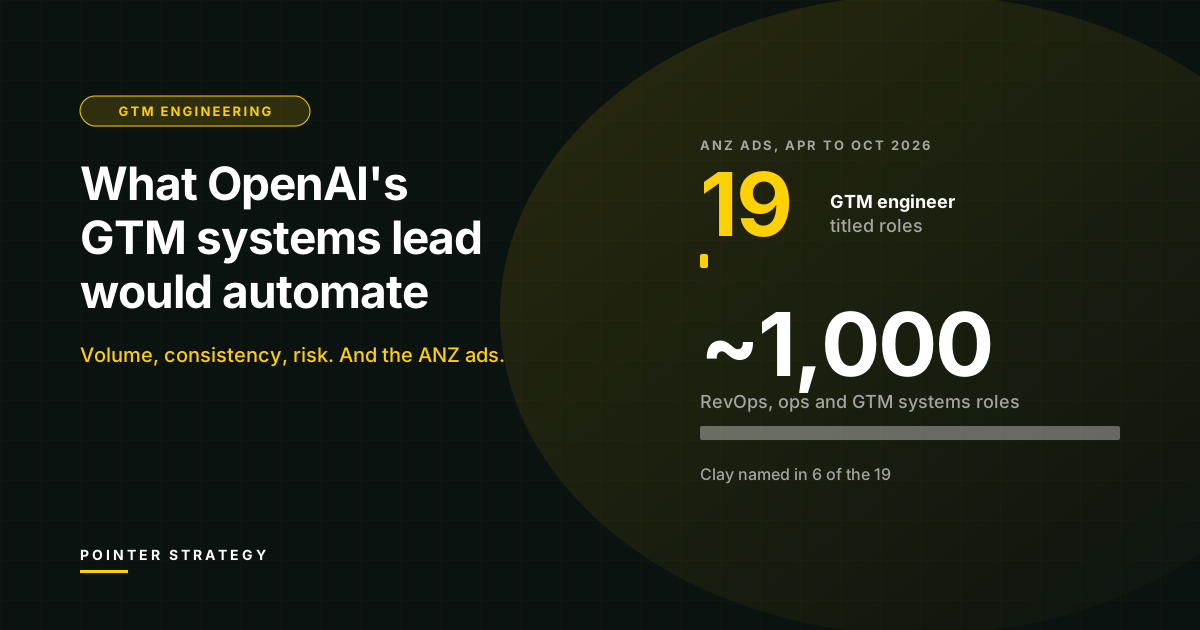
We track GTM job ads across LinkedIn, SEEK and company careers sites. Between 1 April and 16 October 2026 we counted every direct-employer ad in Australia and New Zealand with "GTM engineer" or "go-to-market engineer" in the title. We removed reposts of the same role, recruiter ads and our own ad.
| GTM engineer titles | RevOps, sales ops, marketing ops and GTM systems titles | |
|---|---|---|
| Unique ads, 1 April to 16 October 2026 | 19 | ~1,000 |
| Employers | 16 | about 800 |
| Ads that name Clay | 6 of 19 | under 1% (9 ads) |
| Ads that name HubSpot or Salesforce | 12 of 19 | about a third |
Three things stand out.
1. The title barely exists here yet. Nineteen roles in six and a half months, at 16 companies, including SafetyCulture, UpGuard, Speechify, PitchBook, Podium, Lorikeet and pay.com.au. Over the same period, about 1,000 ads went out under RevOps, ops and systems titles. If you're hiring for GTM engineering in ANZ, most of the people who've done the work don't have the title on their LinkedIn. Search the RevOps and systems pool.
2. It isn't a Clay job in ANZ. Clay appears in a third of local GTM engineer ads. A CRM appears in close to two thirds. That matches Keith's point: the tool is a skill, not the role. An ad that reads like a Clay certification will screen out the systems thinkers you actually want.
3. A few companies are building teams, not hiring a lone wolf. SafetyCulture and UpGuard have both advertised a manager of GTM engineering alongside individual roles. That's the step Keith said they wished they'd taken earlier at OpenAI: designing how the team works, not just fixing the next problem.
On pay, too few of these ads print a salary to say anything with confidence, and the ones that do are mostly recruiters. For ranges, see our guide on how to hire GTM engineers.
Interview questions borrowed from the AMA
If you're hiring a GTM engineer, Keith's thread doubles as an interview guide:
Hiring a GTM Engineer in Australia or New Zealand?
Most of the strongest GTM engineers in ANZ are sitting in RevOps, sales ops and business systems seats under a different title. We find and vet them with people who've built these systems, and our performance contract means you pay monthly and billing stops if the hire leaves.
Hire GTM Engineers with Pointer