

How Much Does It Cost to Hire a Salesperson in Australia? (2026 Breakdown)
The recruitment fee is the number everyone asks about. It's also the smallest part of the total cost.
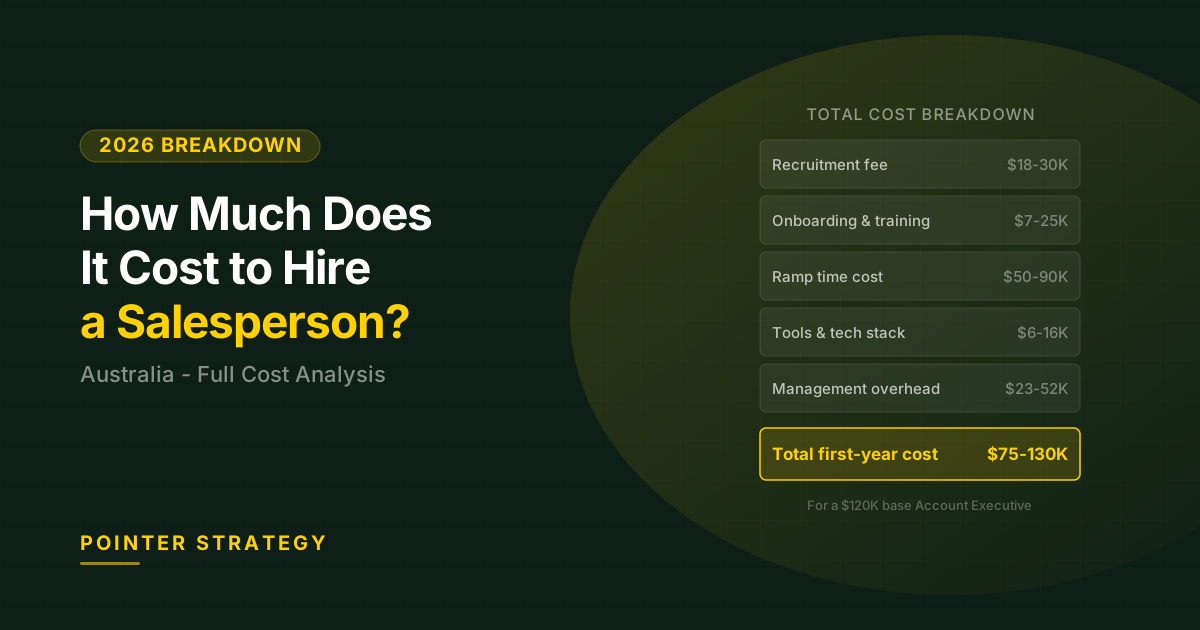
When Australian companies budget for a sales hire, most start and stop at the agency fee: 15-25% of base salary. For a $120,000 AE role, that's $18,000 to $30,000. Significant, but it's roughly 20% of what you'll actually spend by the time that hire is ramped, equipped, managed, and producing revenue.
The total cost to hire a salesperson in Australia in 2026 ranges from $35,000 to $150,000+ depending on the role, hire method, and how quickly they ramp. This guide breaks down every cost category so you can budget accurately and choose the most cost-effective hiring approach.
The Full Cost Breakdown
Every sales hire carries five categories of cost. Most companies only plan for the first two.
1. Recruitment Costs
This is the line item everyone focuses on. What you pay to find and secure the candidate.
| Hire Method | Typical Cost | When You Pay |
|---|---|---|
| Internal (job boards + internal recruiter) | $5,000-$15,000 | Upfront (ads, recruiter salary allocation, screening tools) |
| Contingency agency | 15-25% of base salary | On placement |
| Retained search | 25-35% of base salary | Staged (typically thirds) |
| RPO (Recruitment Process Outsourcing) | $3,000-$8,000 per hire | Monthly retainer + per-hire fee |
| Pay-on-performance (Pointer model) | 1.5% of salary/month | Monthly while hire performs |
For a standard Account Executive at $120,000 base, recruitment costs range from $5,000 (internal, if you have the infrastructure) to $42,000 (retained executive search). The AHRI average across all roles is $23,860.
For a deeper breakdown of agency fee structures specifically, see our recruitment fees guide.
2. Onboarding and Training
Getting a salesperson into the seat is one thing. Getting them productive is another.
| Cost Item | Range | Notes |
|---|---|---|
| Admin and IT setup | $1,000-$3,000 | Laptop, accounts, CRM access, security |
| Sales methodology training | $2,000-$8,000 | MEDDIC, Challenger, SPIN, or custom framework |
| Product knowledge ramp | $3,000-$10,000 | Manager time, shadowing, documentation |
| HR and compliance | $500-$2,000 | Contracts, policies, background checks |
| Total onboarding | $7,000-$25,000 | Higher for complex products or enterprise sales |
These costs are often invisible because they're spread across existing team members' time. But they're real. Every hour a sales manager spends onboarding a new rep is an hour they're not coaching existing reps or managing deals.
Use our Ramp Accelerator to model how onboarding investment affects time-to-revenue.
3. Ramp Time (The Expensive Wait)
This is where most of the money goes, and most companies underestimate it dramatically.
The average time for a new sales hire to reach full productivity in Australia:
| Role | Average Ramp to Full Quota | Cost During Ramp |
|---|---|---|
| SDR / BDR | 2-3 months | $16,000-$30,000 |
| Account Executive | 4-6 months | $50,000-$90,000 |
| Enterprise AE | 6-9 months | $90,000-$150,000 |
| Sales Manager | 3-6 months | $50,000-$100,000 |
"Cost during ramp" includes full salary, super (11.5% in 2026), and the revenue they're not yet generating. An AE on a $120,000 base with super costs your business roughly $11,150 per month in direct compensation alone. If they're producing 30% of quota for the first three months and 60% for months four through six, the gap between what you're paying and what you're earning is substantial.
For context: average time-to-fill for sales roles in Australia sits at 45 to 65 days (Seek, AHRI). Add 4-6 months of ramp time, and you're looking at 6-8 months from "we need someone" to "they're contributing at full capacity."
4. Tools and Technology
Every salesperson needs a tech stack. Here's what a typical Australian B2B sales tech stack costs per seat per year:
| Tool Category | Annual Cost Per Seat |
|---|---|
| CRM (Salesforce, HubSpot) | $1,200-$3,600 |
| Sales engagement (Outreach, Salesloft) | $1,200-$2,400 |
| Data and enrichment (ZoomInfo, Apollo) | $1,000-$5,000 |
| Call recording (Gong, Chorus) | $1,200-$2,400 |
| LinkedIn Sales Navigator | $1,200-$1,800 |
| Email and calendar tools | $300-$600 |
| Total per rep per year | $6,000-$16,000 |
This is a recurring cost for every rep on your team, and it's non-negotiable for competitive performance. If you're exploring whether to build your own Gong setup or buy, we've written about that separately.
5. Management Overhead
The most overlooked cost. Sales hires don't manage themselves, especially during the first 6-12 months.
| Activity | Estimated Time Per New Hire (Monthly) | Cost Equivalent |
|---|---|---|
| 1:1 coaching and pipeline review | 8-12 hours | $2,000-$4,000 |
| Deal support and ride-alongs | 4-8 hours | $1,000-$2,500 |
| Performance tracking and reporting | 2-4 hours | $500-$1,200 |
| HR coordination (if issues arise) | 1-3 hours | $300-$900 |
| Total monthly management cost | 15-27 hours | $3,800-$8,600 |
Based on a sales manager's loaded cost of $180,000-$220,000 per year. During the first six months, a single new hire consumes 10-15% of their manager's total capacity.
Total Cost by Role (2026 Estimates)
When you add it all up, here's what each sales hire actually costs in Australia:
| Role | Base Salary Range | Total First-Year Cost (Including Ramp) | Break-Even Timeline |
|---|---|---|---|
| SDR / BDR | $65,000-$85,000 | $35,000-$65,000 | 3-5 months |
| Account Executive | $110,000-$140,000 | $75,000-$130,000 | 6-10 months |
| Enterprise AE | $140,000-$180,000 | $100,000-$175,000 | 9-14 months |
| Sales Manager | $150,000-$200,000 | $85,000-$150,000 | 6-10 months |
These figures include recruitment, onboarding, ramp-period compensation, tools, and management overhead. They exclude the hire's ongoing salary once productive, which is an investment, not a cost.
For role-specific salary benchmarks and OTE structures, check our OTE Calculator.
Cost Comparison by Hire Method
Not all hiring approaches carry the same total cost. Here's how the main options compare for a $120,000 base AE hire:
| Factor | Internal Hire | Contingency Agency | Retained Search | RPO | Pay-on-Performance |
|---|---|---|---|---|---|
| Recruitment cost | $5,000-$15,000 | $18,000-$30,000 | $30,000-$42,000 | $5,000-$8,000 | $1,800/month |
| Time-to-fill | 60-90 days | 45-65 days | 30-50 days | 45-60 days | 30-50 days |
| Quality assurance | Depends on process | Variable | Higher | Process-dependent | Incentive-aligned |
| If hire fails (3 months) | Total loss: $5,000-$15,000 | Replacement search (fee gone) | Replacement search (fee gone) | Next hire at per-hire rate | Billing stops. Cost: $5,400 |
| Post-placement support | Whatever you build | None | None | Varies | 12 months training (Pointer) |
| Risk allocation | 100% employer | 100% employer | 100% employer | Shared | Shared |
The cost difference becomes stark when things go wrong. A failed contingency hire costs you the full fee ($24,000+) plus all the sunk costs above. A failed pay-on-performance hire costs you only the months they worked. For more on how different recruitment fee models compare, we've written a dedicated breakdown.
The Hidden Costs Most Companies Miss
Beyond the line items above, three hidden costs inflate the true price of a sales hire:
Opportunity Cost of an Empty Seat
Every day a sales territory sits unfilled is revenue that never gets generated. If your AEs carry $800,000 annual quotas, an empty seat costs roughly $3,000 per business day in lost pipeline opportunity. A 60-day hiring process means $180,000 in potential revenue that never enters the pipeline.
This is why speed matters in recruitment, but only if speed doesn't compromise quality. Filling a seat fast with the wrong person is more expensive than leaving it empty.
The Cost of a Bad Hire
A bad sales hire costs 1.5 to 3 times their annual salary when you factor in wasted compensation, lost deals, damaged client relationships, team morale impact, and the cost of re-hiring.
For a $120,000 AE, that's $180,000 to $360,000 in total damage. And it takes an average of 10 weeks to recognise a bad hire (Robert Half AU), by which point the sunk costs are already substantial.
The only reliable way to reduce this cost is to improve hiring accuracy. That means specialist recruiters who understand the role, structured assessment processes, and financial alignment between the agency and the outcome.
Team Productivity Drag
New hires don't just consume management time. They pull experienced reps away from selling. Shadow days, deal coaching, product walkthroughs, CRM training - senior team members lose 5-10 hours per month supporting a new colleague during the first quarter. Across a team of four, that's 20-40 hours of senior selling time redirected to onboarding.
How to Reduce Your Total Hiring Cost
Four strategies that lower the total cost without sacrificing hire quality:
1. Invest in structured onboarding. Companies with formal onboarding programs see 50% greater new-hire productivity (SHRM). The $10,000-$25,000 you spend on proper onboarding saves $50,000+ in extended ramp time. Our Ramp Accelerator helps model this.
2. Use specialist recruiters for specialist roles. Generalist agencies fill roles. Specialist agencies assess whether candidates can actually do the job. The upfront cost may be similar, but the hit rate is dramatically different. For a guide to evaluating agencies, see our best sales recruiters comparison.
3. Align your recruiter's incentives with outcomes. Pay-on-performance models mean your recruiter only earns while your hire performs. That changes everything about candidate selection, post-placement support, and long-term accountability. Read more about how pay-on-performance recruitment works.
4. Plan for the full cost, not just the fee. Budget for 6-10 months of total investment when hiring a salesperson, not just the placement fee. This prevents the "we can't afford to fire them" trap where companies keep underperformers because they've already spent too much to start over.
How Pointer's Model Changes the Economics
Pointer's pay-on-performance model restructures the cost equation in three ways:
For a $120,000 AE who stays 12 months, Pointer's total recruitment cost is $21,600. That's comparable to a mid-range contingency fee, but spread across the year rather than due on day one, and backed by training that accelerates ramp.
If that hire leaves at month three? Your total recruitment cost is $5,400. With a contingency agency, you'd have paid $24,000+ and be negotiating a replacement search.
For a broader comparison of how Pointer stacks up against traditional agencies, see our comparison guides.
Frequently Asked Questions
What is the average recruitment fee for a salesperson in Australia?
The average recruitment fee for sales roles in Australia ranges from 15% to 25% of the candidate's base salary, depending on role seniority and the agency model. For a $120,000 Account Executive, that's $18,000 to $30,000. Executive and VP-level searches can run 25-35%. AHRI's average cost-to-hire across all roles is $23,860. For a full breakdown, see our recruitment fees guide.
How long does it take to hire a salesperson in Australia?
The average time-to-fill for sales roles in Australia is 45 to 65 days from job posting to accepted offer (Seek, AHRI data). Retained search firms typically work faster at 30-50 days due to dedicated focus. However, time-to-fill only measures when someone starts. Time-to-productivity adds another 2-6 months depending on the role, so budget for 4-10 months from "we need someone" to "they're performing at full capacity."
What does a bad sales hire actually cost?
A bad sales hire typically costs 1.5 to 3 times their annual salary. For a $120,000 AE role, that's $180,000 to $360,000 when you factor in wasted salary, recruitment fees, lost deals, damaged client relationships, re-hiring costs, and the productivity drag on the rest of the team. Read our full bad hire cost breakdown for the detailed calculation.
What are the average salaries for sales roles in Australia in 2026?
Current base salary ranges for B2B sales roles in Australia: SDR/BDR $65,000-$85,000, Account Executive $110,000-$140,000, Enterprise AE $140,000-$180,000, Sales Manager $150,000-$200,000, VP Sales $200,000-$280,000. OTE (on-target earnings) is typically 1.5-2x base for quota-carrying roles. Use our OTE Calculator for role-specific benchmarks, or see our APAC sales compensation guide for regional comparisons.
Is it cheaper to hire salespeople internally or through an agency?
Internal hiring is cheaper per hire ($5,000-$15,000) if you already have an established recruitment function with sourcing tools, a strong employer brand, and an experienced hiring manager. If you don't, the hidden costs of internal hiring (job board spend, screening time, interview coordination, slower time-to-fill) often match or exceed agency fees. The right question isn't "which is cheaper" but "which produces better outcomes at the total cost." For companies hiring 1-3 sales reps per year, a specialist recruitment agency with aligned incentives typically delivers better ROI than building internal capability.