

Recruitment Agency vs Hiring Direct: What Actually Works for Sales Teams in Australia (2026)
Should you use a recruitment agency or hire salespeople yourself? The answer depends on what you're hiring for, how fast you need them, and how much a wrong decision costs you.
This is the question behind most sales hiring decisions in Australia. Founders, VPs of Sales, and HR leaders wrestle with it every time a territory opens up or a growth plan requires new headcount. The internet is full of generic advice. This guide uses Australian market data to give you a framework that actually works.
The Quick Comparison
| Factor | Direct Hiring | Generalist Agency | Specialist Sales Agency |
|---|---|---|---|
| Cost per hire | $8,000 to $15,000 | $18,000 to $30,000 (15-25%) | $18,000 to $30,000 or pay-on-performance |
| Time to fill (mid-level) | 8 to 12 weeks | 6 to 8 weeks | 3 to 6 weeks |
| Time to fill (senior) | 10 to 16 weeks | 8 to 12 weeks | 6 to 10 weeks |
| Candidate pool access | Limited to inbound + your network | Broad database, mixed quality | Deep GTM-specific networks |
| Sales methodology assessment | Depends on hiring manager skill | Usually basic competency checks | MEDDIC, Challenger, SPIN evaluation |
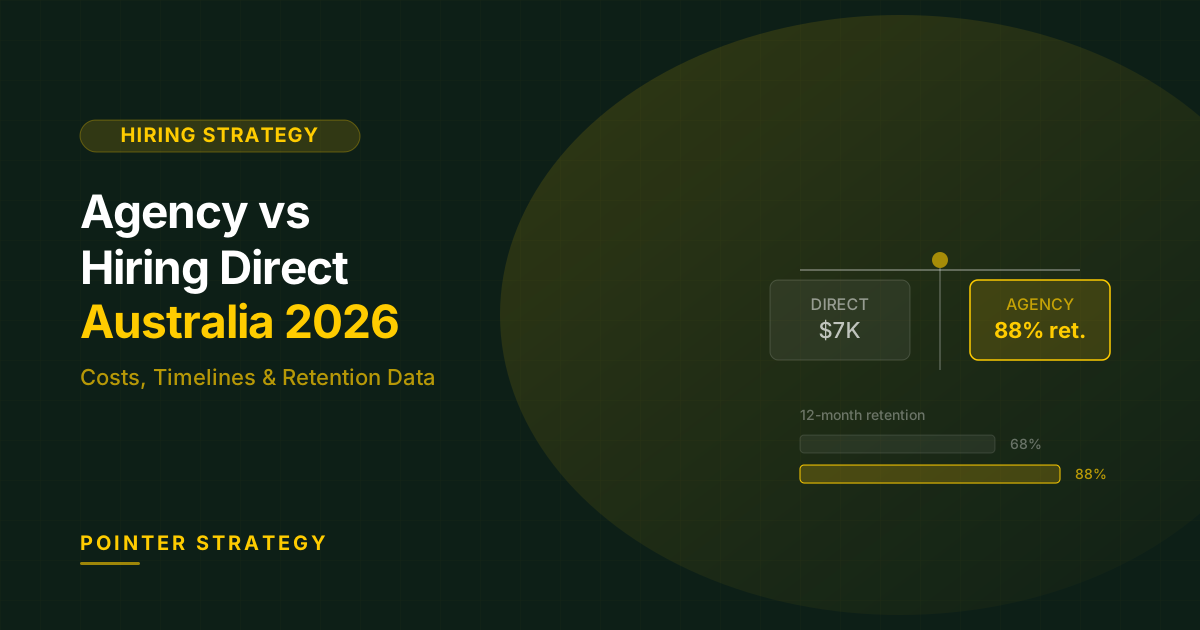
| 12-month retention | 65 to 75% | 72 to 78% | 82 to 88% |
| Post-placement support | Internal onboarding only | Guarantee period (3 months) | Training + enablement (varies) |
| Best for | Strong employer brand, volume roles | Multi-function hiring | Specialist GTM roles |
The Real Cost of Hiring Direct
Direct hiring looks cheaper on paper. Job boards cost $300 to $700 per listing. LinkedIn Recruiter runs $8,000 to $15,000 per year. Assessment tools add another $2,000 to $5,000 annually. Divide by hires made and you get a tidy cost-per-hire number.
But that number hides the expensive part: time.
The hidden costs of direct hiring:
Example: Direct hire for a $140,000 OTE Account Executive
| Cost Component | Amount |
|---|---|
| Job board + LinkedIn Recruiter (pro-rated) | $3,500 |
| Hiring manager time (18 hours at $150/hr) | $2,700 |
| Assessment tools (pro-rated) | $800 |
| Total direct cost | $7,000 |
| Lost revenue from 10-week vacancy (conservative) | $25,000 to $50,000 |
| True cost per hire | $32,000 to $57,000 |
When you include vacancy cost, direct hiring is rarely the bargain it appears.
The Real Cost of Using an Agency
Traditional contingency agencies charge 15 to 25% of base salary, paid upfront on placement. For a detailed breakdown, see our recruitment fees guide.
What you get for that fee:
What you often do not get:
The structural problem with contingency recruitment is the incentive model. Agencies get paid on placement, not on performance. A hire who leaves in month four still earned the agency their full fee. This creates a speed bias: fill the role fast, move to the next brief.
Pay-on-performance changes the maths. Models like Pointer's 1.5% monthly billing mean the agency only earns while the hire performs. A $120K base AE costs $1,800/month. If they leave in month three, total agency cost is $5,400 instead of $24,000. The agency is structurally incentivised to place someone who stays.
When Direct Hiring Works Best
Direct hiring is the right choice in specific situations. Be honest about whether these apply to your company.
1. You have a strong employer brand in your market.
If salespeople know your company and want to work there, inbound applications will be high quality. Companies like Atlassian, Canva, and SafetyCulture attract strong sales talent without needing agencies. Most companies overestimate how well-known their brand is to salespeople.
2. You are filling entry-level or volume roles.
BDR and SDR roles with structured training programs are viable to fill directly. The role is well-defined, the candidate pool is large, and you can train for skill. The assessment bar is coachability and drive, not methodology expertise.
3. You have experienced sales leaders running the process.
A VP of Sales who has hired dozens of AEs knows how to run a mock discovery call, evaluate pipeline metrics, and back-channel reference check. They do not need an agency to assess sales competence. But not every company has that person, and their time may be better spent elsewhere.
4. You are in a low-competition market.
If you are the only SaaS company hiring in your city or niche, direct hiring works because candidates have fewer options. In Sydney and Melbourne's competitive GTM market, this is rarely the case.
When Using an Agency Makes Sense
1. Time to hire is critical.
Every week a sales territory sits empty, pipeline dies. If you need someone in seat within 4 to 6 weeks, specialist agencies with active candidate networks consistently outperform internal processes. The revenue lost to a 12-week vacancy almost always exceeds the agency fee.
2. You are hiring specialist or senior roles.
Account Executives running enterprise deals, sales leaders, or niche GTM roles (partnerships, enablement, CS) require deep assessment. Generalist HR teams struggle to evaluate whether a candidate can actually run MEDDIC or manage a 9-month enterprise sales cycle. Specialist agencies have this built into their process.
3. You need market intelligence.
What should you pay an AE in Sydney vs Melbourne? What is the going rate for a SaaS BDR with 18 months of experience? Is your OTE structure competitive? Agencies that recruit in your market daily have this data. Building it internally takes months of conversations.
4. Your internal team is at capacity.
If your talent acquisition team is already stretched, adding complex sales hiring to their plate leads to longer timelines and lower-quality outcomes. Sales hiring requires specific assessment skills that generalist TA professionals may not have.
5. You are building a team, not filling a single seat.
Building a new sales team from scratch (3+ hires within a quarter) is a project that benefits from agency partnership. Market mapping, compensation benchmarking, candidate pipelining, and coordinated offers are harder to execute internally at speed.
The Retention Question
Retention is where the direct vs agency comparison gets most interesting.
Australian 12-month sales hire retention rates:
| Hiring Method | 12-Month Retention | Notes |
|---|---|---|
| Direct hire (no structured assessment) | 60 to 68% | Highest mis-hire rate, often based on "gut feel" |
| Direct hire (structured process) | 70 to 78% | Competency frameworks, case studies, back-channelling |
| Generalist agency | 72 to 78% | CV matching + competency interviews |
| Specialist sales agency | 82 to 88% | Methodology assessment, quota history verification |
| Specialist agency + post-placement training | 85 to 92% | Structured ramp + ongoing enablement |
The pattern is clear: the more sales-specific the assessment process, the higher the retention. Specialist agencies that combine deep assessment with post-placement enablement produce the best outcomes.
This matters because retention drives cost-per-successful-hire, which is the only metric that actually matters. A $7,000 direct hire that churns at month four costs far more than a $25,000 agency hire that stays for two years.
Cost-Per-Successful-Hire: The Metric That Matters
Most companies compare cost per hire. Smarter companies compare cost per successful hire, defined as a hire who is still employed and meeting targets at 12 months.
Scenario: Hiring 5 AEs over a year at $140K OTE each
| Method | Cost Per Hire | Expected Retention (12mo) | Hires That Stick | Cost Per Successful Hire |
|---|---|---|---|---|
| Direct | $7,000 | 68% (3.4 of 5) | 3.4 | $10,294 + re-hire costs |
| Generalist agency (20%) | $28,000 | 75% (3.75 of 5) | 3.75 | $37,333 |
| Specialist agency (20%) | $28,000 | 85% (4.25 of 5) | 4.25 | $32,941 |
| Pay-on-performance (12mo) | $25,200 | 88% (4.4 of 5) | 4.4 | $28,636 |
The direct hire number looks best until you factor in the cost of replacing the 1.6 hires that did not work out: recruiting again, ramping again, and the months of lost productivity.
A Decision Framework
Use this framework to decide your approach for each open role:
Hire direct when:
Use a generalist agency when:
Use a specialist sales agency when:
For most B2B SaaS companies hiring mid-to-senior GTM roles in Australia, the specialist agency path delivers the best cost-per-successful-hire. The upfront cost is higher, but the total cost of ownership is lower because retention is higher and ramp time is shorter.
Frequently Asked Questions
Related Reading
*This guide is published by Pointer Strategy, a specialist GTM recruitment firm based in Australia. We work on a pay-on-performance model and include 12 months of sales training with every placement. We have a clear position in this debate, and we've tried to present the data honestly so you can make your own decision. Last updated: March 2026.*