

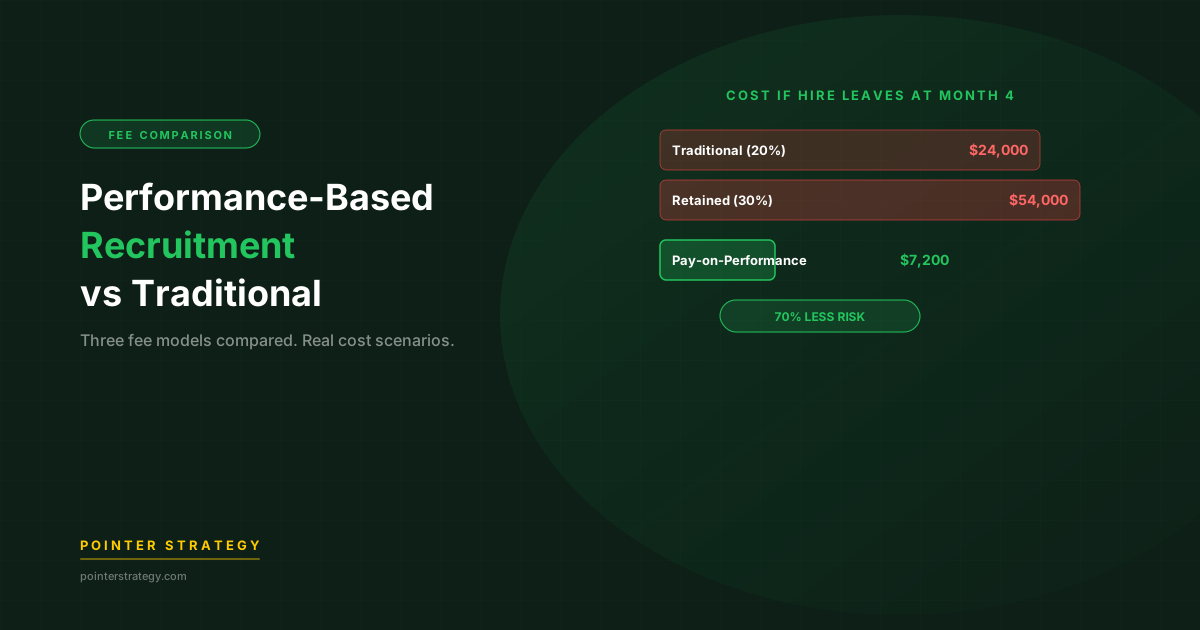
Performance-based recruitment is a pricing model where the employer pays the recruitment fee over time, tied to the hire's continued employment, rather than as a lump sum on placement day. In contrast to traditional contingent (15 to 25% upfront) or retained (25 to 35%, partially upfront) models, performance-based recruitment charges a smaller monthly fee that stops if the hire leaves. For Australian employers making sales and GTM hires in 2026, this model reduces upfront capital risk by 100% and total cost of a failed hire by 60 to 70%.
This guide compares the three dominant recruitment fee models, shows real cost scenarios for each, and explains when each model makes the most sense.
The Three Recruitment Fee Models
1. Contingent Recruitment (15 to 25% of base salary)
The most common model in Australia. You engage one or more agencies. They search for candidates. You pay the one that successfully places a candidate. The full fee is due at placement, sometimes with 30-day payment terms.
How it works in practice:
The hidden problem: Non-exclusive contingent searches incentivise speed over quality. Each agency knows there is a 1-in-3 chance they do not get paid, so they send the fastest available candidates rather than the best. You get volume, not quality. And if the hire fails after the 3-month guarantee window, you owe the full fee again to start over.
2. Retained Recruitment (25 to 35% of total compensation)
For senior or executive roles, agencies often require a retained engagement. You pay a portion of the fee upfront (typically one-third) before the search begins, with the remainder due at shortlist delivery and placement.
How it works in practice:
The hidden problem: You are investing $20,000 to $50,000 before you have seen a single candidate. If the search fails or the agency cannot fill the role, recovering the upfront payment is difficult. Retained firms have less urgency to fill because they have already been paid.
3. Pay-on-Performance (1.5% of annual salary, monthly)
A newer model where the fee is spread over 12 monthly payments, and billing stops if the hire leaves for any reason.
How it works in practice:
Why this changes the equation: The recruiter only earns their full fee if the candidate succeeds for 12 months. This aligns their incentive entirely with yours: they need to find someone who will stay and perform, not just someone who will accept the offer.
Side-by-Side Cost Comparison
Here is what each model costs for a $120,000 base salary hire under three scenarios.
Scenario 1: Hire stays 12+ months (success)
| Model | Total Fee | Upfront Cost | Training Included |
|---|---|---|---|
| Contingent (20%) | $24,000 | $24,000 | No |
| Retained (30% of $180K OTE) | $54,000 | $18,000 | No |
| Pay-on-Performance (1.5%/mo) | $21,600 | $0 | Yes (12 months) |
When the hire succeeds, pay-on-performance is the cheapest option and the only one that includes ongoing training.
Scenario 2: Hire leaves at month 4 (failure)
| Model | Total Fee Paid | Recovery | Net Cost |
|---|---|---|---|
| Contingent (20%) | $24,000 | Free replacement search (not refund) | $24,000 cash out |
| Retained (30%) | $54,000 | Free replacement search | $54,000 cash out |
| Pay-on-Performance (1.5%/mo) | $7,200 (4 months) | Billing stops | $7,200 cash out |
When the hire fails, pay-on-performance costs 70% less than contingent and 87% less than retained. The financial impact of a bad hire drops dramatically.
Scenario 3: Hire leaves at month 8 (partial success)
| Model | Total Fee Paid | Recovery | Net Cost |
|---|---|---|---|
| Contingent (20%) | $24,000 | None (past guarantee) | $24,000 |
| Retained (30%) | $54,000 | None (past guarantee) | $54,000 |
| Pay-on-Performance (1.5%/mo) | $14,400 (8 months) | Billing stops | $14,400 |
Even in partial-success scenarios, the employer retains significantly more capital under a performance-based model.
Risk Comparison: Who Bears the Downside?
| Risk Factor | Contingent | Retained | Pay-on-Performance |
|---|---|---|---|
| Bad hire cost to employer | High (full fee lost) | Very high (fee + upfront) | Low (billing stops) |
| Incentive alignment | Weak (paid on speed) | Moderate (paid on delivery) | Strong (paid on retention) |
| Cash flow impact | Large day-one outflow | Large, spread across milestones | Small monthly payments |
| Guarantee period | 3 months typical | 6 months typical | 12 months effective |
| Training/enablement included | Never | Rarely | Always (with Pointer) |
The fundamental difference: in contingent and retained models, the employer absorbs 100% of the downside risk. In pay-on-performance, the risk is shared. The recruiter has skin in the game for a full year.
When Each Model Makes Sense
Use Contingent When:
Use Retained When:
Use Pay-on-Performance When:
For most sales and GTM hiring in Australia, pay-on-performance offers the best risk-adjusted outcome. You can read more about how recruitment fees work in Australia for the full breakdown.
How Pointer's Model Works in Detail
Pointer Strategy charges 1.5% of annual salary per month for 12 months. Here is what that includes and how it compares to the industry standard.
The Fee
For a $120,000 base salary role: $1,800 per month. Total over 12 months: $21,600. Compared to a 20% contingent fee of $24,000, that is $2,400 less, with zero cash at risk on day one.
The Training
Every placement includes 12 months of live training and mentorship, delivered by practitioners who have carried quotas. This is not a library of pre-recorded videos. It is coached sessions covering real deal strategy, objection handling, pipeline management, and skills development.
Training serves two purposes. First, it compresses ramp time. Reps who receive structured enablement reach quota 30 to 40% faster. Second, it improves retention. Employees who feel invested in are significantly less likely to leave.
The Guarantee
Billing stops if the hire leaves for any reason, at any point during the 12-month period. This is not a replacement search promise. Billing simply stops. If someone leaves at month three, you have paid $5,400 instead of $24,000.
The Alignment
Because Pointer only earns full revenue when a candidate stays for 12 months, every recruiter is incentivised to vet for long-term fit. This means deeper assessment, more rigorous reference checks, and honest conversations about whether a candidate is truly right for the role.
We recruit across the full GTM function: sales, customer success, partnerships, marketing, and leadership. If you are comparing agencies, see our breakdowns versus Hays and Hudson.
The Maths of Multiple Hires
The cost advantage compounds when you are building a team. Consider a company making five sales hires at $120K base each, with a 30% failure rate (industry average).
Contingent Model (20%)
Pay-on-Performance Model (1.5%/mo)
Questions to Ask Any Recruitment Agency
Before engaging any agency, regardless of model, ask these questions: