

Sam Jacobs wrote a piece last week called "The Intercom Moment" that stopped me mid-scroll. If you haven't read it, the short version: a legacy SaaS company torched $60M of ARR to rebuild itself as an AI-first business. Most people cheered. Sam asked the uncomfortable question. Would you cheer if your friend pivoted their 90% gross margin software company into a consulting business?
That question has been rattling around in my head because it has massive implications for revenue leaders. Not for founders. Not for VCs. For you. The CRO, VP Sales, Head of Revenue sitting across the table from a board that still thinks in SaaS multiples while the economics underneath have fundamentally shifted.
I've spent the last six years building Pointer Strategy and working with 200+ GTM teams across APAC. I recently joined Pavilion because I believe the revenue leaders who will thrive in this era are the ones having honest conversations about what's actually happening to the numbers, not just the narrative. That's the same reason we built GTM ANZ, the largest go-to-market community in the region. Because the math is changing, and most of us are still running plays designed for a different game.
Let me walk you through what's actually happening.
The Economic Model That Made Your Career Possible
For twenty years, SaaS revenue leaders operated inside the most forgiving economic model in business history.
You sold a product that cost almost nothing to deliver. Gross margins ran 80-90%. Once engineering built the thing, every additional customer was near-pure profit. That margin cushion is what made everything else work. It justified spending $2+ to acquire $1 of new ARR. It supported 18-month CAC payback periods. It allowed 10x revenue multiples. It made aggressive OTE structures fundable. It gave you room to miss quota by 30% and still have a viable business.
That margin cushion wasn't a nice-to-have. It was the entire foundation. And it's compressing.
The New Margin Reality
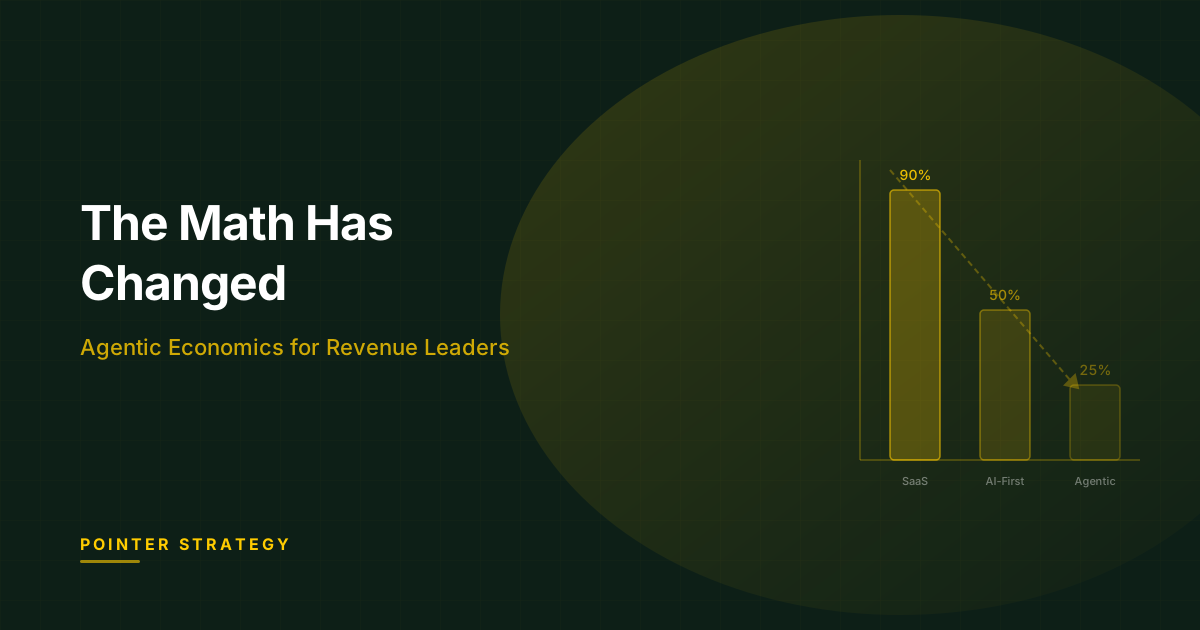
Traditional SaaS: 80-90% gross margins. AI-first companies: 50-65%. The fastest-growing agentic startups, the ones hitting $40M ARR in year one, are averaging roughly 25% gross margins. Some are negative.
OpenAI itself is reportedly operating at around 33% gross margin against $8.4B in inference costs for 2025, projected to hit $14.1B in 2026.
Now, the counterargument is always: "Costs will come down." And they are. The cost of a million tokens has dropped from $180 to under a dollar in eighteen months. That's a 240x reduction.
But here's the thing Sam nailed. Falling unit prices are not the same as falling total costs. Enterprise AI spending hit $37 billion in 2025, up from $11.5 billion the year prior. That's 3.2x year-over-year growth in total spend. Companies are consuming dramatically more compute even as each unit gets cheaper.
Sequoia's David Cahn estimated the industry needs $500B+ in new AI revenue annually just to cover current CapEx, assuming 50% margins. That's not a rounding error. That's a structural reality.
Revenue leaders need to understand this because your company's margin profile directly determines how much it can spend to acquire and retain customers. Which determines how much it can pay you and your team.
What This Means for Your Quota Plan
Here's where it gets personal.
Only 28% of reps hit 100% quota in 2025, according to Salesforce's State of Sales report. RepVue's Cloud Sales Index puts global attainment at 43%. The Bridge Group shows a steady decline of 4.5% over two years.
These aren't just "market conditions." They're symptoms of quota plans built on old margin assumptions being applied to new economic realities.
Let's do the basic math.
The old model: $100K ACV, 90% gross margin = $90K gross profit per customer. 5-year lifetime = $450K lifetime gross profit. You can afford $150K in CAC and still hit a 3:1 LTV:CAC ratio. A rep carrying a $1M quota with a $200K OTE? The business can absorb that.
The new model at 50% gross margin: $100K ACV, 50% gross margin = $50K gross profit per customer. 5-year lifetime = $250K lifetime gross profit. To maintain 3:1 LTV:CAC, you can now only spend $83K to acquire that customer. That's a 45% reduction in your allowable acquisition spend.
Where does that cut come from? Marketing budgets. SDR headcount. Rep OTE. Or, and this is what most boards are actually doing, they just set the same quotas and hope.
The Pavilion 2025 benchmarks show the median new CAC ratio has hit $2.00, meaning companies are spending $2 in sales and marketing for every $1 of new ARR. That's up 14% in a single year. Fourth-quartile companies are spending $2.82.
If you're a CRO at an AI-first company with 50% gross margins and a $2.00 CAC ratio, your unit economics are broken before a single rep makes a call.
Payback Periods Are Stretching Into Danger Territory
CAC payback, the number of months it takes to recoup what you spent acquiring a customer, is the metric that should be keeping revenue leaders up at night.
Median CAC payback across B2B SaaS has stretched to 18 months, up from 14 the year prior. Enterprise deals are pushing 24 months. For private SaaS companies, Pavilion data shows it's hit 23 months.
VCs in 2026 want to see 80-180 day payback before committing capital. Most companies are running at 3-5x that number.
Now layer in the margin compression. If your gross margin drops from 85% to 55%, your payback period doesn't just stretch. It nearly doubles, because each dollar of revenue contributes 35% less to recovering your acquisition cost.
A company with a 12-month payback at 85% margins has an effective 18.5-month payback at 55% margins. A company at 18 months? Now you're looking at 28 months.
At 28 months payback, you need extremely high retention just to break even on a customer. And the data on AI-native product retention is not encouraging.
The Retention Question Nobody's Answering
ChartMogul's "AI Churn Wave" report tells a stark story. AI-native products priced under $50/month are seeing gross revenue retention of just 23% and net revenue retention of 32%. That's 20 points worse than traditional B2B SaaS.
Even at the $50-249/month tier, GRR is 45% and NRR is 61%.
It's only at the $250+/month tier, where products are deeply embedded in workflows, that retention looks normal (70% GRR, 85% NRR).
The takeaway for revenue leaders: if the AI company you're running revenue for hasn't built deep workflow integration and isn't selling at enterprise-grade price points, your retention assumptions are almost certainly too optimistic. And retention is the denominator in every LTV calculation.
Pavilion's broader data shows NRR across SaaS has compressed to 101% overall. The companies commanding 3-5x higher valuation multiples are the ones maintaining 118%+ NRR. The gap between good and average retention has never mattered more.
Valuations: Your Equity Isn't Worth What You Think
For years, SaaS companies were valued at revenue multiples because the underlying assumptions held: cheap delivery, sticky customers, expanding accounts, efficient acquisition.
Look at those assumptions now.
Cheap delivery? Gross margins have compressed 30-40 points for AI-first companies.
Sticky customers? Switching costs are collapsing. The whole promise of AI is that your data is portable and intelligence is commoditised.
Expanding accounts? NRR is compressing across the board.
Efficient acquisition? CAC is up 222% over eight years.
Public SaaS median EV/Revenue has dropped from 18.6x at the 2021 peak to 6.1x. A 60%+ compression. Nearly $1 trillion was wiped from software stocks between mid-January and mid-February 2026 alone.
AI companies are currently trading at a 37.5x revenue premium, but that's a hype premium, not an economics premium. When margins are half of traditional SaaS, a $100M ARR AI company generates the same gross profit as a $55M ARR traditional SaaS company. The revenue multiple is a vanity metric if the margin structure doesn't support it.
If you're a CRO evaluating your next role and a significant portion of your compensation is equity, you need to understand the margin profile of the business you're joining. A $100M ARR AI company at 50% margins is not the same economic entity as a $100M ARR SaaS company at 85% margins. Your equity's value depends on the latter math, not the headline number.
The Org Chart Is Changing Too
This isn't just about financial models. It's about what revenue teams look like.
CNBC and Revelio Labs data shows tech startups are hiring 17.5% fewer workers than five years ago despite raising 50% more capital. Average seed-stage headcount dropped from 6.4 to 3.5 employees between 2022 and 2024.
Kyle Norton, CRO at Owner, reports his AI-infused team books 3x revenue per AE compared to any prior team he's managed. His prediction: CROs will soon manage teams that are 50% AI agents and 50% human. One sales manager can now oversee 12 reps instead of 4. One RevOps leader can support 50 reps instead of 15.
IDC forecasts that 70% of software vendors will refactor pricing away from per-seat models by 2028.
If per-seat is dying, per-rep economics are changing, and AI is multiplying individual output by 3x, the role of the revenue leader isn't to hire more people. It's to architect systems where fewer, better people, augmented by AI, can drive disproportionate results.
So What Do You Actually Do?
If you're a CRO or revenue leader reading this, here's what I'd be focused on.
The Conversation We Need to Have
Sam Jacobs asked the right question. I'm trying to extend it to the people who have to operationalise the answer.
The shift from SaaS economics to agentic economics isn't a footnote. It's a fundamental restructuring of how technology companies make money, how they acquire customers, how they retain them, and what they're worth.
Revenue leaders who understand this shift, who can articulate it to their boards, rebuild their models around it, and design GTM motions that work within these new constraints, will be the most valuable executives in technology.
The ones who keep running the old playbook will wonder why nothing works anymore.
This is exactly the kind of conversation we're having inside GTM ANZ, the community we built for revenue leaders across the region. Six hundred SaaS professionals across 300+ companies, asking the hard questions about what the future of go-to-market actually looks like. If you're a revenue leader in APAC and you're not in the room, you should be.
And if you're anywhere in the world, I'd encourage you to join Pavilion. The calibre of thinking from people like Sam Jacobs and the broader community is exactly what revenue leaders need right now. Frameworks and data to navigate a shift that most people are still pretending isn't happening.
The math has changed. Time to update the spreadsheet.