

This is a recap of a live workshop featuring Dan Brockwell (Co-Founder, Earlywork) and Ricky Pearl (Founder, Pointer Strategy). Between them, they've watched a couple of hundred Australian companies run sales hiring cycles, from first SDR to enterprise account executives. This session pulled together what the best of those teams do differently: how they design roles, set compensation, build targets, and run interviews that surface real selling ability instead of polished answers.
The full recording is below, the slides are throughout this recap, and the full transcript is at the bottom of the page.
Start With the Role, Not the Hire
Most sales hiring goes wrong before a single candidate is contacted. Someone decides "we need help with sales" and posts a job ad. But which role?
The three core flavours of net-new logo sales:
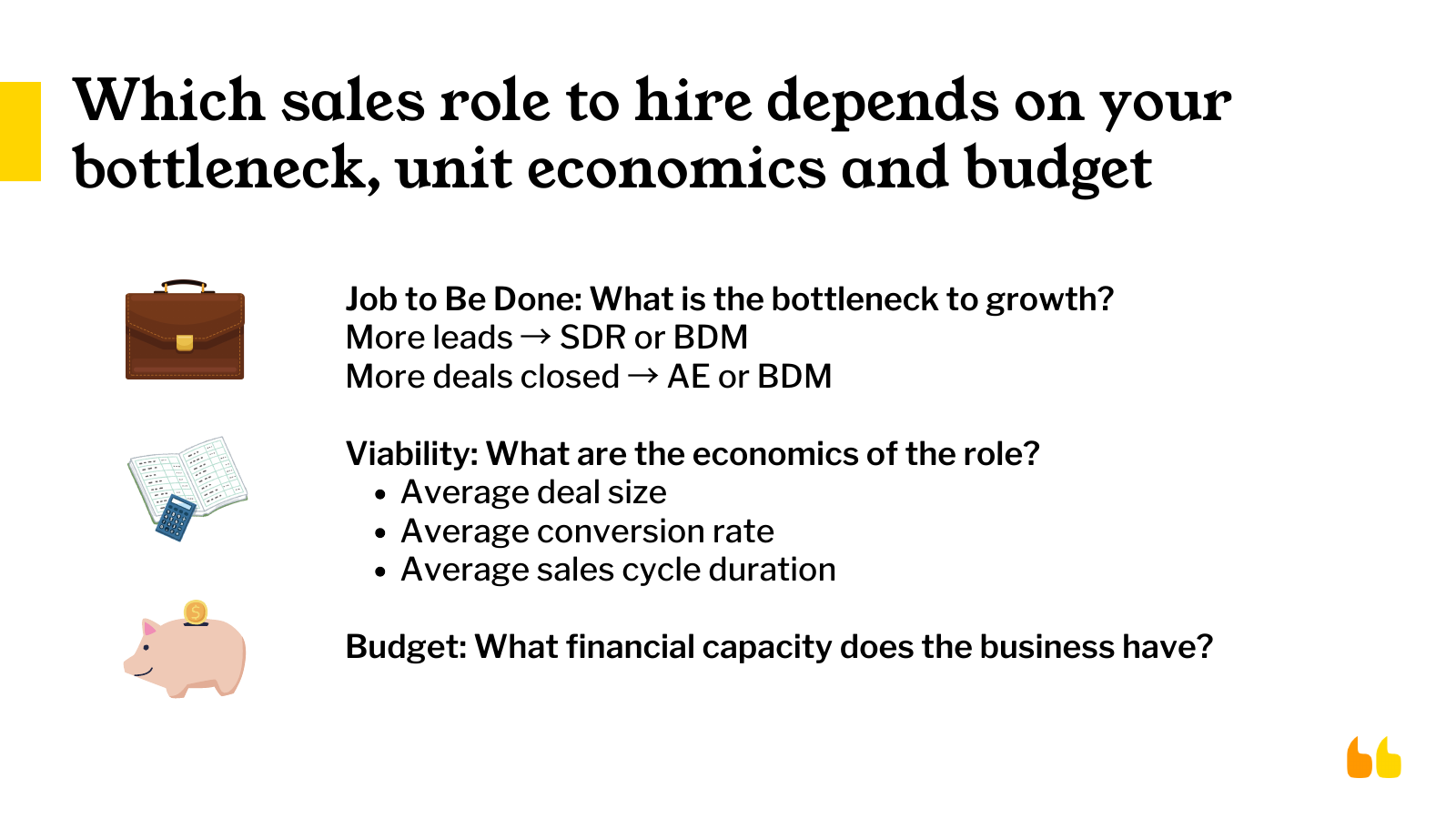
The question that picks between them is simple: what's actually stopping your revenue? If meetings close well but the calendar is empty, the gap is top of funnel. If leads are plentiful but sales cycles are stretching and conversion is slipping because everyone is spread thin, the gap is closing capacity.
Then comes viability. Dan's rule of thumb: a salesperson should produce at least three times their salary in revenue. Model it before you hire. Take your average deal size, your meeting-to-close conversion rate, your sales cycle length, and check whether a standalone SDR on a typical salary even makes sense.
"Half of my discovery calls are with founders working through this revenue architecture, and they realise very quickly: this only makes sense if the SDR is booking 30 meetings a week and we're converting a crazy number of them." — Ricky Pearl
One caveat on the maths: your business objectives sit above the economics. Ricky pointed out that a lot of what the industry believes about SDR roles comes from funded startups between rounds, where every $100,000 of new revenue supports another $1 million to $2 million on the next raise. Those companies will happily spend half a million dollars to generate $100,000 in revenue, and for them it's rational. If you're not on that merry-go-round, don't copy their playbook.
What Sales Roles Pay in 2026
Benchmarks from the session, based on Sydney and Melbourne B2B roles over the past 12 months plus Pointer's live database of 70,000+ advertised ANZ go-to-market jobs:
| Role | Base | Commission | Typical split |
|---|---|---|---|
| SDR | $60K–$80K (average ~$65K) | $15K–$50K (hovering ~$30K) | 70/30 to 60/40 |
| AE (new to closing, software) | From ~$100K, ~$120K typical | Matches base | 50/50 |
| AE (mid-market and above) | Climbs quickly | Matches base | 50/50, sometimes 60/40 |
| AE (enterprise) | Bases into the $200Ks at large vendors | Varies widely | 50/50 |
That puts a typical SDR total package at $75K–$115K, with $95K the average. Weight your offer up or down the range based on sales experience, domain experience, and what your vertical benchmarks at.
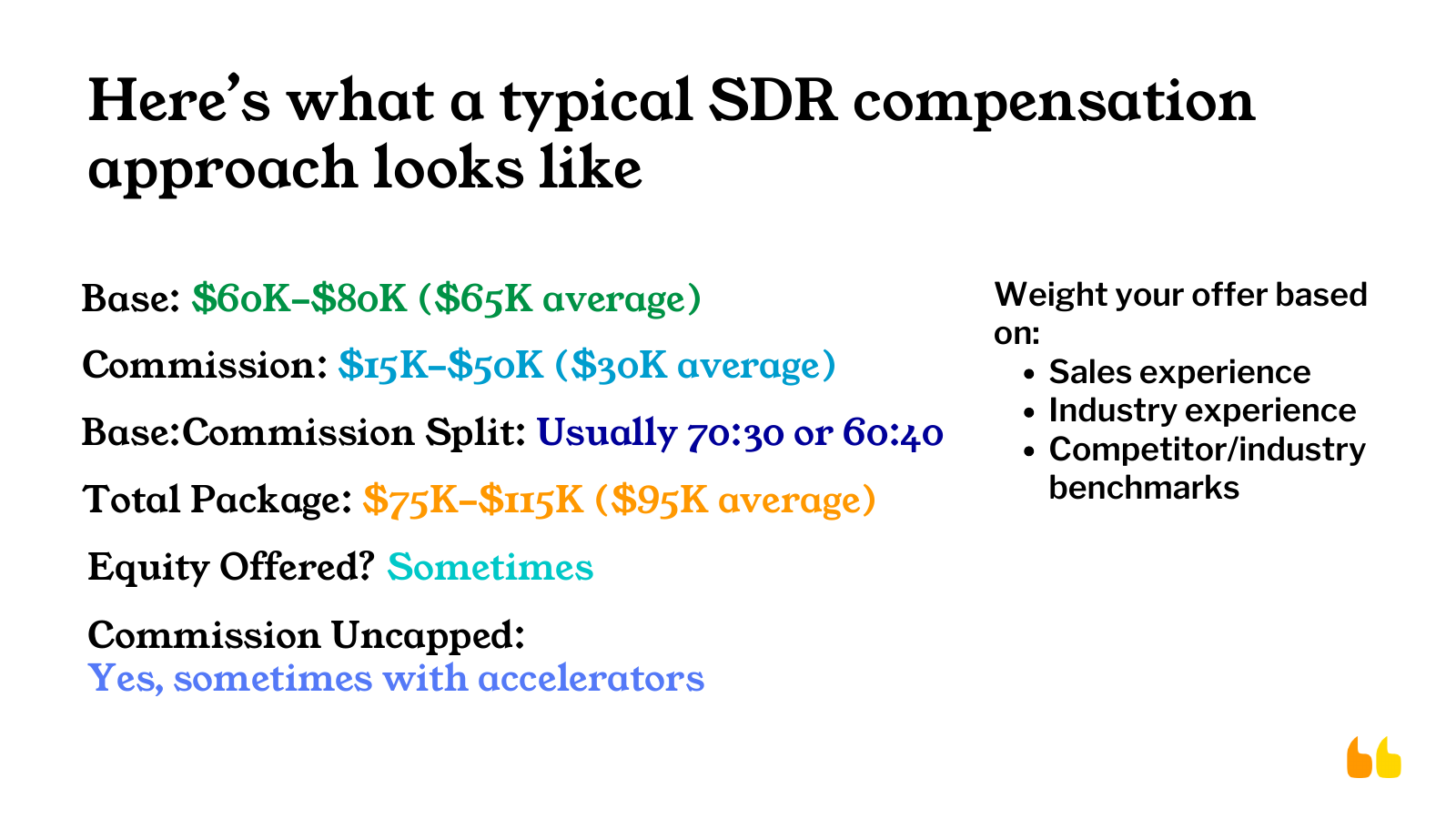
Why the split changes: an SDR sits further from revenue, with more cost between their work and a closed deal, so more of their pay is fixed. An AE is the bulk of the acquisition cost for the deals they close, so it's higher risk, higher return.
Two things the market gets wrong:
"Uncapped commission" is not a perk. Dan's gripe: companies list it like it's free snacks. It's table stakes. If you cap commission, your best rep learns that overperforming pays nothing here and something everywhere else, and you lose them. Ricky went further: drop the term entirely, because commissions are always capped in practice. You're limited by territory, by TAM, by time, and when you smash quota this year, next year's target gets rebuilt and the money gets clawed back into the plan. Experienced reps know to ask about that.
For SDRs, compensation matters less than you think. Nobody picks between a $60K and $65K role based on the money. They pick based on progression. Dan has watched SDR candidates reject higher bases because there was no visible path to AE, and take lower ones where the path was clear. You can pay under market and still win better talent if the role around the money is right. For AEs, the compensation becomes a much bigger driver, and the sophisticated ones negotiate the commission plan, not the base.
If you want to see where a specific role sits right now, Pointer's market data tracks every advertised ANZ GTM role with live medians and percentiles.
Commission Design: Pay On the Right Thing
A number without a mechanism is meaningless. "Base plus $30K commission" tells you nothing until you know what the $30K is earned on. Dan's three principles for designing it:
For SDRs, the common models are qualified meetings, meetings attended, or qualified opportunities, sometimes blended with a kicker when deals close. In short-cycle, high-velocity businesses where the SDR genuinely influences the close, you'll sometimes see them paid directly on closed deals at a smaller percentage.
The one model both speakers ruled out: paying on meetings booked. You can book a meeting with anyone. They might not even show up. A booked meeting is not a pathway to business value. Or as the slide put it: NEVER JUST BOOKED MEETINGS.
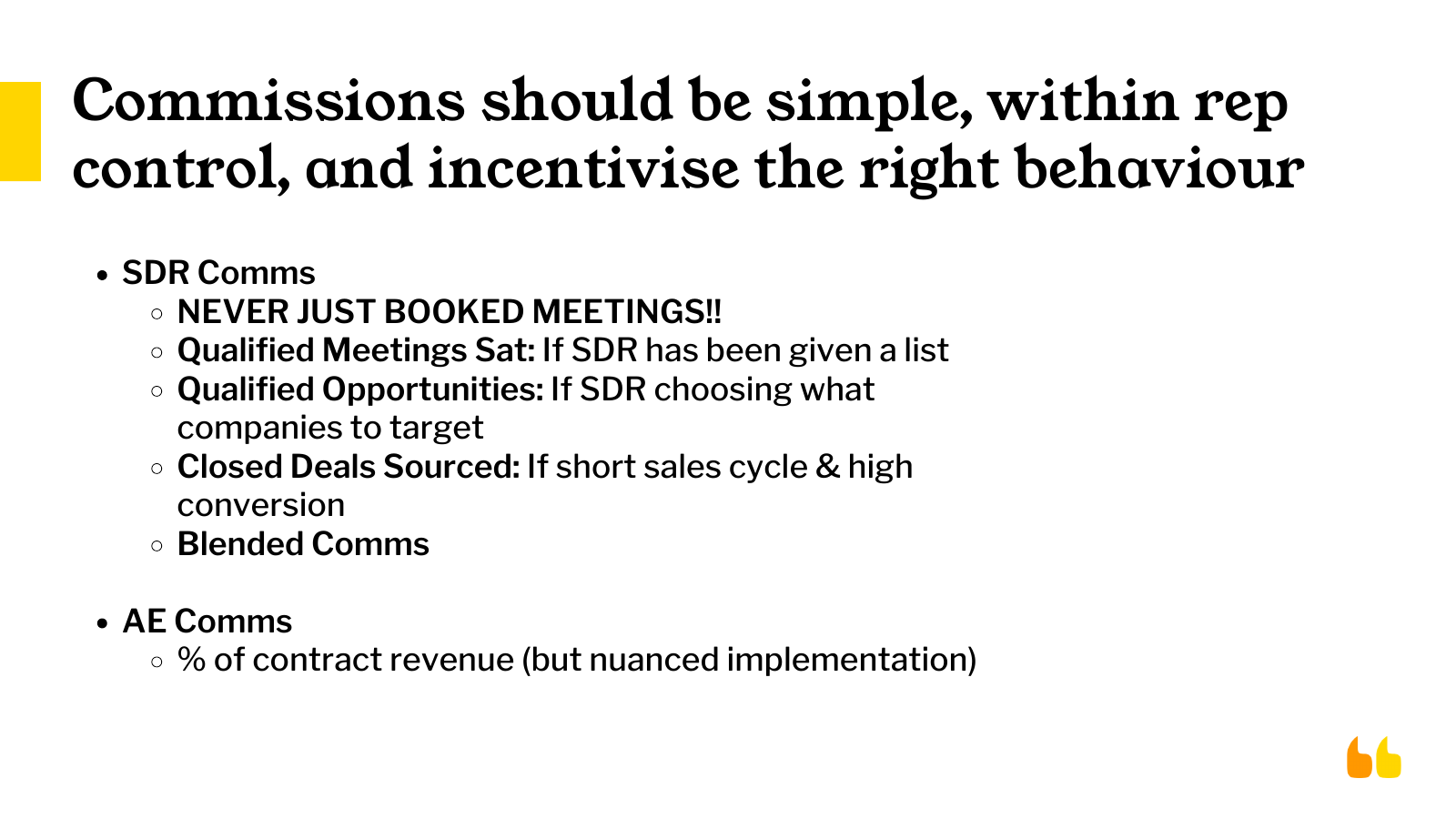
For AEs it's almost always some share of contract revenue, though usage-based and land-and-expand motions are complicating that fast. How do you comp the rep who signs one seat of an AI product and watches the account expand to millions of tokens?
"Some of the most complicated spreadsheets ever built were to launch rockets into space and to calculate account executives' commission." — Ricky Pearl
Targets Are Management. Commission Is Compensation.
This was the sharpest distinction of the session. Compensation answers "what's fair pay for this work at market rates". Targets and KPIs answer "is the machine working". Muddle them and you break both.
"If the only thing we were measuring was revenue, we wouldn't need any sales managers. There are countless activities that are precursors to revenue, and those are where you put your targets and KPIs." — Ricky Pearl
The reason you track the leading indicators is diagnosis. Ricky's line:
"SDRs don't fail companies. Companies fail SDRs." — Ricky Pearl
He gave an example: an SDR missing target while effort was up. The actual problem was their phone number had been flagged as spam. Connect rates had collapsed. If you weren't measuring connect rates, you'd have managed the rep instead of fixing the phone number.
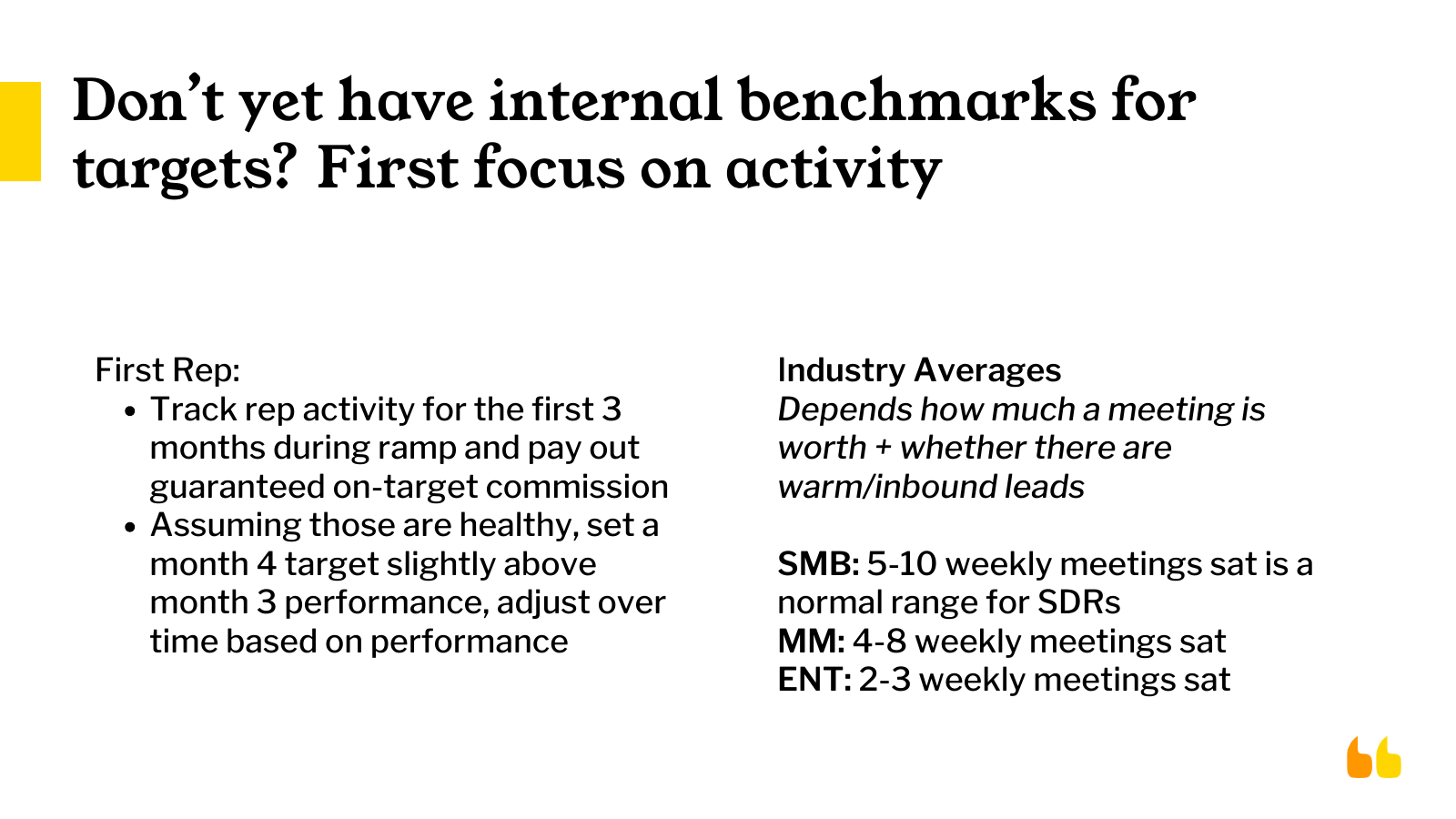
Setting a target for your first hire. When there's no internal benchmark, don't pluck a number from the air and bake it into an offer. Watch activity for the first three months (a normal SDR ramp), pay out what on-target commission would have been during that ramp, and err generous rather than accidentally screwing over a rep because your model was wrong. Whatever they're producing in month three becomes the anchor. Set the ongoing target slightly above it and adjust from there.
What's a reasonable meeting target? It depends entirely on what a meeting is worth to you, which is a simple calculation: average contract value times meeting-to-close conversion. The loose industry ranges for a fully-ramped SDR: five to ten meetings sat per week in SMB (and five is a fine starting target), four to eight in mid-market, two to three in enterprise. And at the extreme end everything changes. One Pointer client targets one meeting per week per rep, and works on quarterly averages, because they sell multi-million dollar deals. One closed deal in ten years covers the rep's salary.
The 70% rule. An audience member asked what percentage of reps hitting target signals a healthy team.
"If less than 70% of your reps are on target, there's a problem with the expectations. If more than 70% are hitting it, same story: the targets aren't high enough, or you should be carving territories differently, or hiring more." — Ricky Pearl
Dan added the metric candidates should actually ask about: not on-target earnings, but average total earnings across the team last quarter. Some companies use a shiny OTE to draw people in, the number turns out to be unreachable, and the rep churns. It's a short-sighted gambit that costs the company the hire and the rep a year.
Interviewing SDRs: Hire the Slope, Not the Intercept
An SDR hire is a junior hire. You're buying attitude and upside, not a track record. Two to three rounds is plenty (behavioural for sales-career fit, technical for your sales approach, cultural for your org), because SDR talent is supply-constrained and slow processes lose the best candidates to faster companies.
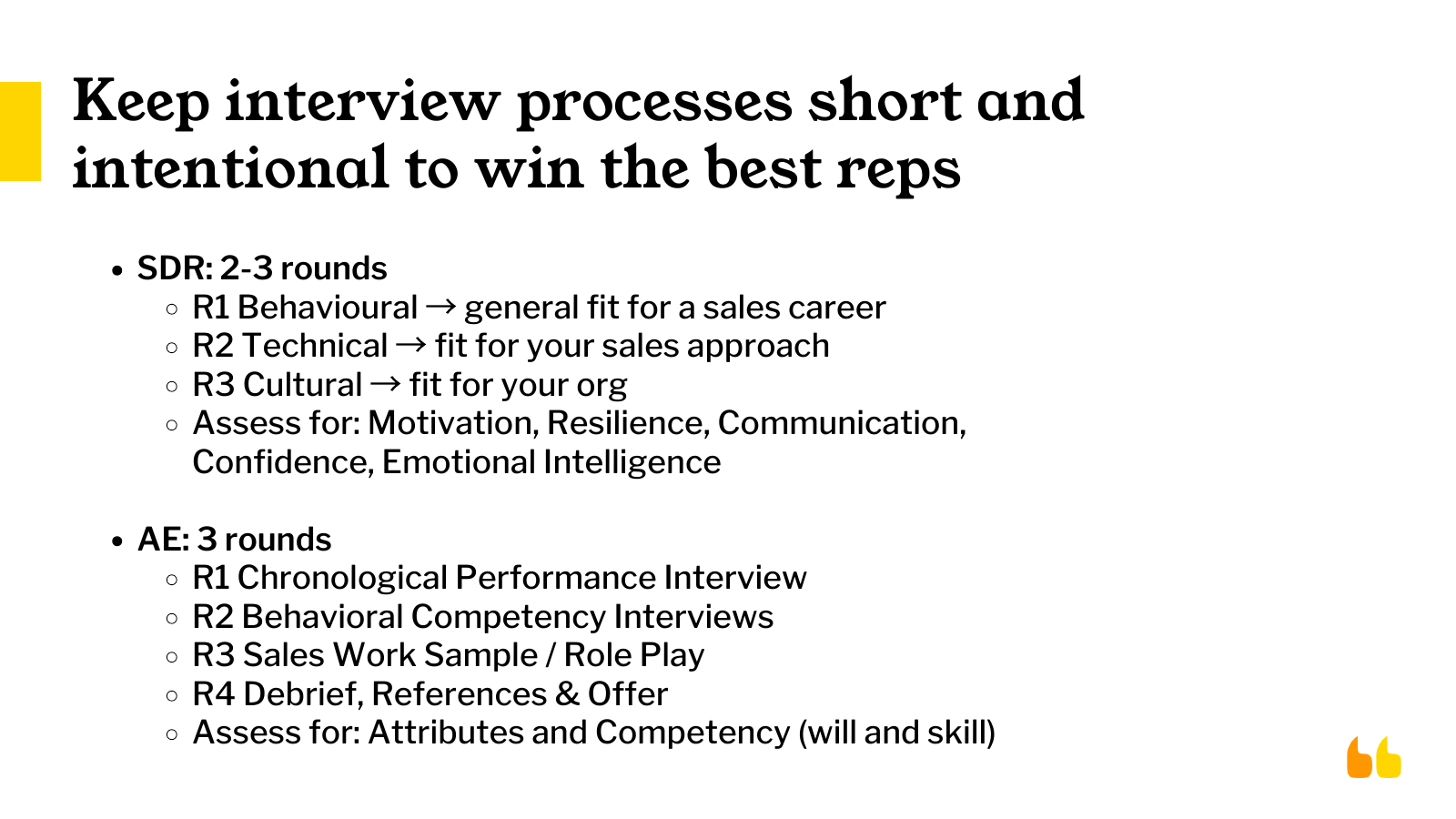
From 700+ job placements over three and a half years, Earlywork's screening framework comes down to five attributes: motivation, resilience, communication, confidence, and emotional intelligence. A rep low on any of the five will struggle in sales long term, whatever flashes of promise show up elsewhere.
But the single biggest mistake Dan sees is companies never testing selling at all. Purely behavioural interviews select for people who talk well about sales, and salespeople are professionally good at talking. Some candidates who say "yeah, I'm up for cold calling" will be drained by the fundamental nature of the work within a month.
The fix is a live mock call in the interview. And the point isn't the quality of the call. These are juniors; most haven't done the job before. The point is what happens next: give them feedback and run it again.
"What you're looking for is not the starting point on the graph, but the slope of the graph. Are they coachable? Can this person improve between calls?" — Dan Brockwell
Prospecting challenges and mock email responses work the same way, provided you run them live. Take-homes are now a test of who has ChatGPT, which is everyone.
Interviewing AEs: An Investigation, Not an Interview
Everything changes at the AE level, because now there should be proof. The same five attributes still matter, but experienced closers are professionally good at rapport, positioning, and storytelling. They interview brilliantly. That's the problem.
Ricky's answer is the chronological performance interview: walk their resume together, company by company, and peel the onion. They were 150% to target? Good. What was the target, and was it sane? Where were they ranked? Because 150% to target can still be last on a team of 20, and top of the team can be 65% to target at a company that never learnt to set them.
Then overlay what they should know. If they ran enterprise deals for a year at a company that used MEDDPICC, they should know MEDDPICC intimately. If they don't, you've learnt they're not motivated by the craft, or they're not a fast learner. Either way you've learnt something the behavioural interview would have hidden.
The second lens: how they run your process is how they'll run deals.
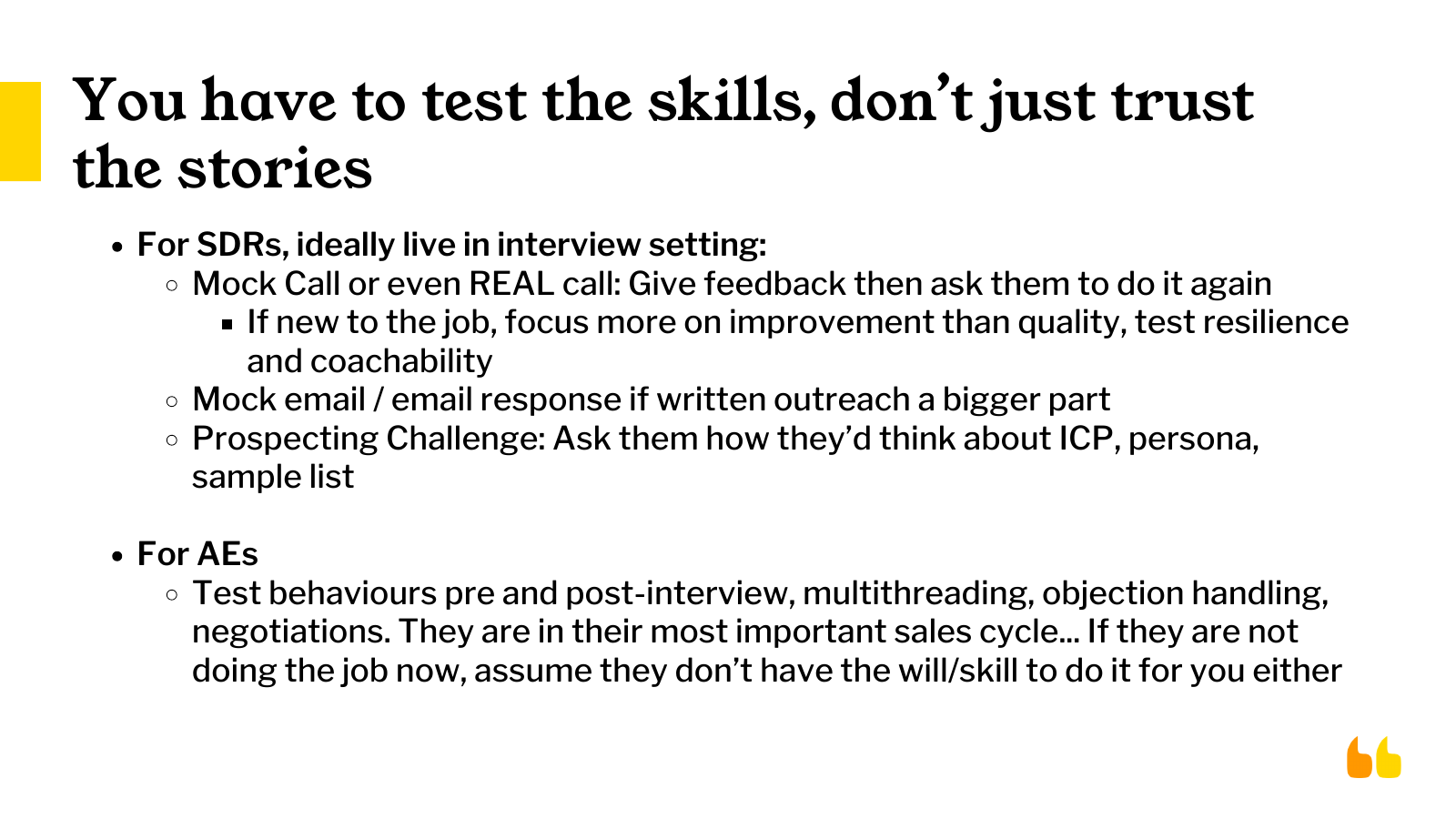
"Applying for an account executive role is potentially a $200,000-a-year deal they might hold for five years. That's a million dollar deal they're working. If they're not multi-threading, following up in a timely manner, and doing everything they'd do on a million dollar deal, assume they won't be doing it in the job either." — Ricky Pearl
Pointer builds tests around this. Tell the candidate "we'll get back to you by Friday, close of business" with no intention of doing so, then watch who follows up on Monday and adds value while doing it. Do the job to get the job. Dan has seen reps lose offers not in interviews but between them: slow email replies, sloppy phone manner while booking a debrief. For a salesperson, all of it is the interview.
And then stop interviewing and start verifying.
"You could spend 90% of your time reference checking and 10% of your time interviewing, and you'll make better decisions." — Ricky Pearl
Not the references on the resume. Treat it as an investigation. They told you about the Qantas deal in the behavioural round? Ask to be connected to the economic buyer or the champion on that deal. Then go to back-channel references, because in this market everyone knows someone who's worked with someone. Five, ten, twenty years of doing the job leaves evidence. Go find it.
From the Q&A
Early-stage comp when you can't guarantee ramp. You don't have to. Guaranteed ramp is mainly for prying on-target reps out of comfortable seats, or for long sales cycles where top talent won't otherwise move (12-month cycles can mean paying full OTE for the first year). For everyone else, the trade is risk for upside: equity, and disproportionate title and career growth. Some heads of sales running big teams today only got there by being the first sales hire somewhere risky. What breaks the deal isn't low commission in month two. It's a rep who expected to earn one number and landed on another. Set the expectation honestly and most reps in 2026 get it.
Steering reps toward bigger deals without rewiring comp. Remuneration is one of the weakest motivators, especially for SDRs, and mis-designed incentives create real damage. Ricky has seen AEs form cosy arrangements with SDRs to load deals they'd already found, because management was comping on deals opened. Use spiffs sparingly, use recognition liberally (a "big dogs" slide in the weekly meeting, deal-size records on the wall, the John Cena walk-in music one attendee's office plays for large deals), and remember the biggest reward on offer is promotion. Ricky's framing for every SDR he's hired: you should be on a path to $300K earning potential in a sales career, so the choice between a $65K and $75K job today is irrelevant. Take whichever gets you to $300K fastest.
Key Takeaways
Your Speakers
Dan Brockwell is the Co-Founder of Earlywork, Australia's first sales school, which has helped 700+ people land and grow sales careers over the past three and a half years.
Ricky Pearl is the Founder of Pointer Strategy, where he's worked with 200+ GTM teams in APAC on strategy, hiring, and implementation.
Earlywork Joins GTM ANZ
The session closed with an announcement: Earlywork is joining forces with Pointer on the GTM ANZ Community, the WhatsApp community formerly known as Tech Sales ANZ. It's already 600+ revenue professionals across sales, marketing, and partnerships, with a simple premise: whatever question you're sitting on, there's a place to get high-quality answers from people who actually do the work. It's free to join.
<details>
<summary><strong>Full Transcript</strong></summary>
Dan Brockwell: Thank you all so much for tuning in live for this one. Really? Yeah. Special fun club we've got going up today. So, for those that don't know me, my name is Dan. One of the co-founders of Earlywork. We run Australia's first sales school, teaching young people about sales because the unis don'ts. And joining me very lucky to have Ricky Pearl, who's the founder of Pointer. Ricky can probably share a few words about himself that will be more elegant than what I would say.
Ricky Pearl: Usually not. Pointer is just a go-to-market recruitment company. We do some outsource sales, but broadly just trying to weave ourselves into the fabric of the go-to-market ecosystem in Australia.
Dan Brockwell: Hell yeah. Ricky and I have known each other for a number of years now. We've probably focused on SDR hiring and Ricky on kind of A and senior sales hiring. And we kind of started to realize chatting between each other that the standard deviation and I guess the hiring process quality for sales teams across Australia was super, super high. There were some teams having very strong, robust processes. Others who were overdoing it, testing the wrong things, not doing enough. And so what we wanted to do was put together our combined knowledge, having seen both junior and senior sales roles, seen probably over a couple hundred companies play out hiring cycles between us. And actually look at what are the common patterns in how the best teams we've worked with have gone about hiring sales reps and actually designing their roles in the first place. So for the first bit, we're going to run through some content around like, you know, folks here who might be sales managers, founders, even if you're a sales rep and leading a team internally. How do you think about designing and building both a role, a target, a compensation strategy, and then an interview strategy? And we do want to have a bit of time at the end as well for Q&A. So I guess like the first piece is like really important to call out and we kind of you've got a bunch of thoughts here is a lot of you folks in the audience who, you know, maybe expanding sales team might be thinking about, hey, you know, what is the role that I need to hire for my business? You kind of know, oh, we need help with sales. But the question is like, which role is it going to be, right? And you know, you think about these like three core flavors typically in the world of net new logo sales of either sales development representative, which is booking meetings, an account executive that's taking existing meetings and then closing those deals and a BDM that's doing that whole process end to end. And so, again, so the first question you need to kind of ask yourself in your specific sales situation, a very company by company is what is the main role like to growth? Like what is stopping your revenue from kind of getting to kind of that next level? And for some companies might be like, hey, we actually need more leads. Like, you know, we've got meetings in the calendar and we're closing them. But there's the top funnel. And for some companies, hey, maybe there's a ton of leads like, you know, to go after warm leads once they're coming through the calendar. But potentially sales cycles are getting stretched out because you stretch thin the conversion rate starts at high as you'd like to be because, you know, you're not able to spend enough time on each lead that is coming through. And so that's probably where you kind of get this core split of like, you know, do you kind of proline more SDR or more account executive and obviously, you know, get into some kind of the viability piece. But yet there's the end to end role of BDM, which kind of more it comes down to, I guess, like economics of the business. But I guess we'll keep on that first point before we kind of dive into some of the other considerations, like any thoughts there around like, yeah, hiring motivation or hiring driver.
Ricky Pearl: Yeah, I think it's like you put there, like what's the job to be done? Where do we need to fill the funnel? What's what are we solving for here? They obviously it does get more nuance, right? Because this doesn't this works at this high level on the assumption that an SDR can always book a meeting. But sometimes by design, you might need exceptionally high context in order to even engage like, you know, some of these companies selling really deep technical products, might skew towards needing the right people on the actual phone begin with. And so there are areas why and this is a BDM in this case, specifically because those two have that overlap in that sales development function. So but yeah, broadly, it's like where we're trying to solve for in our funnel. And let's put some resources at that.
Dan Brockwell: Yeah, I think on that point, the it's like where you kind of get the SDR BDM split, then comes down to some stuff we're discussing on deal viability, like there are some companies where actually, you know, the deal size is fairly small. It might not make sense to have a standalone role like an SDR just to book the meetings. And so you want to think about it as like, hey, you know, if you're paying someone to do a sales role, you're hoping that they're producing at least three times their salary in revenue. And so it's thinking about, well, hey, like what I could do is our average deal is what percentage of meetings convert? How long does that take? And based that you can kind of like run a model of like, well, hey, does it even make sense to bring in someone on kind of a typical SDR sort of salary to do this job?
Ricky Pearl: Then half of my discovery calls are talking sales leaders or not normally sales leaders, they normally get this, but founders who maybe don't through the this revenue architecture and helping them calculate if this role is even worthwhile. And they realize very quickly like, I should this. This only makes sense if the SDRs booking 30 meetings a week and we're converting a crazy number of that. Like there's a certain stage that makes different roles or different salaries or different motions economical. And yeah, we're looking at deal size, conversion rates, sales cycles, and lifetime contract values, velocity. Like there's everything that goes into it. But I think the first thing on design is fundamentally what do we need and why?
Dan Brockwell: And it's fine. For instance, if you look at say like a lot of B2C businesses, the SDR role is a lot less common those structures because, hey, the average cost of getting kind of one extra consumer like onto a product or onto a surface is going to be a lot lower. So like similar to yourself, like sometimes I have conversations come here. It's like, hey, does the SDR role even make sense for you from economics perspective? And I guess the final piece there obviously comes down to like budget for the business, right? And this is obviously going to be constrained particularly when you're looking like, you know, early stage companies, maybe they're pre-funding investors, maybe they're pre-seed or kind of just, you know, early in from a casual perspective. And sometimes it's like, hey, you might ideally want or need a kind of a closing role or an A, but you might not have the budget to get that person you want that has that experience. And I guess your two options there often are like, hey, either you do hire like a junior person and you develop them internally to be able to take on that closing role. Obviously the ramp time is going to be slower than someone more senior. Or I guess there's this other piece, you know, hey, you know, can you get that job done practically part time, you know, with kind of like outsourced approaches. So there's kind of like different ways of solving for the need with limited capacity.
Ricky Pearl: And we also haven't mentioned like we've spoken about SDR, AE, PDM, but there are nuances and differences that with different titles across those, for example, inside sales, you know, where you might be doing that full sale cycle, but going, you know, they won call close, they're very light patch, they very low average contract value type things. There's a lot of nuances. You also get into the top end of SDRs in some organizations where they're going deep into the sale cycle, fully handed qualification, being involved in discovery. So like, this is a spectrum, you know, and we're obviously simplifying it here. And the last thing to add is the objectives of the business. Like this always has to be overarching. A lot of what we learn, particularly around SDR roles comes from these early stage startups that are just in between funding rounds. So every $100,000 they get in revenue, they're going to raise a million dollars or $2 million on their next round. So they're actually willing to spend half a million dollars to raise $100,000 worth of revenue. That doesn't make any economical sense if you're looking at business fundamentals, but it makes a hell of a lot of sense when you're on this VC merry-go-round between rounds. And so we also have to just look at like, what are we trying to emulate here? What are the overarching objectives?
Dan Brockwell: Yeah, I think very thoughtful when you answer that. I think like, obviously, if the goal of recovery is like, hey, to get revenue, to get much more funding through the door, it obviously changes like the economics making sense. But I guess the terminal case, you eventually want to get to a point where it's like, hey, okay, there needs to be kind of a multiplier on that salary. Absolutely. Cool. So I guess, again, assuming you kind of build a hypothesis as a team on, okay, this is the sort of sales we want to hire, then you kind of get to this question of like, you know, compensation. And, you know, in the world of SDR, you know, it's probably a bit more narrow, right? Like, obviously, when you start to get into A, there's a wide split in terms of the seniority, the prospect. But usually, you know, what we kind of see for Sydney, Melbourne roles kind of past 12 months, typically, the base for an SDR will be kind of in that 60 to 80K range. And in the 65K is probably the average. And again, this is typically kind of B2B roles, typically kind of local companies. Mission, obviously, you know, depends on inbound versus outbound. Inbound roles are going to have like a lower commission ratio. But often that's in the realm of 15 to 50K, kind of hovering around that 30K mark. And so usually the ratio you will see when designing a commission package for an SDR is probably around the 70, 30 to 60, 40 ratio. And Ricky, I know you can kind of talk to the nuances here for kind of an accounting executive, where it can be like a little bit more aggressive on the commission side.
Ricky Pearl: Yeah, I think your average account executive in Australia is 50-50. Yes. That's most common. And obviously, you know, we've got on the next slide, but the pays are quite different. And I think this also just comes to the economics of the role. There is a bigger gap between the SDR and the revenue. There's a lot more costs that need to go into acquiring that customer. Whereas the account executive is the bulk of that expense. And so it's much easier to just say, like, hey, if that revenue comes in, like a huge chunk of that's been because of you, we give you a share of it. So it's higher risk, higher return. But yeah, typically 50-50, sometimes 60-40, you know, and 70-30 once you're in your CS account management side might be more.
Dan Brockwell: Yeah. It's like existing logos is obviously a different story. It comes down to like, yeah, then like what is the marginal difference of like, you know, how involved are you in kind of like the decision front? Is that person going to be a customer or not? And then, you know, how likely would that outcome anyway, I guess.
Ricky Pearl: It's something we didn't put on the slide here. And it's pretty, I just want to mention it maybe is that particularly for SDR roles, the compensation is often less important than you think. Like, I don't think people are picking the 60 or a 65K role based on its revenue. Yeah. I mean, based on the income and how that's going to support their lifestyle. Like they're rarely looking at growth, company, trajectory, like a whole lot of that. Like you can pay less if you've and still win better talents if you've got the right things surrounding the role.
Dan Brockwell: Higher percent. Yeah. We've seen, you know, SDRs, you know, SDR candidates like reject roles, you know, where, hey, it might actually be in a high base, but there was no clear progression pathway to say account executive, account manager. You say, yeah, candidates often sometimes even take a bit of a lower base knowing that, hey, in 12 to 18 months, that's going to get me to a point where I will be earning a lot more. Yeah.
Ricky Pearl: So super important. And there are things like that for an account executive, of course, like the, but the compensation starts being a much bigger driver.
Dan Brockwell: For sure. I think approaching other factors that I think about is like, you know, I have this like funny gripe where like you'll see a lot of companies be like, oh, one of our perks is like, you know, we've got like uncapped commission. It's talked about like, like a perk. Yeah. I think this is, you know, an industry default, like this is like table stakes. At the end of the day, if you're, if you're operating in a model where you have cap commissions, what you're saying is, hey, if you continue to bring more revenue to this business, like you're not going to get paid anymore. When there's no financial incentive there, what happens is someone who's a top performer goes, well, hey, other companies are going to pay me if I overperform, you're not. And so you end up losing your best people.
Ricky Pearl: The thing is, I actually just think everyone should drop the term entirely because there's always capped commissions because you limited on size. I mean, time, you limited on territory. You limited on, on a whole host of things. So like you, you might own any one year exceed it, but then the next year your targets get changed because the actual targets are dynamic. So like, you know, it is like, yeah, it protects you from that one windfall deal that you bring in that was like five times above quota because you signed this logo, but make no doubt, make no mistake that next year your targets are changing and they claiming back a lot of the money. So like, I feel like it's this term people use, but it is so uncommon to actually have capped commissions.
Dan Brockwell: Yeah. Most employers now like wouldn't use it. I think really the difference is almost like, is it an organic cap or an artificial cap? Like, but yeah, normally, hey, there's a fund, you know, there's a TAM, there's a certain patch, there's only certain leads you can go after, but it's like, yeah, you don't want to place an artificial ceiling in a rep could over-perform that.
Ricky Pearl: Yeah. And because if you do over-perform, what's the next year they're going to hire another rep and carve up your territory a little bit, makes it harder to over-perform, you know, so like all of those things come into it and your experienced reps know what to ask and what to look for. But if we're just talking high level compensation, absolutely uncapped is absolute type of stakes. You know, these days like equity, if you're going into a high risk startup, same story.
Dan Brockwell: For sure. And I guess like broadly kind of like summarizing here as well, obviously, we're giving some ranges and Ricky's going to go some stuff around the A side, but you obviously need to consider, hey, like all the brief that you have, like how does that candidate suck up in terms of obviously their sales experience? Do they have domain specific experience? Usually you're going to be paying like on the higher end of that range showing if they do and also obviously your vertical and industry benchmarks, you know, something, you know, you say if you're in the cyber security space, oftentimes, you know, hey, Sarge might be a little bit higher, obviously kind of SaaS or other industries tends to outperform. But yeah, Ricky would be good to kind of, yeah, share a little bit more about like how you've kind of built the benchmark database you have kind of more senior and a broader range of sales roles.
Ricky Pearl: So for account executive, it's a bit more of how long's a piece of strength, right? There's reps that are fully commissioned all the way through to account executives earning seven figures. So it's much harder to find a specific range. We've built this from pretty much every job that's been posted in ANZ. It's a rolling total at the moment. It's just over 70,000 jobs and it lists the advertised price. So it's a live market snapshot of average median salaries for these roles. And, you know, what we're looking at there on the right hand side would be like your, you know, your P75, your 75th percentile and your 25th percentile and your median, your 50th percentile. And yeah, we're typically seeing like your account executives kind of started $100,000 if you're in software, like more or less around there. And they're all mostly 50-50. Once you get to your 120, I think that's like your classic, you know, account executive salary for someone who's relatively new. And then once you start climbing into your mid market and above, like it really does climb pretty quickly. Again, these are the averages. So it's really hard to look at because once you get into enterprise, your WASTI is very much any vary you're going to pay, but you also will find base pays in the 200s quite, you know, at your oracles and your Cisco's of the world.
Dan Brockwell: For sure. Yeah. I think that's, and that's the thing. It's like, you know, just because you had all one company pays this or that, obviously you need to consider like the new answers of like, Hey, like in that role, you know, the contracts you're bringing in, how much are there, where, how much is being brought in, what's the levels portrait marketing around leads. And so you, yeah, it's not just like, Hey, here's the number for an account executive is not a simple.
Ricky Pearl: A lot, a lot more interested in that commission. Like it's 50% of your pay and people go in there negotiating so hard on, can I get an extra five grand a base? Can I get an extra 10 grand a base? But you've actually got no idea on how easy or hard it is going to be to get the other 50% of your, of your compensation. I think there's a lot more nuance in how the commission is earned and that needs to be seen, but yeah, like if you want the market rates, you want to see where your role sits. You just go to that link and it will show you it's live, it's updated, it's unbiased and it's, you know, 70,000 rolls and 70,000 go to market rolls. Yeah.
Dan Brockwell: Awesome. So that's obviously kind of the compensation piece, what sort of role, but then like, you know, it's funny. It's funny, right? People be like, Oh yeah, the basis of the commission is this and see to kind of throw out a number. The question that becomes, well, Hey, like what is actually that commission being earned on? Like if you think about, you know, Hey, you're kind of sitting there trying to design a role for your team. Like what should we be paying the reps on? I guess, you know, three principles I generally like when it comes to commission design is like one, it would be simple. You don't want to have like five different things with the rep code. It doesn't even know like how it's calculated or what's going on. It's just hard to, you know, shoot for and hunt for. Two is ideally it's something that's within that reps control or pretty close to it. You don't want to have a situation where like an SDR is doing amazing work and then getting no commissions because their A's aren't pulling that way. And thirdly, I think you want to incentivize the right behavior because you can have, you can give someone a target like calls and they can go and call, you know, random leads that aren't actually relevant, right? And so when we think about kind of SDR commissions, I guess there's a couple of different models you see here. Usually the most common one will either be on qualified meetings, saddle meetings attended or qualified opportunities. So the distinction here being like, you know, either, hey, an SDR book's a meeting and the person kind of, you know, rocks up and is at least kind of, you know, a prospect that is like a relevant prospect type or then actually, you know, in some situations, like if they're kind of controlling which companies are targeting the first place, okay, does that company actually be kind of progressive from that meeting to a further conversation? Now you will see like in some environments where the rate is very high or if it's a very short sales cycle, then really like the SDR has a lot of influence over where the deal closes. And so in those you'll sometimes see it as being paid directly on deals closed similar to an account executive, but usually a smaller percentage. As teams kind of mature over time, it is common also to see like a blended kind of common structure where like, you know, you get probably, you know, often see the majority of, you know, commission around some meeting related target, but in a kicker, if their deal do close. But I think one thing we're pretty aligned on is like, you never just want to have a commission amount on a meeting booked, right? Because you can book a meeting with anyone and they might not even turn up. So it's like a meeting booked is not necessarily a pathway to business value. But obviously, really, I think with account exec, you know, usually this is going to be some sort of contract revenue. They're closing the deals, but there's obviously a fair bit of nuance there depending upon what I type. That's what I type.
Ricky Pearl: Some of the most complicated spreadsheets ever built were to, you know, launch rockets into space and to calculate account executives' commission. Like they rarely can get super nuanced. Ultimately, it's usually a share of revenue. It's just now with land and expand motions with usage based motions. How do you compensate the rep that sells AI into an enterprise and on the contract they sign one seat and one person and then that company expands to use millions and millions of tokens or billions, whatever they're measuring in over the course of that year. It's usually some form of revenue share, sometimes usage, but usually, you know, sorry, Shava just made a comment there. We will definitely touch on that in on the next slide where we're talking about targets and KPIs. But there's I think it's important to differentiate commission and maybe it's time to jump into that, Dan, but there's it's important to differentiate commission and compensation from targets and KPIs. And the reason you need this distinction is like one is like what's fair compensation for the work being done. You've got to be on market. It's got to be equitable. If you're not, you're going to lose good talent. If you're overpaying, you're wasting money and you're slowing growth. So that's one thing to get right. What you track and measure, like we're measuring, we're paying account executives on revenue. Like if the only thing we were measuring was their revenue, we wouldn't need any sales managers. Like there's countless amount of activities that are precursors to revenue and those are where you put your targets in your KPIs.
Dan Brockwell: Yeah, and that's it. Yeah, I very much agree. I think, you know, Shava took on your point in the comments. There are things that are good leading indicators of effort and it's like sometimes Nest looks like they might be doing the right things. Hang on a minute. There's not quality opportunities happening. So studying those metrics of things like how many calls are being made, how many contacts have been enrolled in sequences, how many meetings are being booked, held you in combination with those later metrics that are usually kind of the core commission based targets. Where is the problem happening along the chain when things aren't going to plan? Like you want to understand like at what point we're seeing kind of that drop off.
Ricky Pearl: It's so important Dan, because I'm sure you'll see, I've got the saying like SDRs don't fail companies, companies fail SDRs. So often when reps aren't successful, it's actually something that's outside of their control. So you need to be measuring every element of this recipe for success to figure out where the problem is. Like we've had SDRs miss targets, but actually their phone number was coming up a spam. You know, but you would have noticed that if you had seen the drop off in call connect rates, even though effort was up, but if you weren't measuring that, you wouldn't know where to find it. So pretty critical, but still separates to commissions.
Dan Brockwell: For sure. And I think it's a nice segue where I think obviously, hey, it's good to have that like, you know, very clear commission model, ease it on and incentivize the right behavior. But where it gets challenging is like, you know, we're both Ricky and I work with a lot of companies for hiring their first ever account executive or their first ever SDR. And the question is, well, what is a fair target? How do you suddenly pluck this number from thin air? That's like a quite a confusing challenge. And you don't want to, you know, what's the world in an offer and then realize, hang on a minute, the target, the actual reality is going to be no idea that. So what we often see is like when a company hasn't yet had, it's a new team, a new type of role, it's their first role ever. When you don't have those internal benchmarks, what you can do is when you kind of bring on that first rep, first start by looking at their activity over the first three months. That's not to say like activity is not the goal. It's not the end goal, but you don't necessarily know what the right target is going to be straight away. What you want to at least see is like, hey, in their first three months, it's natural SDR. Round time is going to be around three months, depending upon the sector. But over those three months, are they putting in a consistent effort in terms of, hey, enroll the right number of contacts doing a decent amount of calls? And by default, it's kind of like, like when you don't have those benchmarks, err on the side of being generous rather than accidentally screwing over an SDR because you've kind of gotten your target modeling wrong. So you can see during a ramp period, a lot of companies pay out what the on-target commission would have been. Now then what happens is, okay, after three months, you know, an SDR, you know, unless it's a super complex product or environment, usually kind of by then, they're kind of close to the point where they can kind of start to hit full targets. And so whatever they were hitting in month three in terms of, you know, call it meetings attended or qualified meetings, you can usually then use that as an anchor and try and set a target above that slightly. It's a little bit more ambitious and kind of that then starts to become your water mark that you can adjust over time based on obviously how the market evolves. Some things are seasonal. We'll kind of jump into some obviously like industry average pieces there, but I guess like, yeah, Ricky, any kind of thoughts on this before, err, an account executive situation in terms of leading indicators to track?
Ricky Pearl: Yeah, I think for both is you also need to like measure this against the economic model that you had like too many targets or sets based on that financial model. Like, hey, we need every rep to hit 20 meetings, but they haven't been like means tested, like bottom up. Like, is that actually feasible? When it comes to account executives, like they certainly are benchmarks on, on the ratio of their earnings. Like, you know, let's just say five times their OTE is, might be a typical SaaS benchmark, but different verticals, different industries, different segments that might be a little bit unique. So the things that we'll be tracking would be things like, you know, the full revenue architecture of their funnel, new deals being loaded, from those deals being loaded, what are the conversions through to each stage? What's their, their deal management's like? Like what are their scores on all of the different metrics on conversions through all the times through those stages? And when you start seeing problems there, that's what you manage to. So Ease will often have, particularly as you go more senior, a ramp plan, you know, first quarter, maybe 25% of target, then 50% of target, then 75% of targets. Meaning if they hit 25%, they get their full commission. And some will have guaranteed ramp. Like if you've got 12 month sales cycles and you're looking to attract top talent, you're going to have to just pay them as if they're on target for that year until they've had an opportunity to get on targets. And you might load, like Dan mentioned, some criteria on activity, deal metrics, new business development metrics, whatever it might be. And sometimes companies have clawbacks from account executives. Like if they don't get those targets, then they essentially have to pay that back. And as well, in account executives, I could really can get nuanced. The difference is by the time you're in account executive, you should be pretty good at negotiating. So, you know, you know what you're in for.
Dan Brockwell: Yeah, fair. And I think obviously the LPSA is like, you know, not just SDRA, but obviously people go down off the hospital, you know, people ask me, hey, Dan, you know, what's a reasonable number of meetings this person should be hitting? And I think this is like a dangerous one where sometimes you'll have companies with either like incredibly unrealistic expectations for their scenario or companies that have like used a benchmark that's actually not relevant for their situation. And probably one of the biggest splits here is going to be, you know, again, how much is a meeting worth, right? In terms of setting a target, that contactor of these points about the commercial model, it's like for an SDRA and account executive to be viable, you've got to be thinking about, oh, hey, like how many meetings do we actually need to bring in? Hey, yeah, we're getting a good like return or multiple on their salary. And obviously, you know, it's going to be a lot easier if there's, you know, warm or inbound leads. Is it a brand that's well known? Do they have a lot of, you know, existing support around them? Like in the context of, you know, SDR and again, these are very loose industry ranges. I wouldn't like weigh on these too heavily, but kind of roughly what you'd often see is in an SMB environment, you know, where it is, you know, high volume, there's a big TAM. And again, depends on their level of ownership around prospecting, discovery calls, how much time they have for the pure outbound outreach. But normally for an S in an SMB environment, you know, fully ramped, you'll see like five to 10 meetings sitting a week is kind of an all range. Often even say like, Hey, like, you know, if you're in an SMB environment, even like five a week is often a pretty good place to start target wise. But obviously with mid market enterprise, you know, it's harder to kind of get those meetings happening, but they're worth more. And so you need to modify and adjust your expectations based on the difficulty of attaining the meeting and the commercial value of it. And so, you know, Ricky, I think you'd mentioned an example even where the enterprise there was a company that was like one equivalent of like one meeting a week, maybe.
Ricky Pearl: No, one of our clients targets a meeting a week is the goal. And if the rep gets more than two in the month, like they still find like it's only if they're getting less than two and they work on averages of a quarter. It's like if they got six meetings in a quarter, they won't be fired. But we're talking all over a million dollars, multiple, multiple million dollar deals. They need one deal to close in 10 years to cover the rep salary.
Dan Brockwell: Yeah, exactly. So it really just comes back to understanding what is a meeting worth in your company environment. And that's like a reasonably simple calculation of, oh, hey, like what is the average contract value of a customer closing? And then what is the percentage conversion rate of meetings to deals actually closing and running that math. Obviously you need to model some assumptions around how long the customer stays and these sort of things. But you can usually kind of represent like, hey, like that's what a meeting is worth to us as a business. And based on that set of target, it's economic, not just based on what has been done before. Cool. There's a lot of fun stuff around modeling for roles. But I know like a lot of folks here kind of stepping in with the theme about hiring and actually in a situation where, hey, we've already got a role. It's got a salary. It's got a clear scope. We know what we need and we just now need to go get it. And this is, I think where like you can have two companies that have like have the same shape and design role and end up making wildly different choices in terms of the type of person they hire. What I'd say when it comes to SDR hiring, at the other day, it's a junior role. You're hiring for attitude and upside, not necessarily just their technical skill today. And so you want to, I guess, like, ensure two things. One, the interview process shouldn't be like too long because you're going to lose out on top candidates. They're getting snapped up quickly by other people. SDR is a particularly supply constraint market. But also you can be intentional about those interviews that you are vetting for the right things. And so typically for SDR, we see this being two, three rounds. You know, some large scale companies might even have one big group assessment day, but they kind of stack those in a single mega interview. But that's often a combination of behavioral, technical and cultural. So one is broadly like, hey, generally a fit for like a sales career. Do they have the right sort of interests and motivations? Then there's going to be usually some sort of technical interview where you go deep and like, hey, can this person actually sell in our environment? Like, you know, let's run them through simulation. And then sometimes you will also have a separate cultural interview, which looks at, hey, fit for the organization specifically, even if they're greater sales. Often though, like companies to do this more efficiently will blend the cultural behavioral into a single interview. And really like, like, you know, the five points going for if we developed, you know, we've had 700 folks land jobs and sales over the last three and a half years. So we've always seen, hey, who performs best, who stays longer, who gets promoted. And the five point framework we recognize at a psychological level, putting aside experiences, just for SDRs, assuming it's an outbound role, what you want to be screening for is motivation, resilience, their communication skills, their confidence, and then their emotional intelligence. If a rep is low to five chances are, you know, they are going to struggle significantly long term into sales role, even if there's like flashes of positivity. Yeah, Ricky, from your side, when it comes to kind of A's, I guess, like how do you think about it compared to SDR role? Like what changes when you start to build at the more senior level?
Ricky Pearl: I think a fundamental thing that changes is that there should be proof now. So the attributes aside, obviously we still want to hire the right attributes, the right attributes, etc. All of the things that you mentioned, like that doesn't change. As you mentioned, if they don't have that, they're going to struggle in sales. They're not going to struggle in an SDR role only. So we want the attributes, but now we're looking for clues. And this is where it gets difficult because account executives, because they are now more experienced, are good at building rapport. They are good at positioning what they want relative to what another person wants, and they're good at storytelling. So they interview very well. So how do we actually now assess people that should have evidence of their skills and their capabilities? And that's the real differentiator here, is if they're a top performer, there should be those signs, and we need to dig into that. So this is almost an investigation as much as it is an interview.
Dan Brockwell: Yeah, I think the piece that jumps out as interesting is like with AEs, you have the work that they've done that you can dig into. With SDRs, there's not much of a portfolio there, but with account executives, they've been there, done that before. And so you have this chance to dig in and understand what is the way that you work currently, what is your current workflow.
Ricky Pearl: And so that's what our process is designed around. So for example, we recommend a chronological performance interview. This is where you just sit down and you'll read through their resume with them, saying, "Oh, you were at this company. Good. Tell me about your numbers." You do that about their numbers. Now you might dig in even further because we're just layering right to the center of this onion. "Okay, that sounds really good. So what were you to target?" "Oh, I was 150% to target." "Where were you ranked in the team?" "Okay, what the 150% to target?" That's not true. You could still be the last on the team of 20.
Dan Brockwell: We're target set reasonably. Whenever you see a percentage to target, sometimes that's something you could have a rep who is under target, who's actually really good at their job. I've seen a team where it's like a rep was top of seven reps of their team and was maybe 65% to target because the target is just not the top.
Ricky Pearl: Absolutely. They had a brutal company that doesn't know how to set targets, right? Doesn't have product market fits. So you rarely got to dig in. And so this chronological one, we're like absolutely leaning into their experience and digging into what they've done to the nth degree. And importantly, we're overlaying that with what they should know. So if they've been doing enterprise sales at a company that used, I don't know, used MEDDPICC as a deal management framework, all right, we've now uncovered this through this chronological interview. Now we can start digging in. Well, if they've done this for a year at a company that used MEDDPICC, they should deeply and intimately understand that. I can now ask them questions about this. And if they don't know, all right, no, this person isn't really motivated by the academics of sales or isn't a fast learner. So we go through this process chronologically, then behavioral competencies, and finally some practical examples and workflows, and then finally, and of course through all of this is culture. I think a big difference. And the one thing to mention Dan, I don't want to hop on the slide. Applying for a job is a deal. For a person applying for an account executive role. This is a potentially $200,000 deal that they might do over five years. So this is a million dollar deal that they are about to do. If they are not multi-threading, being overly communicative, putting in the extra efforts. If they are not following up in a timely manner, if they're not doing everything that they would be doing on a deal for a million dollar deal, that's their million dollars, just assume they won't be doing it in the job either. So they can very much do the job to get the job, which is something Dan, we all interestingly would also look for if someone was an experienced SDR. Same story. Like if you're an experienced SDR and you're not called calling the hiring manager, what are you doing?
Dan Brockwell: Crazy. Yeah, like I think about this so much. Like, yeah, the entire time when you are interviewing for a role as a salesperson, you are selling. I have seen reps lose offers and be rejected based on not the interviews, but how they communicate between interviews. What's your time to respond to emails? How are you communicating in those emails? How do you handle yourself on the phone when booking in a chat or debriefing a chat? It's all the interview is everything, not just the live in-person conversations.
Ricky Pearl: 100%. And in fact, often that is what we're looking for. Now, Dan, it goes back to what you do with these early stage SDRs. It's very different because they don't know to do that. They don't know that it's appropriate to call the hiring manager yet. And so it is a real art being able to absolutely identify attributes well, with like your Five Point Framework, but becomes a little bit easier in some ways and harder in other ways as they get more experienced.
Dan Brockwell: For sure. And I guess like the final thing here is like we really zoom in on the interviews is like probably one of the single biggest mistakes I've seen companies make when it comes to sales interviews is not testing at all the technical ability of selling, not looking for that and thinking about it and actively trying to measure it. You can have someone who, salespeople are meant to be good at talking, right? That's one part of the job. So I've seen companies who have purely behavioral interviews. They ask reps about their past roles. They go, "Hey, yeah, it seems like the good, let's give them a shot." But particularly SDR, doing say outbound calls is not for everyone. Like some people just are going to get drained by that fundamental type of work even they say, "Yeah, yeah, I'm up for it." So ideally for SDRs what we see in this technical interview piece is having some form of mock call, if not even potentially a real call for a customer, but I think mock calls are more controllable. But be there live in the interview with this SDR candidate, run a mock call with them. And the key thing is not because these guys are new, right? Not all of them have worked SDR roles before. It's different if they have different expectations. What you're looking for is not just the quality of the call, but more importantly, when you give them feedback on that call live, how do they respond to feedback? Because what that's going to tell you is not the starting point on the graph, but the slope of the graph. Are they coachable? Like, can this person improve between calls? So I've seen SDR interviews where they'll do a mock call, they'll run it back, do it again, sometimes even do it again a second time. Now you could do similar things as well with, I guess it depends on how important these are in that SDR role, but a mock email response, if written is a really big part of the role, a prospecting challenge where you get them to think about, or how do you think about ICP, persona, sample list. And again, the thing here is not to rotate too much on the quality of the response itself, but it's more so the thinking that's going into it. And obviously, these days with a chat GPT, you obviously want to be mindful that if you're trying to do it as a take-home, obviously people can just do it with their friends. They can use AI live in the interview. Yes, it is under pressure and not everyone works well in those scenarios, but you are getting a more raw and I guess authentic signal on the way they think. I guess, yeah, really for A's, obviously these guys are all going to have sales experience. So it probably becomes a little bit differently.
Ricky Pearl: A little bit harder in some ways to test, easier in other ways because they should be doing it. We'll have things like we'll tell people, we'll get back to you by Friday, close up business, the absolute latest. And we've got no intention of getting back to them on Friday. I want to see who's following up with me on Monday in a meaningful way, whilst adding value, et cetera. Like, okay, do the job to get the job. One thing I didn't put down here on the slide, but I'll also emphasize is there's evidence if they are a good A.E. It's hard to figure out that evidence in a contrived 30-minute meeting, but they've been doing this job for 5, 10, 15, 20 years. There is a lot of evidence out there. You could spend 90% of your time reference checking and 10% of your time interviewing, you'll make better decisions.
Dan Brockwell: Yeah, provided you're speaking the right references.
Ricky Pearl: Oh, it's not. You got to think of it like an investigation. This isn't for calling the references on their resume. You said you were top of 20 at your previous company. Great. Let me go and explore that. You know, and you went in your behavioral interview, you spoke, you told me, you talked me through this deal that you ran with Qantas. Would you be able to put me in contact with the economic buyer there or the champion? I'd love to have a conversation about how their experience in working with you. Like we can really get deep. And that's before we even get into back channel references. And these days, like you all know someone who's worked with someone who's worked with someone. Like we go hard on references. And that's where we find out a lot more than what's just on the surface value. But for the sake of time, we'll move on.
Dan Brockwell: For sure. Folks, conscious of time and Ricky, I'm happy to kind of stay on a little bit longer than five, 10 minutes. I want to give you guys in the audience here, folks who kind of stayed on live, a chance to kind of ask any questions that you're having at the moment when it comes to anything in your sales org, thinking about the next role that's coming up, target design, interview process, like be selfish. If there's anything top of mind, welcome to drop it in the chat or if easier, raise a hand depending upon the environment you're in. Yeah, I guess any any top of mind questions for folks still on the call for anything to do with sales hiring. Everyone knows what they need to do. Have we given you all the secret sauce?
Ricky Pearl: Seems that way.
Dan Brockwell: Bryce, I see a hand up. Yeah, hey, guys.
Bryce (audience): Yeah, thanks for writing this, guys. It was, yeah, super, super informative. I think a lot of these things that are that seem my video pause to me. Turn it off. A lot of the things that seem pretty like there are a lot of assumptions. I think they get made with sales hiring that I think people miss out on all the key things like reference checks and not just behavioral based with the technical stuff. But my question for you guys is, or an early stage company, what are some of the incentive structures that you've seen when you really are building from the ground up scratch? You can't really afford to pay a rep for three months ongoing. So what type of creative incentive structure have you seen for companies at day one?
Dan Brockwell: I mean, it's an interesting question. Like, you know, when you can't afford to pay a rep three months ongoing.
Ricky Pearl: Are you saying they're full commissions for three months or you can't afford anything for three months?
Bryce (audience): Full commissions for three months. Yeah, rather than just saying, hey, you're going to have an OTE for the next three months and then ran for month four.
Ricky Pearl: I'll start on that on. I mean, Dan, unless you want to kick off, I'd be saying jump in. If you if you can't afford like the per meeting cost because it's a 70 30 split, like don't start. But I assume that's usually not the case. We talked more about account executives here. Very common to not give guaranteed ramps. Very common. The only time we're really looking for guaranteed ramps is when we are trying to take people out of companies where they are currently on target. But if you're taking an SDR and they stepping up to an account executive role, like we're all business people. We understand sometimes you've got to take a little one step backwards to take two or three steps forward. So more common than not, I'd say companies don't give guaranteed ramps. When we're looking for executive high, like senior roles, a little bit different. So it is fun. There are roles that we place very frequently where the rep kind of knows they're not going to make any commission for the first nine months. Some of them might not even make commission for the first year. It's still relative to what people expect to earn. And as long as there's a mutual understanding there, that's the most important thing. Where it's broken is if they're expecting to earn up here or in that particular time frame and then they land up over here, that's when they start putting their resume back out there.
Bryce (audience): Yeah, I think creating like a just having that communication up front about what's realistic and what's not. And more often than not, the company sells itself. If you're on a good trajectory or if you're on an exciting industry, for example, the company sells itself. And that understanding from a rep in 2026 seems to be pretty common.
Ricky Pearl: Sure. And the two big upsides that people get like is always risk relative to reward and return. So if there's more risk for them, well, maybe they sharing in the upside of that risk in the form of equity or maybe they're getting disproportionate titles and career growth opportunities. Like I know some heads of sales now that are running big teams that would not have gotten there in any other way other than starting as the SDR or the first sales hire at that company. So there is disproportionate potential upside that comes with the increased risk. As long as there's a mutual understanding and a shared understanding of that, usually it will work out fine.
Dan Brockwell: Yeah, I broadly agree with points Ricky made. I think there's two pieces that are jumping to mind. One is the question of like, hey, it can actually potentially be from a financial feasibility perspective, like a bit too early to hire someone full time. And the question I would like interrogate is like, is there a sensible business case to either use, say, an outsourced piece or have someone fractionally doing sales if you're not able to commit to that? But then, yeah, let's assume you're kind of getting pretty close there. You do need that full commitment and you know it's going to be a big part of the future of the business as a core growth lever. Then, yeah, I guess like your lead is obviously going to be equity, like, you know, particularly in a startup environment versus a small business environment. If you are looking at that very high upside, very high trajectory, it's like, yeah, this is the classic trade. It's like, why does someone join as the first employee of a startup? They're usually going to be paid a base that's often 10 to 20 percent lower than industry average. And often, hey, it's like, you know, the equity, but as Ricky pointed out also, I guess the career progression opportunities and learning opportunities. Sam's got to see if I can hand up.
Sam (audience): Yo, thanks for the chat. I'll lower the hand. Good to see you, Danny. I'll switch you, Ricky. Yeah, I got two questions, maybe just the more interesting one. First, like when you're thinking about setting salaries, there's X percent, you know, I've seen a number that's 55 percent in software. I'm not really sure where the actual number sits of reps that are hitting target across sales teams. So depending on the salary that you set, which has like the shiny sticker price, some reps are more likely to preference taking the role at a company. And but the targets might be less achievable. Like have either of you ever had experience or kind of have a better read on the market in terms of what percentage of reps is like a green flag for like what percentage of reps should be hitting target? Is there a percentage that shouldn't be you doing it wrong if all your reps are hitting target in terms of where you're setting that salary and expectations for people coming on board?
Dan Brockwell: Yeah, it's a fascinating one. And it's funny, I've always talked about this where like the more important metric than on target earnings is almost 80 average total earnings. And I think probably more senior reps who have been in these environments before, like, you know, as a rep, you know, you're interviewing between interrogating, hey, you know, how many reps in the team, you know, what percentage like a hit target kind of last quarter? What was the average versus like, yeah, like that kind of that shiny number, because you see some companies use that to draw people in. And then people realize it's not feasible, end up churning for the role. So it's kind of a short side of gambit. But in terms of, you know, kind of come into a question like, you know, like should, you know, every single rep hit target? Like, I think it's a healthy thing in a sales team that like not all reps are hitting target. Like, I don't think that's like a red flag that some are and some aren't. But, you know, you want to be in a situation where ideally, you know, that kind of at least like, you know, 50%, if not more hitting target as like a reasonable indicator that that's the fair target. And obviously, there's going to be seasonality things, right? They can be product changes. Companies, you know, do different types of recorders sometimes they get it wrong. But I think target shouldn't be something that's, you know, like feels like impossible to reach. I think it's almost like a nice middle ground of it should feel ambitious, but achievable. It shouldn't, a target shouldn't be easy to hit. It shouldn't be a rock up, chill, hit targets. But it also should be feasible for someone who's consistently putting in the work. But Ricky, perhaps you might have some kind of further conics on those like average.
Ricky Pearl: If I was to throw out a round number of like what CROs would consider the generally acceptable number at 70%. If less than 70% of your reps are on targets, then there's a problem with the expectations. It could be a top down problem or a bottom up problem. But there's a problem. If more than 70% of hitting it, then there's the same story. Like the targets aren't necessarily high enough. Or maybe you need to reconsider how you're carving up territories or maybe you're meant to be employing more. Like there's a lot to it. So like 70% is kind of that perfect fit model in most eyes. Like I'll tell you with our outbound team, pretty much every month we look at who the two bottom performers are. And almost always the easiest way for us to increase our average booking is by replacing the bottom two with better performers. Yeah, like that's usually the way to increase the average is higher above average. And then it lifts your whole average up and you got a new average. And then if you can higher above average, higher above average and it lifts your whole average up. So 70% would be the number for me. And yeah, if it's low, there's problems. And that problem, if you can identify it, you can solve. And if you can't identify it, it just acts like a, you know, like a loose cancer in the body. Like you'll have the symptoms spewing out of everywhere within your organization from churn through to everything in between. And you won't know what the problem is.
Sam (audience): Yeah, we could. Thank you for that answer. Look, if there's time for a second question there.
Dan Brockwell: Rick, can we do a second question?
Ricky Pearl: Yeah,
Sam (audience): I'm happy to say. Wicked. Thank you. I mentioned like targets being within an SDR's control like that makes lots of sense. I guess for deals whereby the actual deal value is not necessarily guaranteed on the spot. It can be more variable. Like it's almost a prediction. It's a reporting based on higher value deals can there can be a bit of guesswork involved. It can be a bit tricky. I don't know. I guess this is probably not a common situation in the industry or something. You come across a lot, but it makes setting targets like for us in this instance, it's made sense to set targets based on close rates. But there's an element of it that's in the AEs hands. So out of the BDR's hands, but just the alternative is just way too much variance. So I just wanted to hear, I guess, if you had thoughts in that particular situation.
Ricky Pearl: I definitely do. I'd love to hear Dan's thoughts.
Dan Brockwell: Ricky, you should.
Ricky Pearl: So in a lot of these models, it's you able to like what you gave me is there's like a known and then there's an unknown. It's a good deal. It's a potential deal and the unknown value of how big it is. So you can reward one at a fixed rate, you know, on fixed volumes. And the second one on variable based on outcomes like this is where the blended model that Dan presented makes a lot of sense. You know, like, hey, every book attended meeting or every deal or every opportunity is X. And then retrospectively, we'll look at the end of the quarter at values and we'll give you a commission. And just like something we didn't stress enough, Sam, is that there's a huge difference between like you've got to separate your compensation from your management. You know, the outcomes that you want, like people on coin operated machines, like if you want people chasing bigger deals, don't think, let me pay them more on the bigger deals. And then they start doing that. That's more about like what you encourage, what you motivate, what you support in the organization. Like don't be scared to separate it out as long as you're also aware that you're going to separate out your management from your commissions.
Sam (audience): Any bonus point tips on what you think might be a good way to draw attention or like from a management perspective, managing for higher deals separate from there? From a remuneration perspective?
Ricky Pearl: I've found that remuneration is one of the weakest motivators, like genuinely one of the meek, particularly for SDRs, where like the money isn't life changing either which way. And we've seen far more misalignments, right? We've seen account executives who now form relationships with their SDRs loading deals so that they can get comped on the deal and then closing the deals. You know, because management was looking at deals opened, not deals closed or deals lost. So like there's so many ways that it can create misalignments. And if you're talking about here about the culture of how can we focus on bigger deals, like maybe I'm not the expert there. But I'd say like, yeah, go Dan.
Dan Brockwell: I think there's two, yes, I agree with Ricky's point. You know, compensation is like one motivator but not the only motivator. You can do very like, you know, tactical compensation pieces like beyond a standard commission structure. You'll sometimes see organizations do spiffs. So a temporary bonus where it's like, hey, the person who closes or who like, you know, closes the biggest deal, gets this kind of extra bonus for this month. Or it's like, hey, whoever closes the most deals above like XYZ gets a bonus. So you can have these like special competitions if there is like a temporary particular focus on large deals. Again, still compensation related. I think the other one is just like at the end of the day, like recognition is like free compensation. I think a lot of people just want to be seen and appreciated for doing great work. Now that could be like in your weekly team meetings, you have a whole slide called like, I don't know, yeah, you call like enterprise wins, big dogs, whatever you want to call it. Where you like in particular, like single out and shout out the people who like, hey, you know, this rep like close like this massive deal for us. It's awesome. You do it like the company wide meetings. You can have a
Ricky Pearl: awards or a great one. Like Sam Penneth was on the call. The company here is at previously had every kind of award like that would bring in a deal and that'd be like, this is the biggest deal brought in since 2001. You know, like they had these kinds of stats that was like, loved it.
Dan Brockwell: So I'm a, yeah, yeah. The direct interest is huge there. You can do awards, achievements, and you can do that on like a weekly basis, monthly basis, quarterly. You can even, and this can extend also to something physical in the office. So I've seen companies where they have, you know, whiteboards or posters up or like you get to do some sort of ritual where it's like, if you close a deal that's like more than this, you know, pop a bottle of champagne, whatever it is, hit a goal. Little things like that.
Ricky Pearl: The biggest, the biggest reward for an SDR, and I'd say this to any person, I'd say like anytime we were hiring SDRs, I'd say like, eventually you're going to, you should be in a position where you're earning $300,000 or have the potential to earn $300,000 in a sales career. Now you currently making a choice between a 65,000 and a $75,000 job. It's irrelevant. You're going to get what's going to get you to the 300 quickest. Because if you can decrease the amount of time taken over that ramp, if you look at your total earnings over a 10 year period, it's going to be significantly higher. So the promotion is by far the biggest reward you have even more than the compensation. Like if they know, hey, the people that are able to bring in bigger deals, the more sophisticated operators are the ones that are likely to be promoted. I think that tops any compensation that you could possibly offer.
Sam (audience): Yep. That lines up. Blaring, John Cena, WWE, Walk-In theme song. Every time someone books a large deal on the office. Oh yeah. Watch this first.
Dan Brockwell: You can't say me. Folks, we're probably a little over time now. I appreciate all you staying on, Ektra. I guess, yeah, for folks who, you know, have already.
Ricky Pearl: Sorry about the technical issues.
Dan Brockwell: Oh, good. Yeah. Yeah. No, that's okay. Thank you guys for leaving the page with us on the, it was first time trying Zoom Live. But you know what happens? It's like, you know, if your first cold call isn't good, you learn, reflect, reiterate, order come. I actually don't know too much about Earlywork. As mentioned, we run Australia's first sales school. As a part of that, there are two distinct programs. One kind of helping folks land their first jobs in sales or second jobs in sales, typically SDR roles. And the other is kind of a training program for SDRs and A's looking to, you know, book meetings, close more deals in Australia, outbound focused. Kind of the program we run, you know, in terms of help folks land jobs completely free for job seekers, you know, kind of work with, you know, over 100 employers across Australia, you know, across tech, professional services, finance, et cetera. And so that's one that's kind of suitable for, yeah, folks who've maybe done six to all months in sales or career switches. And then from a training perspective, rather than a 10 week program, it's actually kicking off end of this month, which is teaching reps how to book more meetings and close more deals using multi-channel outbound. And it's specifically designed for the Australian market because we felt, you know, there was a lot of US sales content out there that didn't quite land from a messaging perspective locally. I teach a program personally. And so, you know, for folks watching this after as well, welcome to shoot me a message if you want to learn more about either those programs, kind of, you know, whether you're trying to find a job or you just need help with kind of where you're at in sales, always welcome to hit me up. And then, Pointer, Ricky.
Ricky Pearl: Got to market talent solutions. You know, we work closely with Earlywork. They are certainly the best when it comes to early careers, SDR roles and the likes. But sometimes companies need everything from their chief revenue officer or head of sales all the way down to their account executives. We focus on all go to market roles, recruitments, and we've kind of specialized in that. So that's us in a nutshell. Yeah. And on the next slide, we wanted to talk about pretty exciting announcement rights, Dan.
Dan Brockwell: Yeah. So, yeah, Ricky has, you know, kind of a couple years ago, like, you know, done some awesome work laying the foundations for what used to be called Tech Sales, ANZ, but it's now GTM, ANZ. And so really excited at Earlywork to be kind of stepping on board and working with Pointer on essentially trying to grow the number one sales community and more broadly, like revenue professional community in Australia. So right now we've got 600 folks across sales, marketing, sales partnerships, GTM roles, all on a kind of a WhatsApp community together. And the core idea there is that, you know, whatever kind of question you have or, you know, whether it's an intro you need, that there is a place you can go and reliably get high quality input, feedback, advice, insights from other people actually thinking about the future of the revenue profession. So if you're keen to join that one, you can see here a nice CTA slide. It says CTA slide. If you had to kind of point his website and you kind of scroll down to the bottom, you'll find a link to join the GTM ANZ community. And this is the link here for those who need it, pointerstrategy.com/gtmanz. Cool. Thanks. That's all we have time for today. I know we've gone a bit over. Mission on LinkedIn. Yeah, very meta with the CTA slide. All right. Ciao for now, folks. Thank you so much for tuning in.
Ricky Pearl: Thanks, Dan.
Dan Brockwell: See ya.
</details>
*Want more conversations like this? Join the GTM ANZ Community, free for revenue professionals across Australia and New Zealand.*