

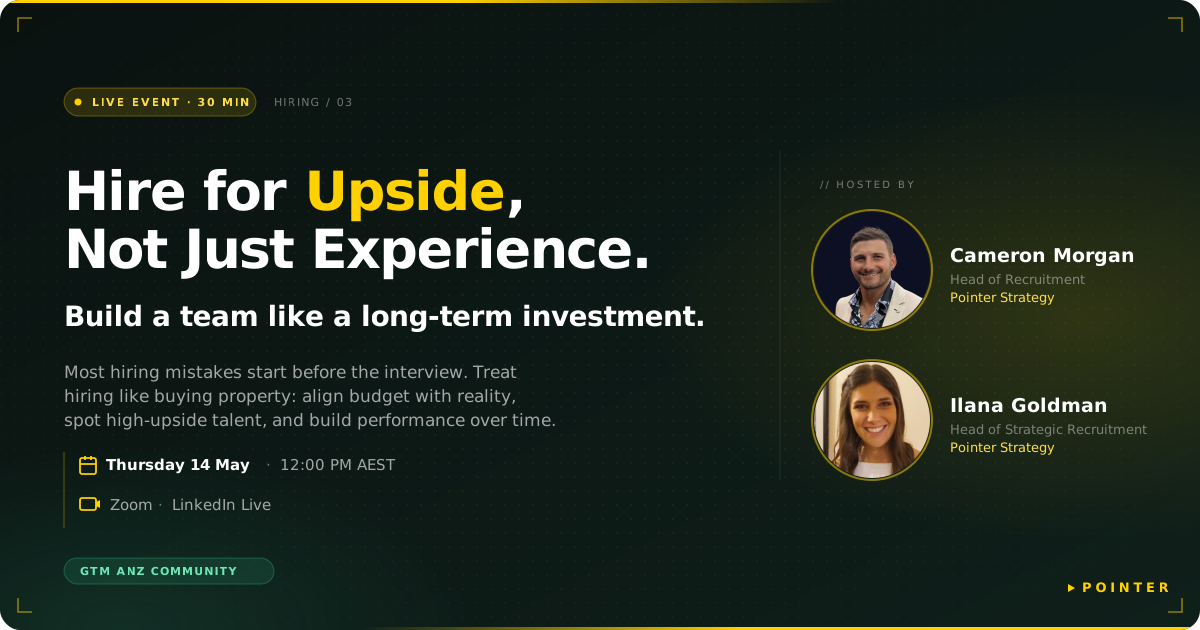
This is a recording of a live session from the GTM ANZ Community, featuring Cameron Morgan (Head of Recruitment, Pointer Strategy) and Ilana Goldman (Head of Strategic Recruitment & Culture Lead, Pointer Strategy).
Why "Hire Like a Property Investor" Is the Right Mental Model
Most hiring mistakes don't show up at the offer stage. They show up about three months earlier — in the job brief.
A founder or sales leader writes down what their dream rep looks like. Ten years of enterprise experience. Carrying a $2M number. MEDDPICC trained. Running a 9-month sales cycle with executive sponsors. Then they pin a salary band to it that the market priced two years ago. Suddenly the search drags, candidates ghost, the interview panel gets fatigued, and the eventual hire is either a compromise no one is excited about or a unicorn who churns in twelve months.
The investor reframe fixes most of this before a job ad ever goes live.
"Everyone wants the two-storey beachside house. Then they look at their budget and wonder why nothing is coming up. A smart investor goes a street or two back, finds the place with the right foundations, and builds a plan to get the beach views in twelve months."
>
Cameron Morgan
The five-step framework below is what we use at Pointer to help founders, CROs, and Heads of Sales hire the way smart investors buy property — with realistic expectations, a clear renovation plan, and a long-term view of returns.
The Five-Step Framework
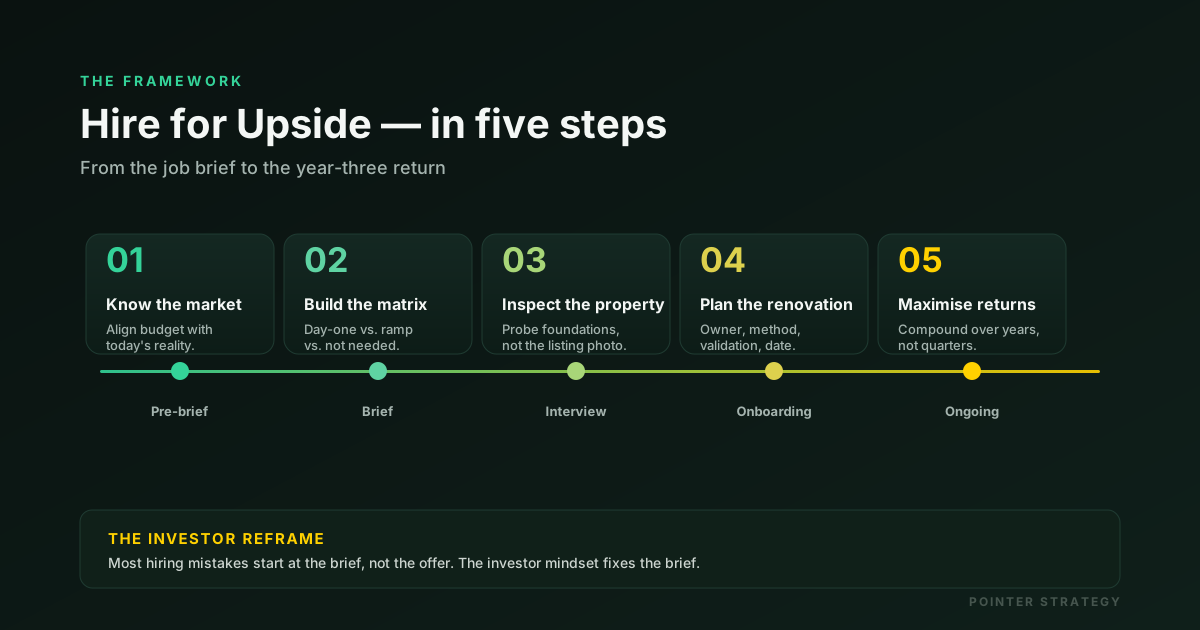
We'll walk through each one.
Step 1: Know the Market — Or Stop Wondering Why Your Search Is Stuck
The 2026 market is not the 2025 market, and it certainly is not the 2023 market. What you paid an enterprise AE eighteen months ago does not buy you the same person today. Equally, in some categories, what you'd have paid a top mid-market rep last year overshoots what they'll accept now.
The first step is brutally simple: get a current read.
That means:
Take the most common version of this we see week to week. A founder wants an Enterprise AE who is currently hitting quota selling 9-month deals into the ANZ enterprise mid-market. That person, today, is on a ~$150K base and earning ~$300K OTE because they are already at quota.
If you want them to leave the place where they are crushing it, walk into a 9-month pipeline build with you, and accept your $150K base — you are asking them to take a real pay cut for nine months while they wait for commissions to land.
Money can solve that problem. Most companies cannot afford to. The good news is you do not have to solve it with money alone.
"Unrealistic expectations always end in disappointment. If you're trying to tick a hundred boxes and the candidate has ninety, you'll be disappointed. Realise the ten you missed don't matter, and you'll be stoked with the same candidate."
>
Ilana Goldman
Step 2: Build the Skills Matrix — The Tool That Saves the Search
Every sales role we brief is built on a skill set, not a job title. We've mapped roughly 50–60 skills against most GTM functions, and the work in step 2 is to triage them into three buckets:
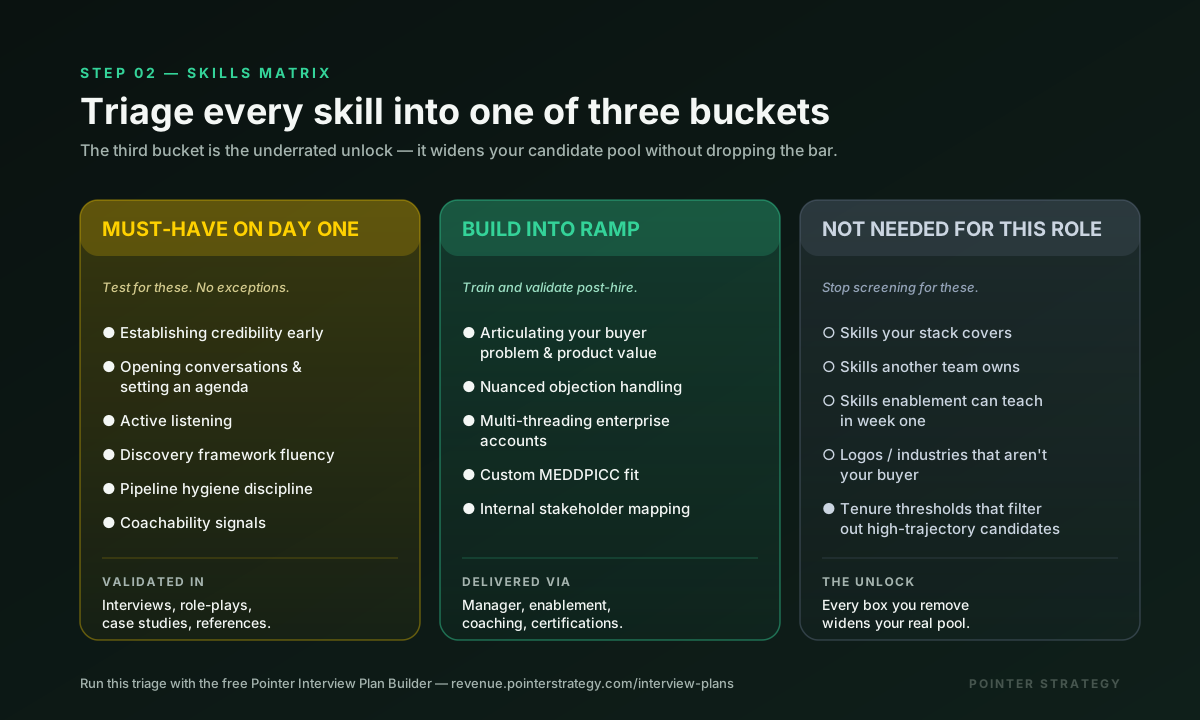
Bucket 1 — Must-have on day one. The non-negotiables. These are skills you will test for or validate during the hiring process. Examples for a senior AE might be: establishing credibility early, opening conversations and setting an agenda, active listening.
Bucket 2 — Build into ramp. Skills you are happy to develop in the first 30, 60, or 90 days, with the right support. Common ones we move into ramp: nuanced objection handling, articulating your specific buyer problem, advanced multi-threading on your particular product.
Bucket 3 — Not needed for this role. Skills that don't move the needle for this seat. Identifying these is the underrated unlock — every box you remove widens your real candidate pool without dropping the bar on outcomes.
This is also where you, the hiring company, take honest stock of your *own* internal capability. Going back to the property analogy: if you are an ex-plumber buying a house that needs bathroom work, that's a renovation you can do cheaply. If the same house needs a full electrical rewire, that's an expensive contractor problem.
Translated to hiring: if your enablement function is strong on objection handling, that skill belongs in the ramp bucket. If you have nobody who can coach MEDDPICC, MEDDPICC has to be a day-one skill — and you need to budget for that.
We've put a free Interview Plan Builder on our site that walks you through this triage and generates an interview kit and ramp plan from your selections. Use it for any open role. The output is the spec the rest of this framework runs on.
Step 3: Inspect the Property — Stop Reading Listings, Start Checking Foundations
The biggest hiring mistake we see at this stage: hiring managers reading the resume like a property listing. Nice tenure. Brand-name logos. Big quotas. Ship it.
Sellers know how to sell themselves. The worst sellers know how to sell themselves *especially well*, because they've sat through more performance reviews than the high performers — they've internalised every coaching cliché their managers have ever delivered. They will quote it back to you fluently in an interview.
Inspecting the property properly means:
"Some of my best placements have been the underdogs — the ones who had the most to prove. People wired that way don't let you down."
>
Ilana Goldman
This is also where the AFL draft analogy lands. The top draft picks usually go on to be top-10 players. Your middle-of-the-pack draft picks could still be in the league in five years — or they could be making burgers. High performance compounds. If a candidate has been a high performer at every level — SDR, SMB, mid-market — the odds they perform at enterprise are much better than the odds a middle-of-the-pack enterprise rep magically turns it on at your company.
The Bell Curve Trick: Why Top of Mid-Market Beats Bottom of Enterprise
If your budget will not stretch to the top quartile of the segment you want, the answer is almost never "compromise on the same segment." It's "shift down a segment and buy the top quartile there."
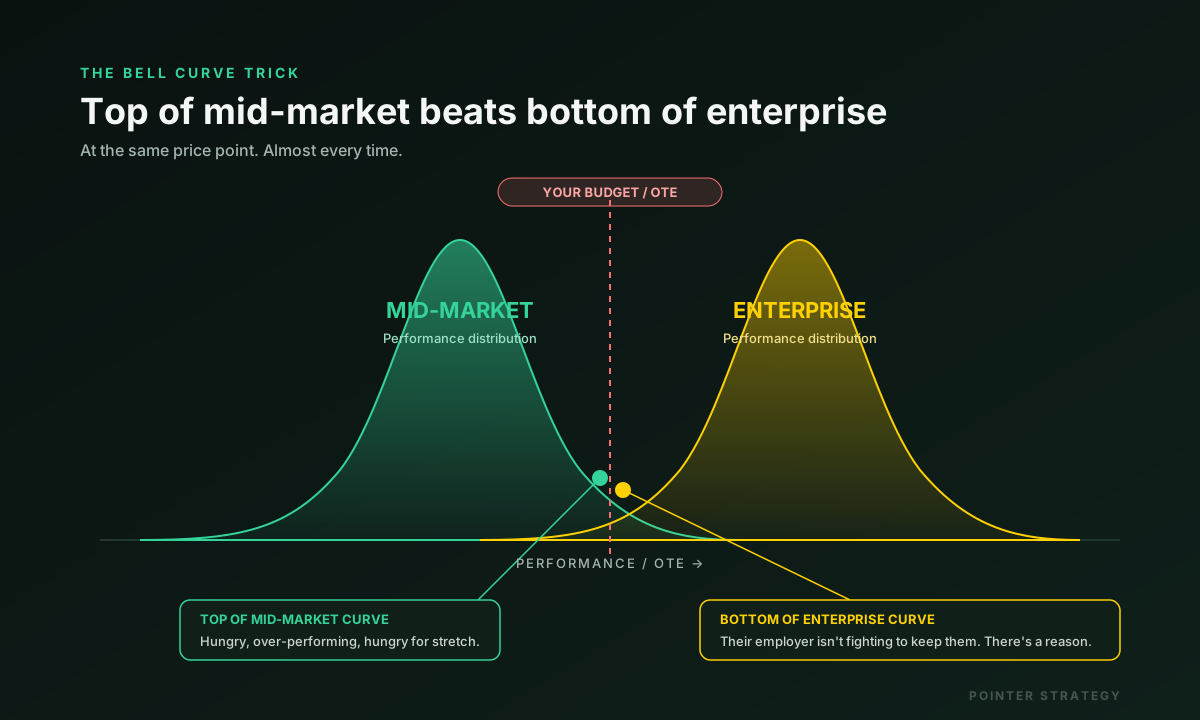
If your number is at the bottom of the enterprise band, you'll attract enterprise reps who *are* at the bottom of the bell curve — the ones their current employer is not fighting to keep. If the same number sits at the top of the mid-market band, you attract reps who are over-performing in their current segment and who are hungry for a stretch. The second pool consistently outperforms the first in our placements, especially on a 12-to-24-month view.
You're not lowering the bar. You're moving where on the curve your offer competes.
Step 4: Plan the Renovation — Where Most Hires Are Quietly Lost
You bought the house with the foundations and the bones. Now what?
Most companies hand the new hire a generic onboarding deck, a 30/60/90 that hasn't been updated since the last hire, and call it good. Three months later they are surprised when ramp slips.
The renovation plan is the second-half of the skills matrix you built in step 2. For each skill you parked in bucket 2 ("build into ramp"), you need:
Without this, the gaps you knowingly accepted in the brief turn into the gaps you complain about at the six-month review. You hired this person *with* those gaps on purpose. Closing them is your job, not theirs.
Step 5: Maximise Returns — Performance Compounds, Or It Walks Out the Door
The whole reason you're investing in this person is the year-two and year-three return, not day-one production. We all know the cost of replacing a rep wildly outweighs the cost of investing in their development. Yet investment in development is almost always the first thing to slip when the quarter gets tight.
High performers do not sit still. They want the next thing. If the next thing isn't visible inside your business, the next thing they see will be a recruiter's InMail.
The core question to be having every quarter with every high performer:
These conversations are not extras. They are the maintenance on your investment property. Skip them long enough and you wake up to a vacancy.
"The moment a top performer has one eye out the door, they're not 100% committed to your goal. The cost of keeping that eye in the room is almost always cheaper than re-hiring."
>
Cameron Morgan
Q&A: Will AI Replace the Recruiter?
A question came in live: what about AI-led recruitment processes — initial interviews handled entirely by AI agents (Fyre, etc.)? What's our view?
We use a lot of AI inside Pointer — pre-screening, CV vetting, market research, list building, scoring. It's genuinely useful for the volume parts of the funnel.
But the part that AI is not yet good at is exactly the part that matters most for *sales hiring specifically*: detecting the polished answer that doesn't match the polished outcome. Every salesperson knows what to say in an interview. The *worst* salespeople often know the language best, because they have heard it from their managers in a thousand performance reviews.
Decoding "they know how to say it" from "they know how to do it" requires intuition, follow-up questions a candidate didn't expect, and reference triangulation. We're sceptical that AI agents are there yet for high-stakes commercial roles. We're very sure they're useful for screening, scheduling, and surfacing.
Our take: use AI to widen the top of your hiring funnel, keep humans on the gate at the deciding interviews. That balance shifts every six months — we'll keep updating the call.
Key Takeaways
Free Tool: The Interview Plan Builder
The skills matrix described in step 2 is live and free on our site. Pick a role, triage the skills, and the tool generates an interview kit (with prompts and timing) plus the structure of a ramp plan. Built off the same 100+ skills we use across Pointer placements.
Your Speakers
Cameron Morgan is Head of Recruitment at Pointer Strategy. He works daily with founders and sales leaders across APAC on hiring strategy, candidate assessment, and team design. Previously in construction, where the property analogy is more than analogy.
Ilana Goldman is Head of Strategic Recruitment and Culture Lead at Pointer Strategy. Ex-DoorDash, ex-Mars, and former GM of Partnerships at FightMND. She brings a strategic lens to hiring, culture, and long-term team development.
Related Reading
*This session is part of the weekly GTM ANZ Community series. Join free for conversations on sales hiring, revenue enablement, partnerships, and AI, every Thursday.*